
Search LEMIX Products
Twin-screw extruders play a pivotal role in multiple application fields, including solvent-free dry electrode extrusion processes, wet-process microporous separator extrusion processes for lithium batteries, and hot-melt extrusion processes for electrolytes of all-solid-state batteries.
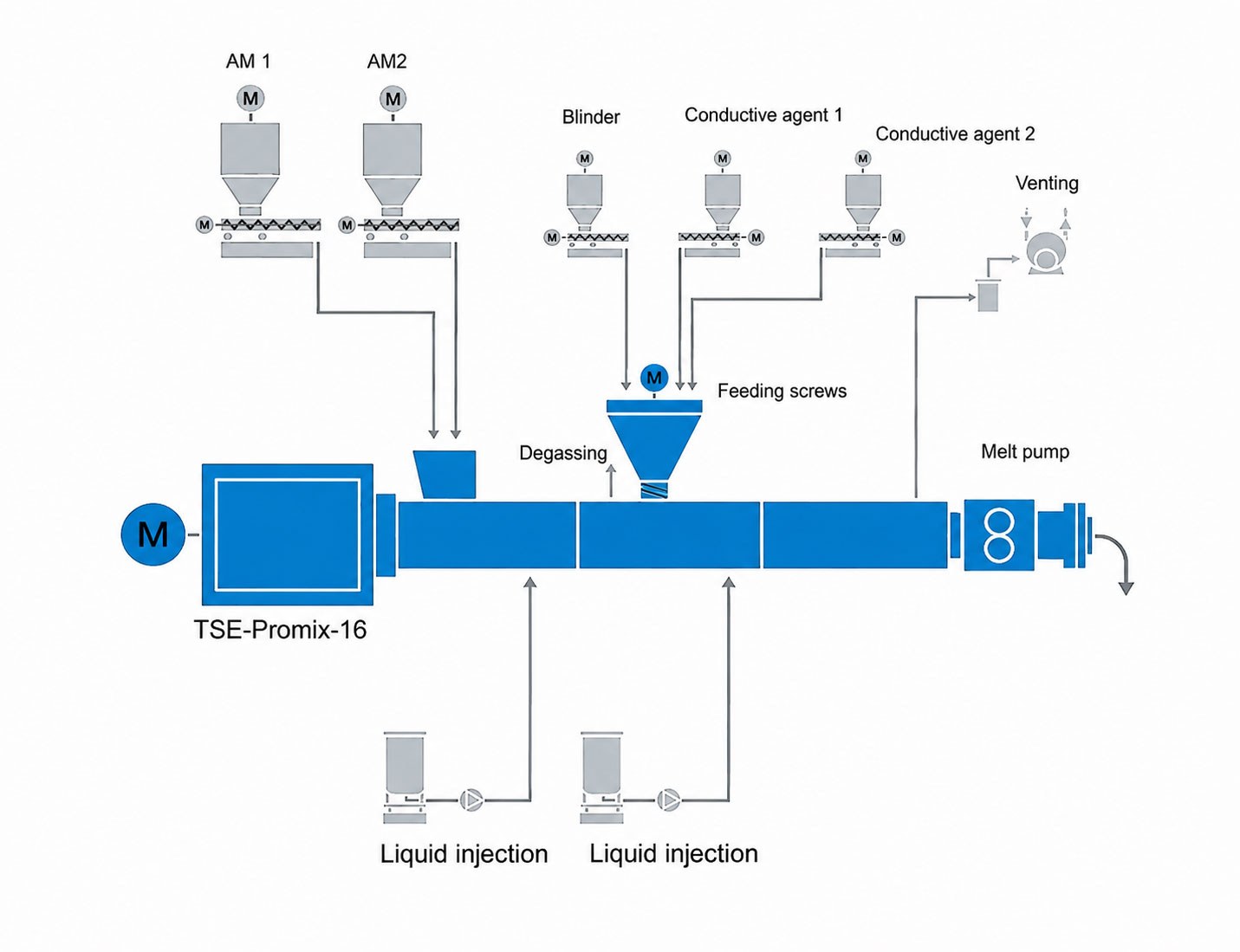
High-load conductive aggregates can be fed via multiple feeders. Combined with a moderate shear rate and intermediate relaxation sections, immediate mixing delivers excellent distributive mixing performance without damaging the internal structure of conductive materials and/or polymers. Equivalent or even superior electrical properties can be achieved with a reduced dosage of conductive components, while lower viscosity brings improved processability.
Corresponding screw configurations are adopted to cope with viscosity rise inside process zones, enabling customized control and flexible adjustment of process parameters to fully meet production requirements.
Modular screw segments enable precise shear regulation to fully preserve the microstructure of conductive materials and polymer backbones.
Multi-channel independent loss-in-weight feeding system supports homogeneous feeding of high-load conductive aggregates.
Customizable screw geometries adapt dynamically to viscosity variations throughout the entire process.
Ultra-high wear-resistant and corrosion-resistant materials are adopted to completely prevent the precipitation of metallic foreign matter. Meanwhile, our self-developed ultra-high molecular weight plastic screws are also applied to lithium battery manufacturing processes.
Temperature & Pressure Control The barrel adopts zoned precise temperature control ranging from 140 to 210℃ with independent cooling oil circuits, limiting melt temperature fluctuation to ≤±1℃. Melt pressure is monitored online in real time, paired with a pressure-stabilizing extrusion structure to restrict pressure fluctuation within ±0.5 bar, ensuring consistent cast sheet thickness.
Degassing & Filtration System Pre-stage vacuum devolatilization removes small-molecule volatiles from raw materials. A large-capacity continuous melt filter is installed at the discharge end to trap impurities and gel particles, preventing pinholes and crystal spots on separators.