
Search LEMIX Products
Learn how key hot melt extrusion parameters, including temperature, screw speed, feed rate, residence time, vacuum, cooling, and PAT, affect API stability, mixing quality, impurity control, and GMP scale-up performance.
Category:Pharmaceutical Extrusion Technology
Author:LEMIX Admin
Date:2026-07-17
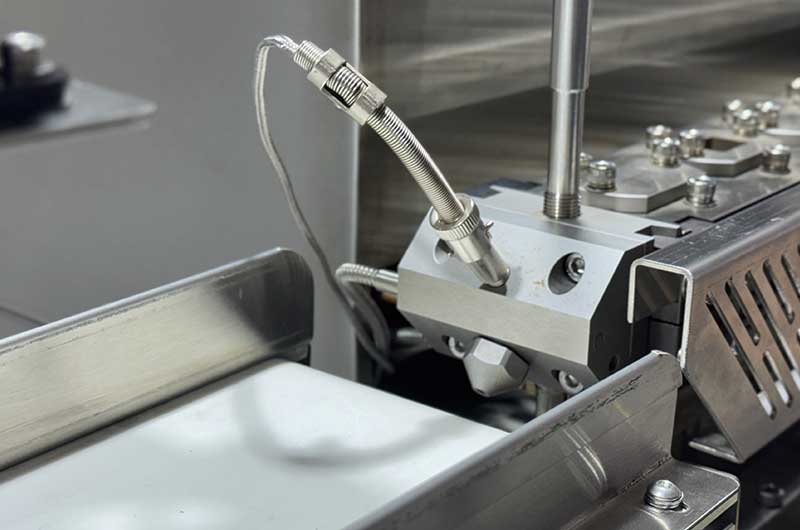
Pharmaceutical hot melt extrusion is controlled by several connected process parameters, not by a single machine setting. The main parameters are barrel temperature, screw speed, feed rate, screw configuration, residence time, torque, melt pressure, vacuum devolatilization, cooling rate, and process monitoring. These settings affect drug-polymer mixing, API stability, amorphous solid dispersion quality, impurity control, and final dissolution performance.
In pharmaceutical production, these parameters must be selected around the API, polymer carrier, plasticizer, excipient system, and target dosage form. A good HME process should keep the API stable, disperse the drug uniformly, reduce crystallization risk, remove moisture and volatile impurities, and provide repeatable data for GMP validation.
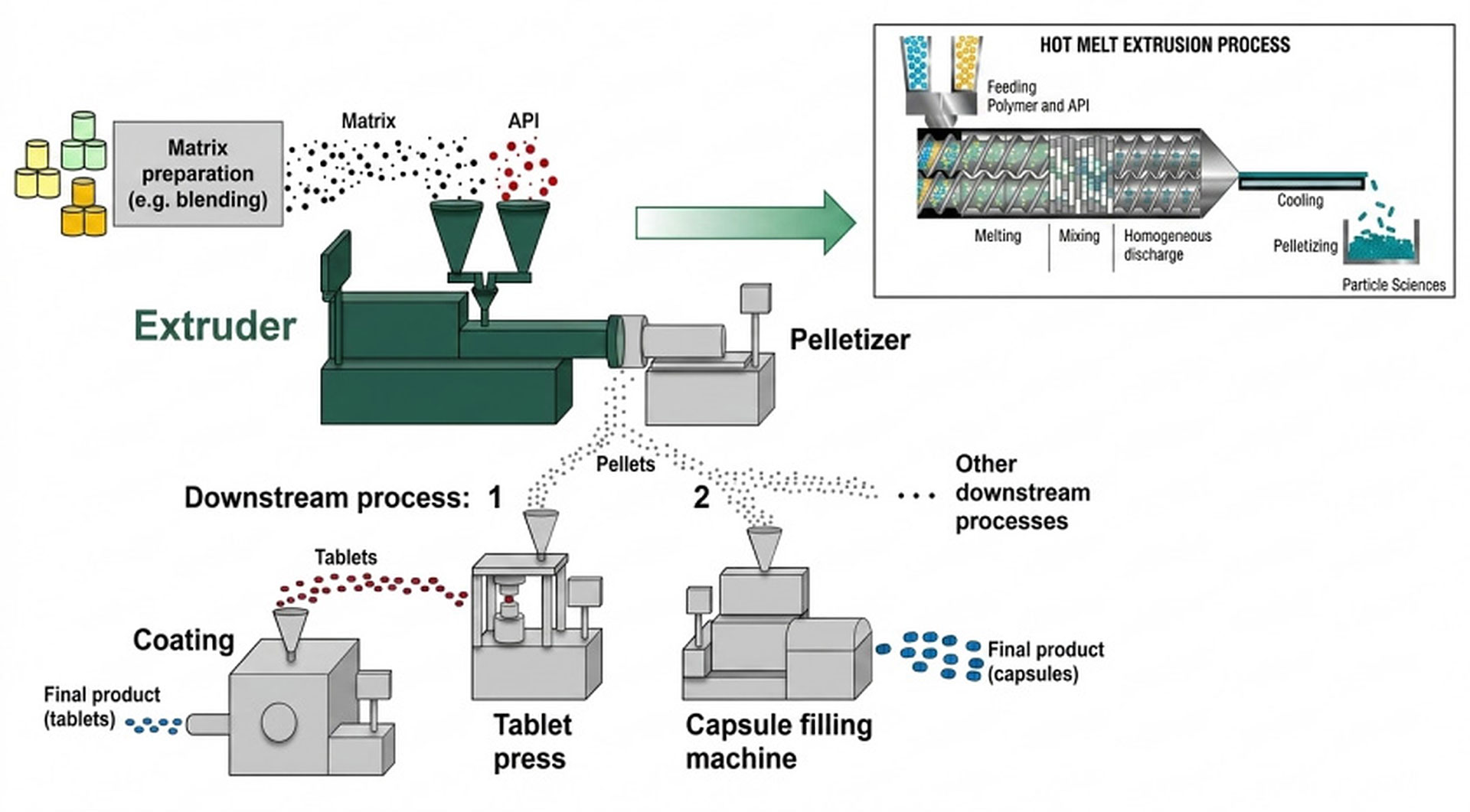
Hot melt extrusion uses heat, pressure, and screw movement to process APIs and polymer carriers in a molten or softened state. The material passes through feeding, melting, mixing, conveying, discharging, cooling, and shaping stages. During this process, the API can be dispersed in the polymer as a molecular, amorphous, or metastable form.
This is one reason HME is widely used for amorphous solid dispersions. Many poorly soluble drugs have low dissolution rates in their crystalline form. When the drug is dispersed into a suitable polymer matrix, the formulation may improve apparent solubility and dissolution behavior. The polymer can also help slow recrystallization during storage and use.
For this reason, pharmaceutical HME is not only an extrusion process. It is a controlled formulation process. Every parameter should support thermal stability, uniform mixing, amorphous stability, and impurity control.
Barrel temperature is usually the first parameter to review. It affects polymer softening, API dispersion, melt viscosity, torque, die pressure, and degradation risk.
The temperature profile should be set according to the API melting point, polymer glass transition temperature, polymer melting behavior, degradation temperature, and formulation viscosity. The feeding zone is often kept lower than the melting zone. This helps reduce early sticking and material buildup near the feed opening. The melting and mixing zones need enough heat to soften the carrier and allow the API to disperse. The discharge zone should keep stable flow into the die without adding unnecessary heat history.
Too low a temperature can cause poor melting, high torque, rough extrudates, or weak drug-polymer mixing. Too high a temperature can cause API degradation, color change, impurity growth, or loss of assay. Heat-sensitive APIs need tighter control because a small temperature drift may change the impurity profile.
LEMIX pharmaceutical extrusion systems use independently controlled multi-zone temperature regulation with ±1°C temperature control accuracy. This type of control is useful for heat-sensitive, oxidation-sensitive, and chirally unstable APIs because it helps reduce temperature fluctuation during long production runs.
Screw speed controls material movement inside the extruder. It also changes shear input, mixing strength, residence time, and mechanical heat generation.
A higher screw speed can improve mixing and reduce viscosity through shear thinning. It may also increase frictional heat and create local hot spots. This can be risky for thermally sensitive drugs. A lower screw speed can reduce shear stress, but it may increase residence time if feed rate is not adjusted correctly. Longer residence time means longer heat exposure.
The correct screw speed is the setting that gives stable torque, stable pressure, uniform mixing, and acceptable thermal exposure. It should always be developed together with feed rate and screw design. Screw speed alone does not define the process.
Feed rate decides how much material enters the extruder. It affects screw filling, output, residence time, torque, pressure, and content uniformity.
If feed rate is too high, material may accumulate near the feed port. This can lead to unstable torque and poor melting. If feed rate is too low, the barrel filling level may drop. The screw may not mix the material effectively, and residence time may become less predictable.
In pharmaceutical HME, feed stability is closely related to content uniformity. Powder blends can segregate because of particle size, density, flowability, and electrostatic charge. A loss-in-weight feeder helps reduce feeding variation and supports a more stable material balance.
LEMIX uses high-precision loss-in-weight feeding for pharmaceutical extrusion systems. This helps reduce material stratification and segregation, especially during extended continuous operation.
Screw configuration decides how the material is conveyed, melted, mixed, vented, compressed, and discharged. It is one of the most important design choices in pharmaceutical HME.
Conveying elements move material forward. Kneading elements increase mixing and shear. Reverse elements can increase residence time and pressure. Venting sections help remove moisture and volatile compounds. Pressure-building sections prepare the melt for stable discharge through the die.
Twin Screw Extruders are commonly preferred in pharmaceutical HME because they offer better mixing, better feeding behavior, shorter residence time, and stronger dispersion than many simple single screw systems. A fully intermeshing self-cleaning screw design can also reduce material retention and dead zones. This matters because retained material can degrade and contaminate later production.
LEMIX uses modular screw configurations with mixing elements arranged at multiple angles. The design supports molecular-level dispersion, content uniformity, and stable amorphous solid dispersion processing. It also allows the screw layout to be adjusted for different APIs, polymers, and dosage forms.
Residence time is the time that the formulation stays inside the extruder. It is affected by screw speed, feed rate, screw design, filling level, melt viscosity, and barrel length.
The residence time must be long enough for melting and mixing. It must also be short enough to avoid unnecessary API degradation. A narrow residence time distribution is preferred because most material then receives a similar heat and shear history.
Residence time should be measured during process development. It should be linked with assay, impurity profile, dissolution behavior, crystallinity, and content uniformity. If a drug is heat-sensitive, residence time becomes one of the most important process limits.
Torque is a useful signal for process stability. It shows the resistance that the screw drive is facing.
High torque may point to low barrel temperature, high viscosity, excessive feed rate, poor melting, or unsuitable screw design. Low torque may point to low filling, excessive temperature, weak mixing, or unstable feeding.
Specific mechanical energy is also important. It reflects how much mechanical energy is introduced into the formulation. Too little energy can cause poor dispersion. Too much energy can raise melt temperature and increase degradation risk.
LEMIX pharmaceutical HME systems use a high-volume, high-torque screw structure designed for low-temperature and low-shear processing. This helps reduce frictional heat while keeping enough mixing capacity for drug-polymer dispersion.
Melt pressure shows how the material flows before the die. A stable pressure trend usually means the feeding, melting, mixing, and discharge stages are working in a controlled way.
Pressure fluctuation may come from feeding instability, viscosity change, incomplete melting, die restriction, venting problems, or material degradation. A sudden pressure rise can also create equipment stress and safety risk.
Melt pressure should be monitored together with torque, temperature, screw speed, feed rate, and vacuum level. The pressure number alone is not enough. The trend is more useful than one reading.
Vacuum devolatilization removes moisture, residual solvent, trapped air, and low-molecular impurities from the melt.
Moisture can affect polymer behavior, API stability, final density, and extrudate appearance. Residual solvent must be controlled in pharmaceutical products. Air and volatile compounds can create bubbles, internal voids, strand defects, and inconsistent discharge.
LEMIX uses a dedicated large-pitch vacuum section and a multistage high-vacuum system. This design increases the contact area between material and the vacuum environment. It helps remove moisture, residual solvents, and low-molecular impurities. It also helps produce denser and more uniform extrudates.
Cooling affects the final physical state of the extrudate. In amorphous solid dispersion production, cooling is especially important because it can help lock the API in an amorphous form.
If cooling is too slow, the API may have more time to recrystallize. If cooling is uneven, the extrudate may show inconsistent shape, hardness, or dissolution performance. Cooling method, roll temperature, air cooling, conveyor speed, and cutting condition should be selected according to the formulation and dosage form.
Cooling should be evaluated together with solid-state analysis. Common checks include crystallinity, dissolution, stability, moisture uptake, and mechanical properties.
Process parameters cannot be separated from formulation design. Polymer selection affects processing temperature, viscosity, miscibility, drug release, and storage stability.
A suitable polymer should help keep the API in an amorphous state during processing and storage. It should also support the target release profile. Important polymer properties include glass transition temperature, degradation temperature, melt viscosity, hydrogen bonding ability, drug-polymer miscibility, and moisture sensitivity.
Plasticizers can reduce processing temperature and improve flow. But they may also change stability and release behavior. For this reason, API, polymer, plasticizer, and process parameters should be developed together.
Pharmaceutical HME needs process data that can support development, validation, and production review. PAT helps monitor the process in real time or near real time. It can reduce dependence on delayed offline testing and help identify process drift earlier.
Useful monitoring points include barrel temperature, melt pressure, torque, screw speed, feed rate, vacuum level, product temperature, and downstream product quality. In some HME applications, near-infrared spectroscopy, Raman spectroscopy, UV-Vis measurement, or other PAT tools can be used to monitor content uniformity, crystallinity, moisture, or drug transformation.
LEMIX pharmaceutical extrusion systems support PAT online monitoring and 21 CFR Part 11 data integrity requirements. This helps support electronic records, audit trails, process validation, and GMP documentation.
A lab HME process cannot always be moved directly to a larger machine by increasing output. Scale-up should consider shear rate, fill level, residence time, specific mechanical energy, temperature profile, screw configuration, die design, and cooling conditions.
LEMIX covers small-volume research machines, pilot-scale systems, and commercial production lines. Core parameters such as shear rate, fill level, and specific mechanical energy can be transferred across equipment scales. This helps reduce repeated process development and lowers the risk of unexpected quality changes during scale-up.
| Parameter | Main Control Target | Risk If Poorly Controlled |
|---|---|---|
| Barrel temperature | Melting and API stability | Degradation, poor mixing, impurity growth |
| Screw speed | Shear and residence time | Local overheating or weak dispersion |
| Feed rate | Filling level and output | Segregation, unstable torque, poor uniformity |
| Screw configuration | Mixing, venting, and pressure building | Dead zones, long residence time, weak dispersion |
| Residence time | Heat exposure | API degradation or incomplete mixing |
| Torque | Mechanical load | Overload, unstable process, wear risk |
| Melt pressure | Die flow | Pressure fluctuation, strand defects |
| Vacuum devolatilization | Moisture and volatile removal | Bubbles, voids, residual solvent |
| Cooling rate | Amorphous stability | Recrystallization or uneven product properties |
| PAT monitoring | Process understanding | Late detection of process drift |
A pharmaceutical HME process should be developed with a clear parameter record:
Confirm API thermal stability and degradation limits.
Select the polymer based on miscibility, Tg, viscosity, and release target.
Check whether a plasticizer is needed.
Build a segmented barrel temperature profile.
Select screw elements for feeding, melting, mixing, venting, and pressure building.
Set screw speed and feed rate together.
Monitor torque and melt pressure during trials.
Measure residence time distribution.
Evaluate vacuum devolatilization performance.
Define the cooling or quenching method.
Test crystallinity, assay, impurity, dissolution, and stability.
Use PAT tools when process risk is high.
Record validated parameters for GMP production.
Confirm scale-up rules before pilot or commercial production.
The key process parameters in pharmaceutical hot melt extrusion are barrel temperature, screw speed, feed rate, screw configuration, residence time, torque, melt pressure, vacuum devolatilization, cooling rate, and PAT-based monitoring. These parameters should be controlled as one connected system.
A stable HME process should protect the API from thermal degradation, disperse the drug uniformly in the polymer carrier, support amorphous stability, remove volatile impurities, and provide repeatable product quality. For pharmaceutical manufacturing, the equipment should also support GMP cleaning, data integrity, online monitoring, and smooth scale-up.
LEMIX pharmaceutical hot melt extrusion systems are designed for low-temperature and low-shear processing, high mixing accuracy, efficient vacuum devolatilization, stable continuous production, linear scale-up, and pharmaceutical-grade compliance. These features help formulation teams build a more reliable HME process from laboratory trials to commercial production.
Internal reference: Pharmaceutical Extrusion