
Search LEMIX Products
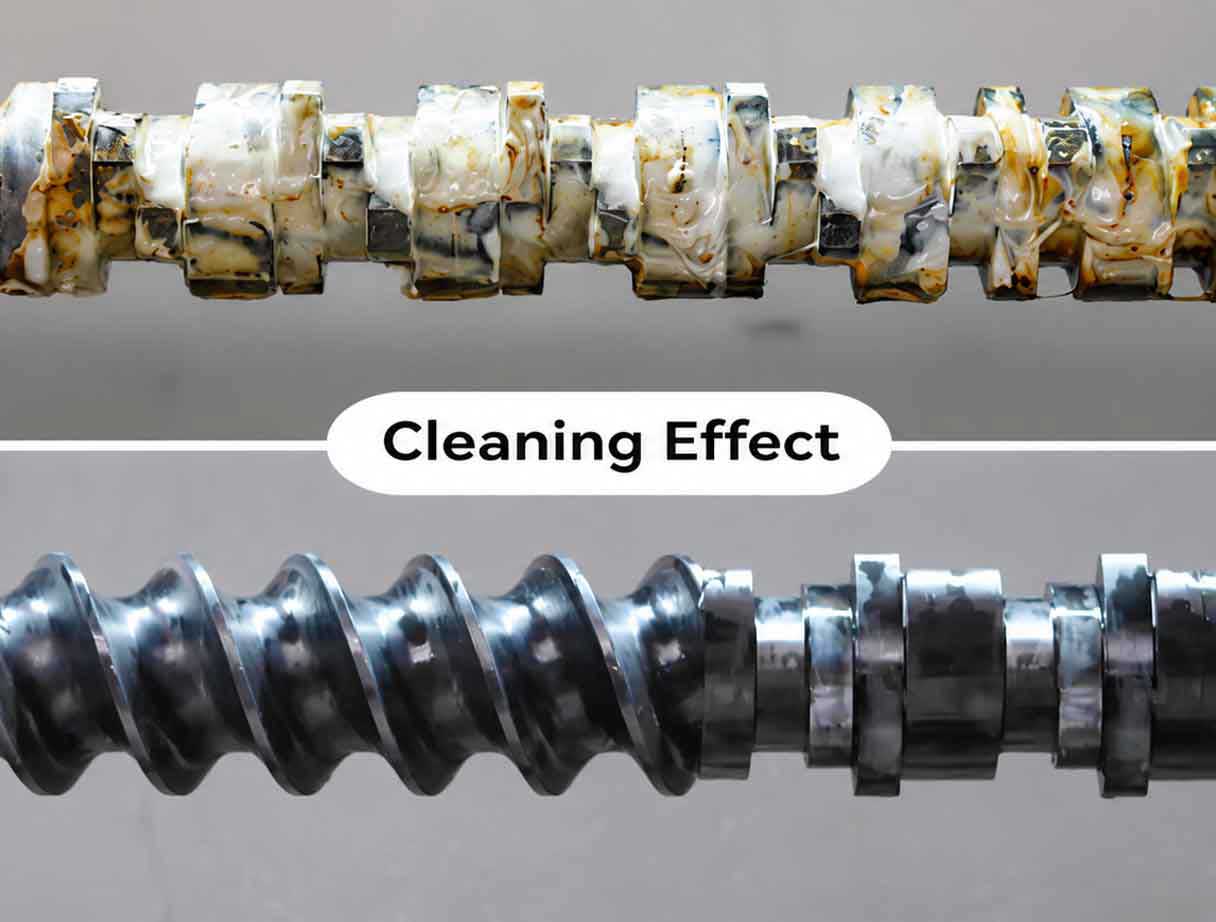
Cleaning extruder screws and extrusion components is a necessary maintenance task in plastics processing. The cleaning result affects color change, material change, production stability, screw life, die flow, and product quality. When polymer residue stays on the screw, die plate, breaker plate, filter screen, mandrel, nozzle, or other tooling parts, the next production run may face black specks, color contamination, gels, burnt material, unstable pressure, and longer start-up time.
The safest cleaning method should remove polymer buildup and carbonized residue without damaging the screw surface, coating, hardness, or dimensional accuracy. In many extrusion plants, the common process still starts with purging the barrel while the screw is hot. Then the screw is pulled out and cleaned. Traditional cleaning methods include manual brushing, flame burning, vacuum oven cleaning, chemical cleaning, and mechanical scraping. These methods can work in some cases, but they also bring risks such as surface scratches, hardness loss, oxidation, toxic smoke, high labor cost, and long downtime.
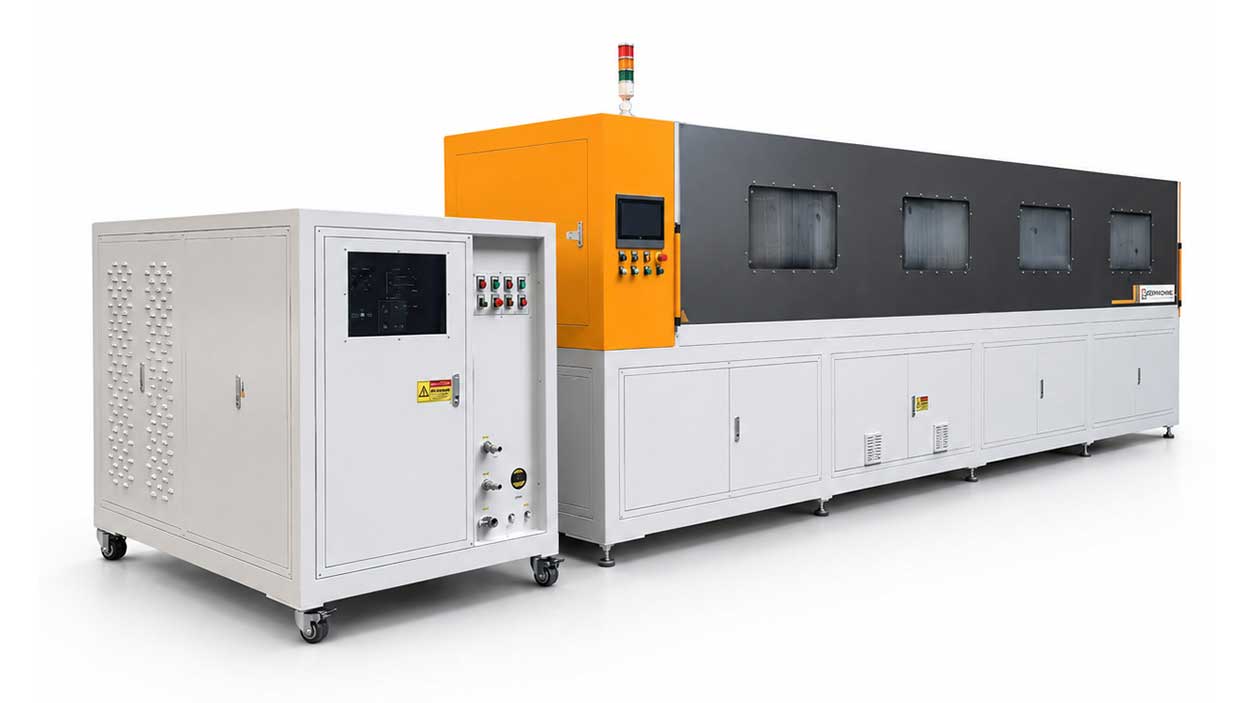
For more controlled maintenance, LEMIX PRO-COOL Screw Cleaning Machine provides an automatic high-pressure water cleaning solution for extruder screws and extrusion components. It is designed to remove stubborn residue without flame burning, incineration, manual brushing, toxic smoke, or surface damage.
Extruder screws and extrusion components should be cleaned by first purging the machine while it is hot, then removing the screw safely, and then using a non-destructive cleaning method to remove polymer residue from the screw flights, screw root, die plate, breaker plate, filter screen, mandrel, nozzle, and tooling channels.
The best cleaning method depends on the resin, residue level, screw material, coating condition, component shape, and allowed downtime. For screws with hardened, nitrided, bimetallic, or coated surfaces, harsh scraping and steel tools should be avoided. High-temperature burning should also be controlled carefully because it can reduce screw hardness, create oxidation, or damage the surface layer.
A non-destructive automatic cleaning system can reduce these risks. PRO-COOL uses high-pressure water as the cleaning medium. It removes polymer residue and carbonized material while helping protect the original screw structure and surface condition.
Extruder screws should be cleaned during material change, color change, formula change, scheduled maintenance, screw inspection, and before long storage. Cleaning is also needed when the extrusion line shows signs of contamination or unstable processing.
Common signs include black specks, color streaks, gels, burnt particles, pressure fluctuation, unstable output, longer purging time, odor from degraded material, and visible residue on pulled screws or die parts. These problems may come from old resin trapped in the screw root, dead areas, die channels, filter screens, breaker plates, and vent components.
Cleaning should not be delayed until residue becomes fully carbonized. Burnt residue is harder to remove. It can also break loose during the next production run and contaminate the product. A regular cleaning plan helps reduce random downtime and makes production changeover more predictable.
Before the screw is pulled, the extruder should be purged while the system is still hot. The goal is to push out as much old resin as possible before the material hardens inside the barrel and die.
The hopper should be emptied first. The screw can then run slowly until most of the old material exits the die. A suitable purging compound may be added based on resin type and process temperature. The purge should continue until the discharged material becomes clean and shows no obvious old color, black specks, or unmelted residue.
This step reduces the cleaning load after screw removal. It also reduces the risk of material locking the screw inside the barrel. Purging does not replace screw cleaning, but it makes later cleaning safer and faster.
After purging, the screw should be removed according to the machine manual and site safety procedure. Many operators prefer to pull the screw while it is still warm enough to prevent resin from hardening tightly around the screw. The die head and related parts may need to be removed first.
The screw should be supported during pulling. Long screws should not be allowed to bend or drop. For twin-screw extruders, screw elements and shafts should be handled carefully because wrong force can damage the spline, element surface, or assembly accuracy.
If manual cleaning is used, soft metal tools are safer than steel tools. Brass scrapers, copper brushes, copper gauze, and soft cloth are commonly used because they reduce the chance of scratching the screw surface. Steel scrapers, grinders, and hard wire brushes should be avoided on precision screw surfaces.
The cleaning method should remove residue without changing the screw geometry or surface condition. This point is important because screw performance depends on accurate flight clearance, screw root condition, surface hardness, and element shape.
Traditional methods have clear limitations:
| Cleaning Method | Main Problem | Possible Risk |
|---|---|---|
| Manual brushing | Slow and labor intensive | Scratches, incomplete cleaning, coating damage |
| Flame burning | Fast surface removal | Oxidation, hardness loss, deformation risk |
| Vacuum oven | Can remove carbonized material | Long cycle time and high energy use |
| Chemical cleaning | Useful for selected materials | Chemical cost, limited material compatibility |
| Mechanical grinding | Strong removal force | High risk of surface and profile damage |
| High-pressure water cleaning | Efficient residue removal | Requires proper machine design and safety protection |
A cleaning method should not only make the screw look clean. It should also help maintain screw service life, coating quality, and dimensional stability.
PRO-COOL Screw Cleaning Machine is designed for automatic high-pressure water cleaning of extruder screws and related extrusion components. It uses water as the cleaning medium and removes residue without flame burning, incineration, manual brushing, toxic smoke, or dust.
The machine uses a Hammelmann high-pressure pump with 2100 bar pump pressure and 8.9 L/min water flow. The cleaning process is controlled by a PLC system, which makes operation more stable and repeatable. The average cleaning efficiency is about 30 minutes per screw, depending on screw size, residue type, and cleaning condition.
This method is useful for plants that need frequent color change, material change, or screw maintenance. It helps reduce downtime and labor while avoiding high-temperature damage. It also helps prevent the next production run from being contaminated by the previous material.
| Item | Specification |
|---|---|
| Cleaning method | Automatic high-pressure water cleaning |
| Cleaning medium | Water |
| Pump pressure | 2100 bar |
| Water flow rate | 8.9 L/min |
| Average cleaning efficiency | About 30 min per screw |
| Maximum cleaning diameter | Ø180 mm, customizable |
| Maximum cleaning length | 6500 mm, customizable |
| Water filtration | 2-stage filtration |
| Residue collection | Automatic transfer to filtration system |
| Residue filtration | Filters solid particles above 1 mm diameter |
| Safety door | Pneumatic control |
| Control system | PLC automatic cleaning control |
Many extrusion defects do not come from the screw alone. Old polymer can remain in die plates, breaker plates, filter screens, mandrels, nozzles, shafts, vent blocks, and tooling channels. These areas can hold burnt material and release it during the next production cycle.
PRO-COOL can be equipped with an optional rotating worktable. This allows the system to clean die plates, breaker plates, filter screens, mandrels, and other extrusion components. This is useful because these parts often have holes, grooves, and narrow channels that are difficult to clean by hand.
A complete cleaning process should include:
Extruder screw
Screw elements
Shafts
Die plates
Breaker plates
Filter screens
Mandrels
Nozzles
Vent blocks
Tooling channels
Cleaning these parts together can reduce repeated contamination after the screw has already been cleaned.
After cleaning, the screw should be dried before storage or reinstallation. Compressed air can be used to remove water from the screw root, flight surface, and narrow areas. The screw should then be visually inspected for cracks, wear, corrosion, coating damage, deformation, or abnormal marks.
If the screw will not be installed immediately, an anti-rust treatment should be applied. The screw should be stored in a dry and protected area. Long screws should be supported properly to prevent bending. Screw elements should be arranged and marked clearly if they are removed from the shaft.
This final step is important. Cleaning removes residue, but drying and protection prevent new problems such as rust and surface stains.
Extrusion plants process many different materials, and each material leaves different residue. Engineering plastics, high-temperature resins, filled compounds, elastomers, and coating materials can be difficult to clean after long production runs.
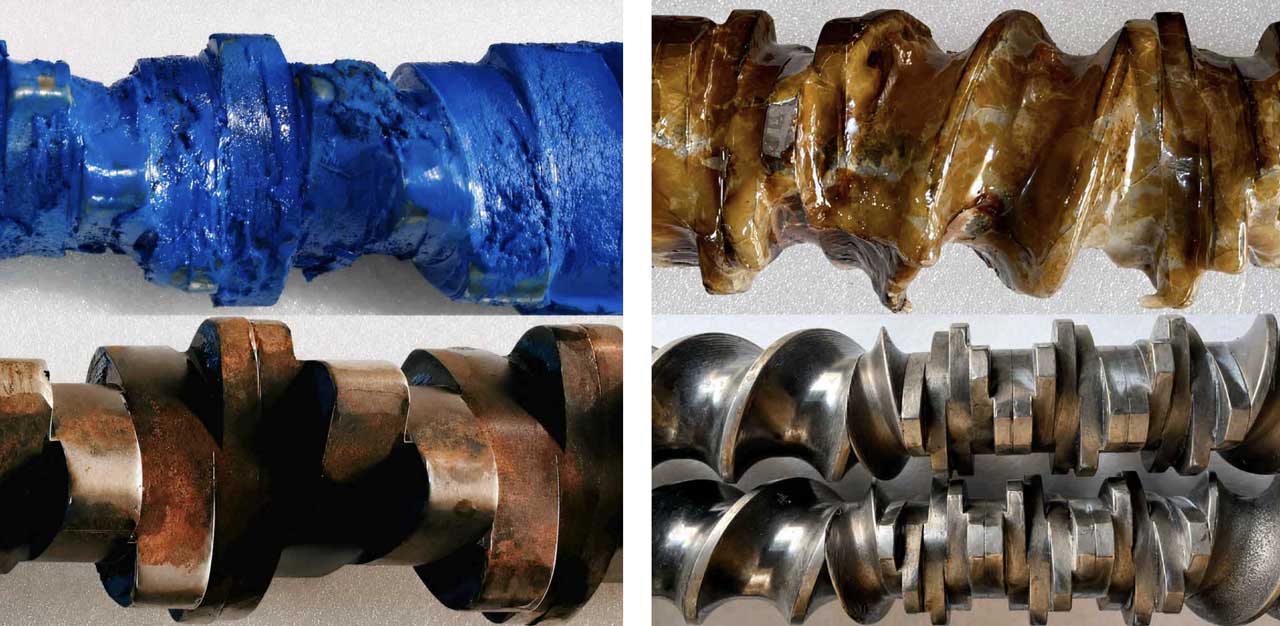
PRO-COOL has demonstrated cleaning results for materials such as BOPA, PPS, PA6 with glass fiber, ABS, powder coating, TPE, PEI, and PC. These examples are important because high-temperature materials and filled materials are often harder to remove than simple commodity plastics.
For glass fiber reinforced compounds, residue can be abrasive and tightly attached to the screw surface. For high-temperature polymers, residue can become hard and carbonized. For color masterbatch or powder coating, pigment contamination can remain in small gaps. A controlled non-destructive cleaning method helps reduce these problems while protecting the screw surface.
Cleaning extruder screws can involve heat, pressure, heavy parts, sharp edges, and moving equipment. The cleaning process should follow local safety rules and the machine manual.
Key safety points include:
Lock out the extruder before screw removal.
Support long screws during pulling and handling.
Avoid direct contact with hot resin and hot metal.
Do not use steel tools on precision screw surfaces.
Use suitable personal protective equipment.
Keep hands away from moving fixtures and cleaning areas.
Confirm safety doors and emergency stop devices before automatic cleaning.
Dry and store screws safely after cleaning.
PRO-COOL includes safety protection features such as emergency stop, limit switch, two-hand button system, pneumatic safety door, electric door travel limit switch, safety light curtain, IP54 electrical cabinet protection, and high-pressure hose protection. These features support safer operation during high-pressure water cleaning.
A good screw cleaning plan should be based on resin type, color change frequency, residue level, screw structure, production schedule, and quality requirement. Cleaning should not be treated as an emergency task only. It should be part of planned extrusion maintenance.
A practical cleaning record can include:
Resin or compound type
Previous color and next color
Purging compound used
Screw pull-out time
Cleaning method
Cleaning time
Visible residue condition
Screw surface condition
Die plate or breaker plate condition
Final inspection result
Operator notes
This record helps the plant understand which materials create the most residue and which production changes need stronger cleaning. It also helps reduce repeated trial and error.
Extruder screws and extrusion components should be cleaned with a process that removes old polymer, carbonized residue, pigment contamination, and tooling buildup without damaging precision metal surfaces. Purging before shutdown is useful, but it is not enough for many material changes and maintenance tasks. Manual brushing, flame burning, vacuum ovens, and chemical cleaning can create extra risks when they are not controlled well.
A non-destructive cleaning solution such as LEMIX PRO-COOL helps extrusion plants clean screws, die plates, breaker plates, filter screens, mandrels, nozzles, and other components more efficiently. With high-pressure water cleaning, PLC automatic control, 2100 bar pump pressure, 8.9 L/min water flow, two-stage filtration, and average cleaning time of about 30 minutes per screw, PRO-COOL can help reduce downtime, labor cost, surface damage, and cross-contamination between production runs.
For extrusion plants, clean screws are not only a maintenance detail. They are part of stable output, clean product appearance, reliable color change, and longer screw service life.
Product reference: PRO-COOL Screw Cleaning Machine