
Search LEMIX Products
Explains key boundary conditions limiting twin-screw compounding throughput, mixing, devolatilization, and overall process performance.
Category:Process Control & Troubleshooting
Author:LEMIX Admin
Date:2026-06-29
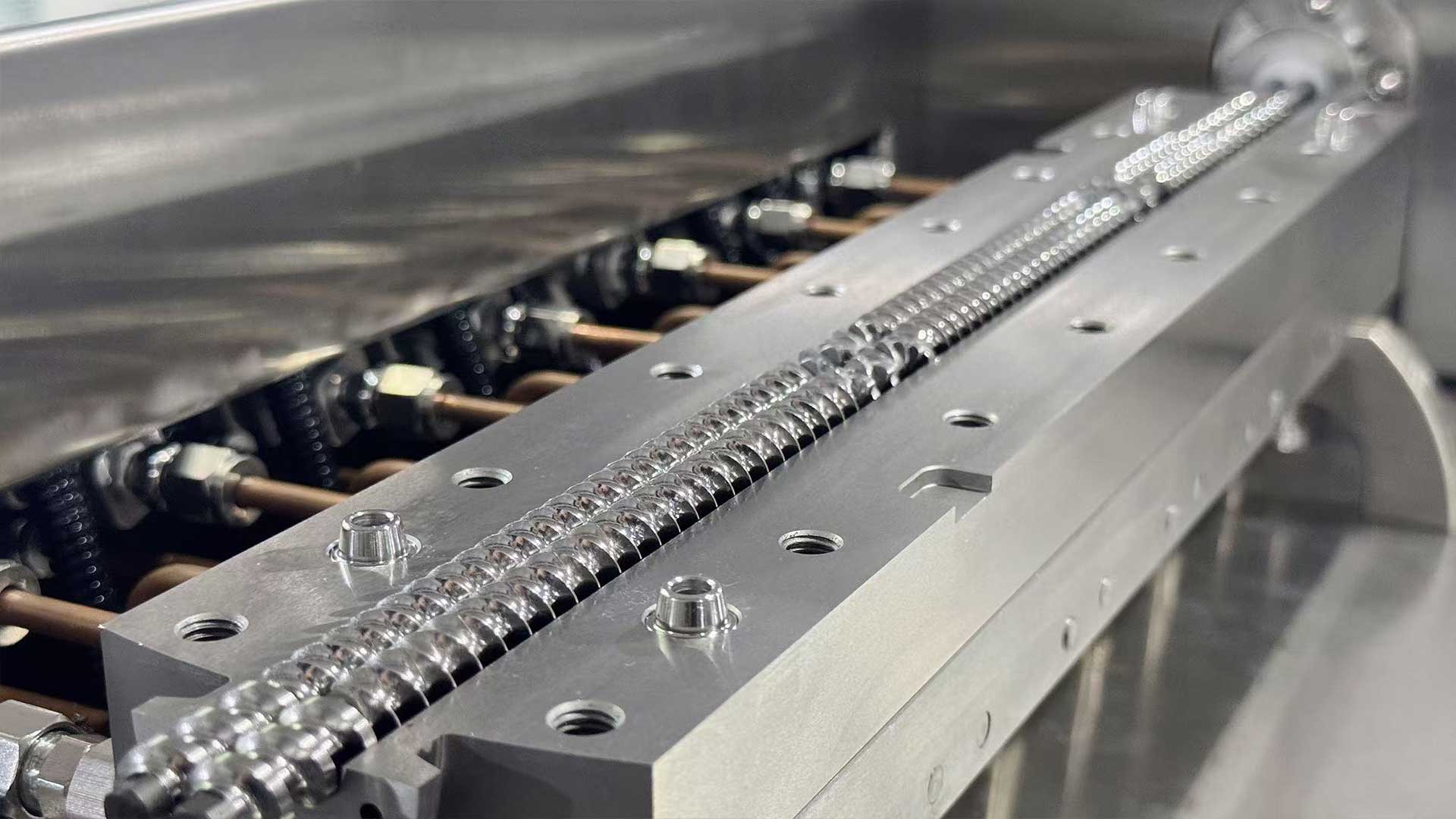
Overview
In twin-screw compounding, the objective is generally to produce the highest quality product at the maximum strand. But sometimes there are operating parameters that prevent this objective from being realized.
Co-rotating, intermeshing Twin Screw Extruders (TSE) mix plastics with additives and fillers to impart desired properties into the final product. Dispersive/distributive mixing and venting are strategically performed in the TSE process section. As with most manufacturing operations, in the twin screw system it is often the goal to operate at the maximum attainable rate while making a quality product.
A “boundary condition” is the operating parameter that prevents higher throughput rates from being produced. A simple example is screw speed/rpm, so if screw rpm are increased from 400 to 800, output might also be doubled, as long as another boundary condition was not encountered.
Examples of typical boundary conditions are as follows:
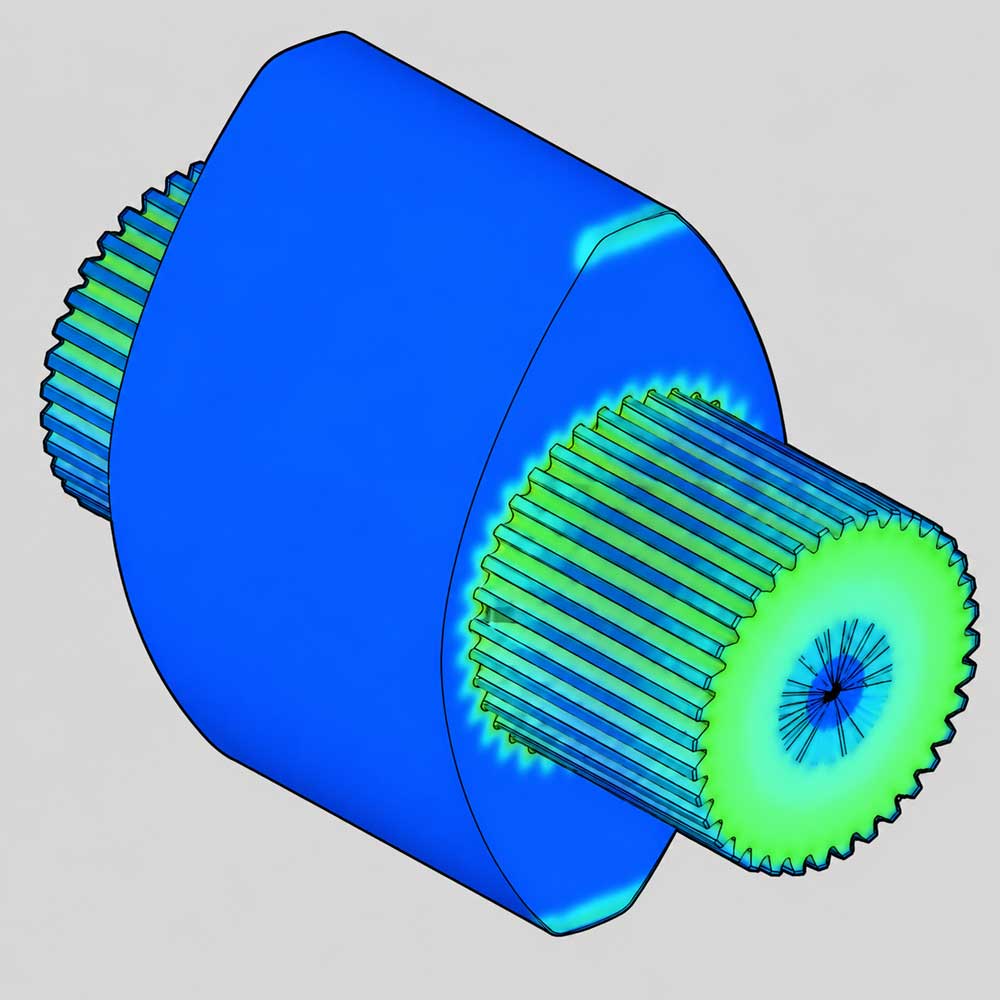
Torque: A torque-limited process occurs when there’s not enough power (kW or hp) from the motor to turn the screws and pump the materials through the TSE process section and front end/die system. The screw shaft is what limits torque transmission in a TSE. The screw shaft rating is denoted in Newton-Meters (Nm) or equivalent (both shafts) and design factors include: cross-section shaft dimension, shaft metallurgy, spline geometry and shaft hardening process. State-of-the art asymmetrical splined shafts transmit power from the motor isolating a tangential force vector into the screws.
Processing of a fractional melt HDPE or PP formulation might be torque limited, so a TSE with a higher Nm torque rating (all else being equal) run at a higher rate than TSE with a lower torque rating. TSE factors to increase the rate for a torque-limited process might involve removing kneading elements and increasing the zone temperature set points in the melting zone.
The screw shaft
Volume: A process is a volume-limited process when the free volume in the TSE keeps more material from being metered into the process section. The outside screw diameter divided by the inside screw diameter, referred to as the OD/ID ratio, is an indicator of the available free volume in a TSE at a given screw diameter.
Increasing the screws’ rpm and/or decreasing the rate generally improves devolatilization efficiencies.
Because twin-screw manufactures do not have standardized screw sizes, the cc’s/diameter is the best indicator. As an example, when comparing a 70-mm TSE with 1.55 OD/ID ratio with 240 cc/diameter to a ZSE-75 MAXX with 1.66 OD/ID ratio with 300 cc/diameter, you can expect a 30% throughput rate increase, all else being equal.
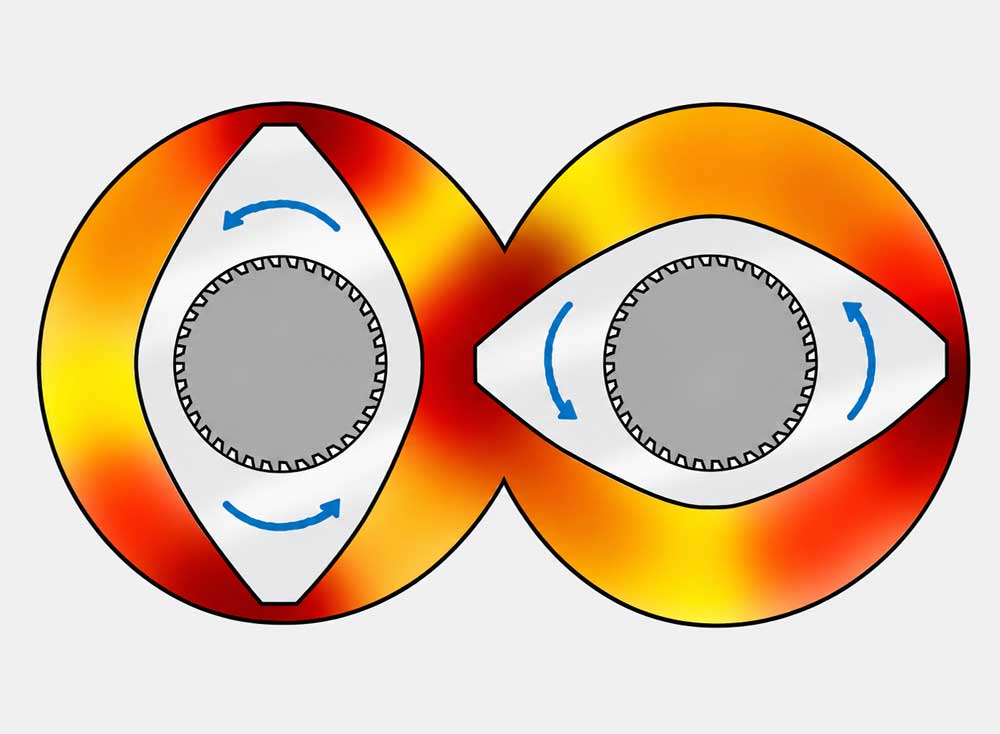
Free volume (in orange) of twin screw extruder process section.
Other factors that can increase the attainable rate of a volume-limited process are targeted at maintaining feed densities and can include: material handling equipment; minimizing the drop distance of the loss-in-weight feeder to the TSE (or side stuffer); oversizing side stuffer screws with baffled drop chute; utilizing vacuum assist processing; adjusting barrel temperature profiles; and manipulating screw and vent design in the TSE process section.
Mass Transfer-Dispersive Mixing: Dispersive mixing requirements for color masterbatch for thin film or fiber processes may set the boundary condition and be the limiting factor to achieve higher rates. Dispersive mixing relies on the strong forces being applied by rotating screws to the polymer matrix. Wider kneading elements accentuate extensional mixing and planar shear effects that result in dispersive mixing. Narrow kneading elements, by comparison, facilitate high division rate mixing with minimal extensional effects, causing a distributive mixing effect. Kneading elements can be arranged with a forward pitch (less aggressive), neutral or reverse pitch.
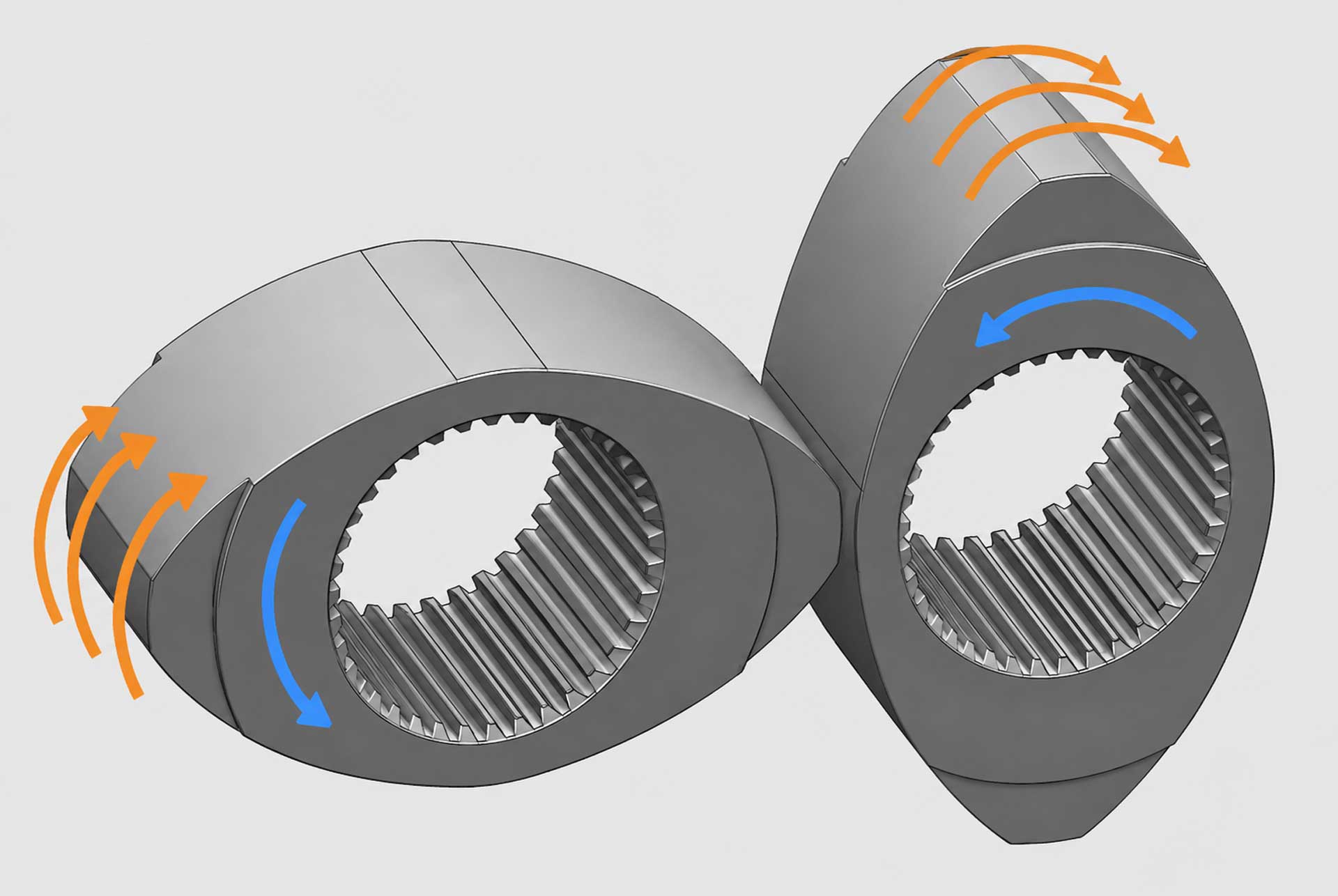
Mixing mechanism in wide mixing/kneading elements for dispersive mixing.
The mixing effects inherent with any TSE are influenced by:
Channel region: The mixing rate in the TSE channel is similar to a single screw extruder (and much lower compared to the other TSE regions).
Overflight gap: Between the screw tip and the barrel wall is where the material undergoes significant planar shear effects.
Extensional mixing: Extensional mixing occurs as the material “accelerates, stretches and breaks” in the transition from the channel to the overflight gap.
Apex (upper/lower) region: Upper and lower apex regions are where the material “feels” the second screw which results in directional flow changes, compression/expansion and axial mixing effects.
Intermesh: A small, finite amount of material passes between the screws and experiences intensive shear forces (and maybe degradation).
Feed rate versus screw rpm determines the residence time distribution and, with the screw design and temperature profile, regulates the mass transfer/mixing properties of the process.
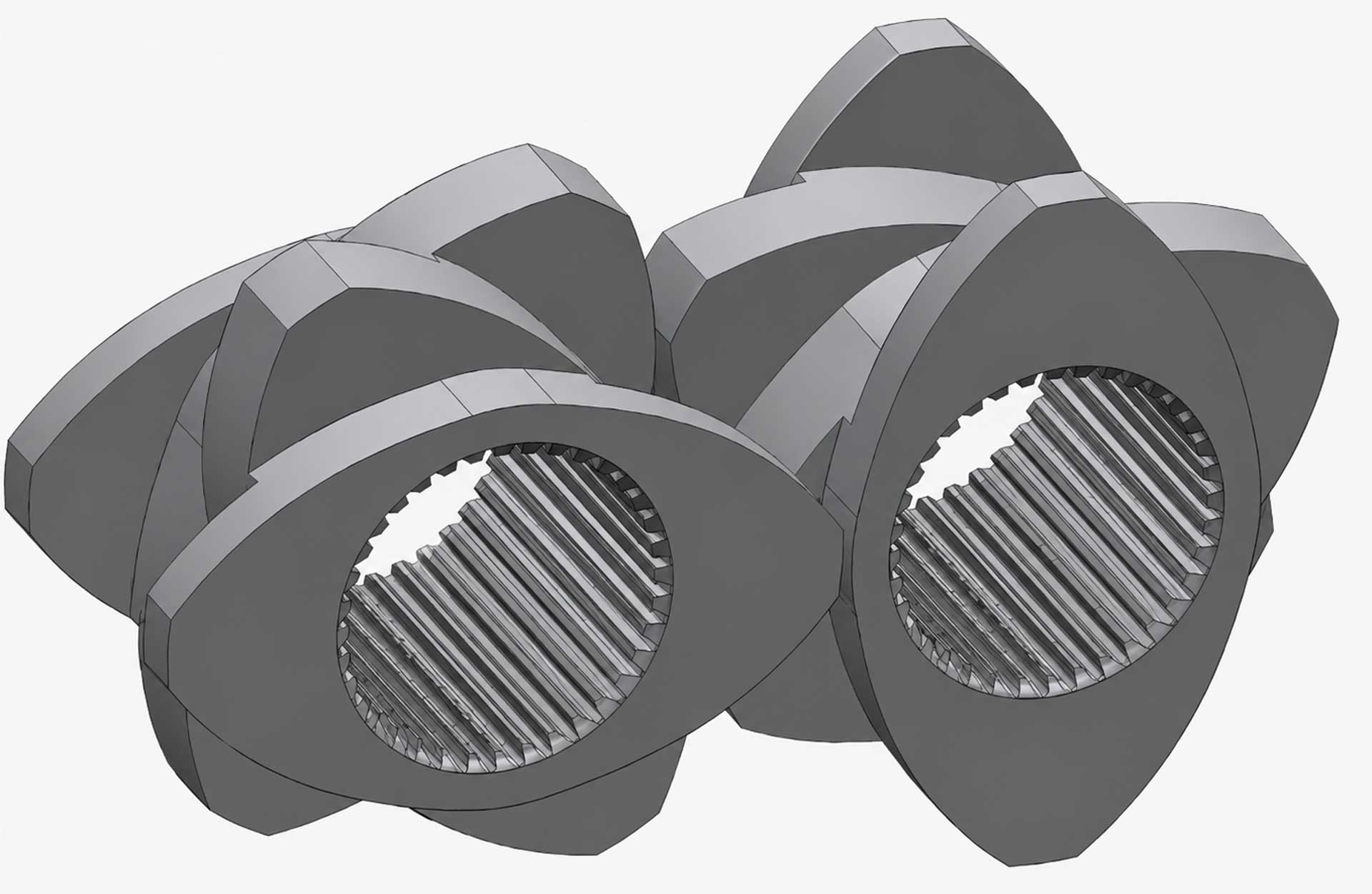
Examples of kneading blocks. Narrow disks promote distributive mixing; wide disks promote dispersive mixing.
Dispersive mixing applications run at comparatively lower throughput rates. As the rates are decreased or increased (at a constant screw rpm) the materials spend more or less time in mixing zones where shear effects and extension flow fields are dominant, and thus the “mixing experience” is impacted.
Mass Transfer-Devolatilization/Removal of Gases: TSEs are well suited for devolatilization as the pressure gradient in the TSE process section is easily designed to accommodate zero pressures under the vents to prevent vent flooding. Devolatilization is a mass transfer limited process where unreacted monomer, solvent, water or other undesirable volatile contaminants are removed from a polymer melt during the TSE process (up to 25% is viable).
Extended residence times at elevated temperatures may be the primary cause of degradation
Increasing the screws’ rpm and/or decreasing the rate generally improves devolatilization efficiencies. Vents can be sequenced and atmospheric, or vacuum can be applied to further enhance devolatilization effects. At high screw rpm, degradation of the formulation may occur.
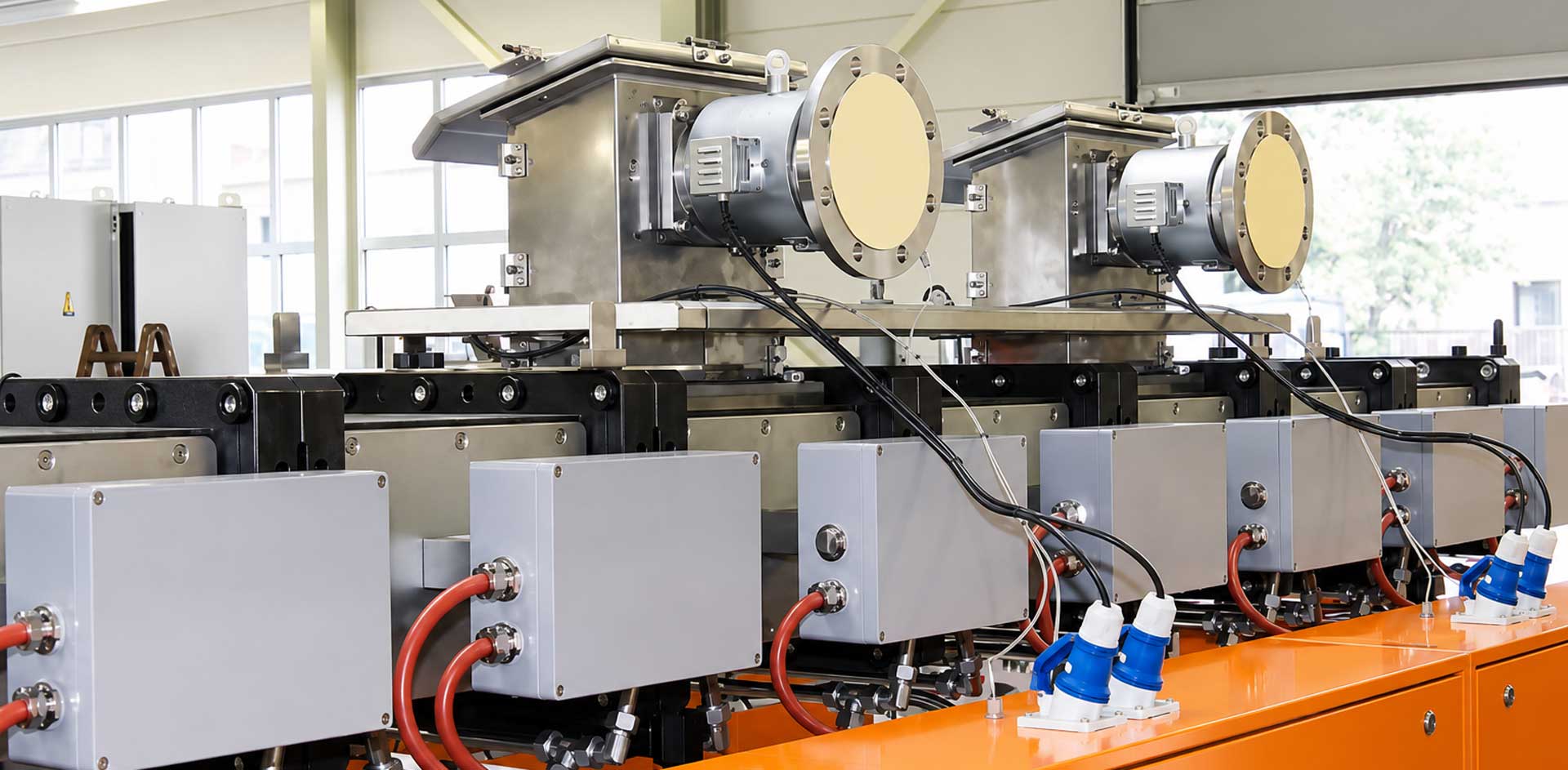
Heated vent stacks equipped for vacuum hookup on twin screw extruder process section.
Factors that affect devolatilization efficiencies include:
Residence time under the vent or vents. Longer is better but ...
Oxygen, shear, time and temperature may contribute to degradation and side reactions
Understand the kinetics of degradation
Surface area of the melt. Higher is better
Smaller melt pools
Increase screw rpm
Decrease rate
Surface renewal. Higher is better:
Renewed surfaces come from rolling pools and partially filled screw channels
Increase screw rpm
The residence time in a twin screw process section is typically in the 15 seconds to 1+ minute range. Extended residence times at elevated temperatures may be the primary cause of degradation compared to the TSE discharge Tm. Front-end systems that include screen changers, gear pumps and dies will dictate a lower Tm input requirement from the TSE.
Scarcity/Cost of Raw Materials During the R&D Phase: In early-stage development, there is often limited amounts of expensive materials available. So the challenge is to extrude a usable sample that can be scaled up. To accommodate limited batch processing, twin screw extruders are specified with low volume screws (1.2/1 OD/ID ratio with 1 cc diameter. Free volume) and specialty feed mechanisms for microbatch sampling. (for example, 50 gms total) to enable sampling for scale-up purposes.
Upstream and/or Downstream Limitations: A TSE system is just like a chain, it’s only as strong as the weakest link. There are typically multiple feed streams to the twin screw extruder and a variety of auxiliary equipment. A die and downstream system are then attached to the TSE front end. If any component in the manufacturing “train” does not do the job, the overall kgs/hr of the system will be limited by that piece of equipment.
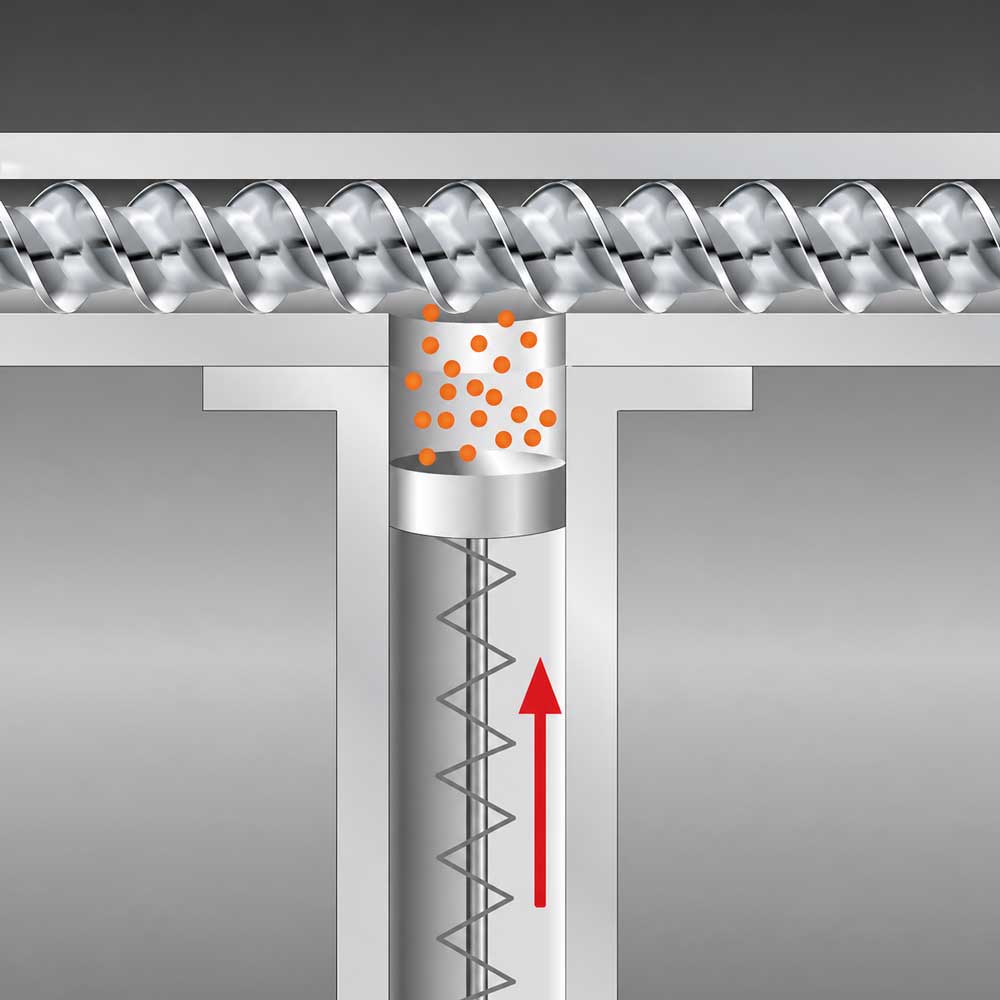
Patented micro-plunger feeder for small-batch processing on a TSE.
Source from: ptonline:《How To Produce Highly Filled Compounds on Co-Rotating Twin-Screw Extruders》 by THE AUTHORS: Roman Segiet&Mark A. Spalding
Disclaimer: Some data, charts and other contents in this article are sourced from the Internet and other publicly published materials, which are only for readers' reference, communication and study, and not for any commercial activities or purposes. All copyrights belong to the original authors and original sources. If any copyright holder believes that this article involves infringement or other issues, please contact us for timely handling.