
Search LEMIX Products
Learn how APIs and polymers are selected for pharmaceutical hot melt extrusion based on compatibility, stability, and processing requirements.
Category:Materials & Applications
Author:LEMIX Admin
Date:2026-09-21
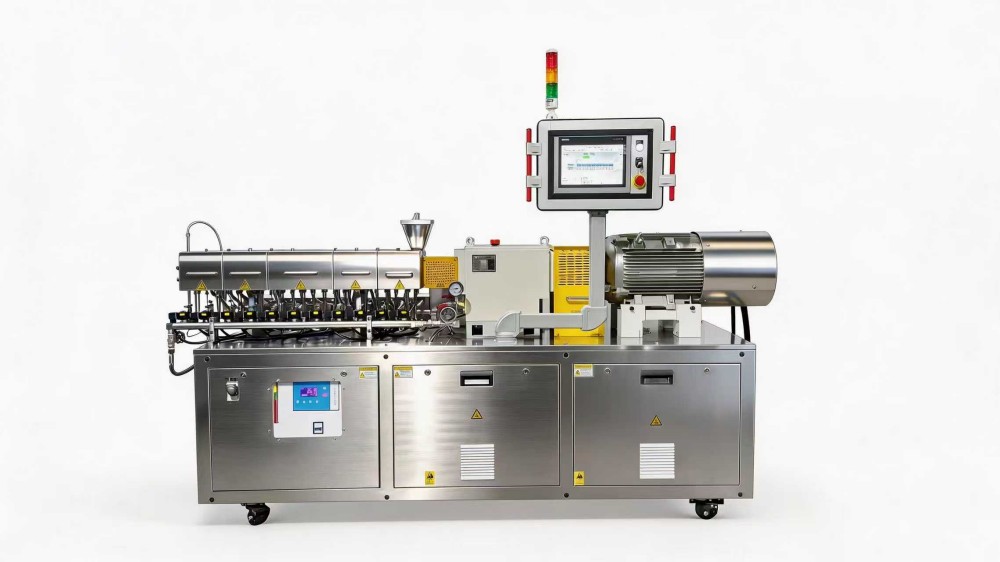
APIs and polymers for hot melt extrusion are selected based on drug properties, polymer compatibility, thermal stability, solubility improvement needs, and processing requirements.
Material selection is one of the most important factors determining the success of pharmaceutical hot melt extrusion (HME).
Hot melt extrusion combines active pharmaceutical ingredients (API) with polymer carriers under controlled temperature and mechanical forces to create pharmaceutical formulations with improved performance.
The selected API and polymer system directly affects:
Drug release behavior
Physical stability
Bioavailability
Processing temperature
Product quality
Long-term formulation performance
A suitable combination allows manufacturers to achieve stable extrusion processing while maintaining the effectiveness of the active pharmaceutical ingredient.
For pharmaceutical developers, successful hot melt extrusion begins with understanding the relationship between API characteristics, polymer properties, and extrusion conditions.
Active pharmaceutical ingredients must meet specific requirements before they can be processed through hot melt extrusion.
Important selection factors include:
The API must withstand the processing temperature required for polymer melting and mixing.
If the processing temperature exceeds the API's stability range, degradation may occur, reducing drug effectiveness.
Manufacturers usually evaluate:
Melting temperature
Decomposition temperature
Thermal degradation behavior
Many HME applications focus on improving poorly water-soluble drugs.
The API should be evaluated based on:
Solubility profile
Crystallinity
Amorphous transformation potential
Hot melt extrusion can help convert crystalline APIs into amorphous solid dispersions, improving dissolution performance.
The API must interact properly with the selected polymer.
Poor compatibility may cause:
Phase separation
Reduced stability
Uneven drug distribution
Compatibility testing helps determine whether the API and polymer can form a stable formulation.
Polymers act as carriers that control drug dispersion, stability, and release behavior.
The selection of polymers depends on the desired pharmaceutical performance.
Important polymer characteristics include:
The polymer should provide suitable thermal behavior during extrusion.
A proper Tg helps maintain:
Processing stability
Amorphous dispersion
Product storage stability
The polymer must melt or soften at a temperature that does not damage the API.
The difference between polymer processing temperature and API degradation temperature is an important consideration.
A suitable polymer can improve API distribution and prevent recrystallization.
Common interactions include:
Hydrogen bonding
Dipole interactions
Molecular dispersion
Different pharmaceutical applications require different polymer systems.
Common polymer categories include:
Used for controlled release and formulation stability.
Examples include cellulose derivatives designed for specific drug delivery requirements.
Widely used because of their ability to form solid dispersions and improve drug solubility.
Used when lower processing temperatures are required.
Commonly used for modified release applications because of their adjustable dissolution characteristics.
Used in controlled release and matrix formulation systems.
The final polymer choice depends on the API characteristics and desired product performance.
Compatibility evaluation helps determine whether an API and polymer combination can achieve stable processing.
Common evaluation methods include:
Techniques such as DSC (Differential Scanning Calorimetry) help evaluate:
Melting behavior
Glass transition changes
Thermal interactions
Methods such as FTIR can identify potential chemical interactions between API and polymer.
Long-term studies evaluate whether the formulation maintains:
Drug distribution
Amorphous state
Performance consistency
These evaluations reduce formulation risks before moving to extrusion production.
The API-polymer combination directly influences extrusion conditions.
Material selection affects:
Different polymers require different melting or softening temperatures.
The selected temperature must balance:
Polymer flow
API stability
Mixing efficiency
Materials with different viscosity and sensitivity may require different screw element arrangements.
For example:
Sensitive formulations may require gentle mixing
High-viscosity materials may require stronger conveying and mixing capability
The formulation should remain inside the extruder long enough for proper mixing but avoid excessive thermal exposure.
Several challenges must be considered during HME formulation development.
Some APIs cannot tolerate high processing temperatures.
Solutions may include:
Selecting lower-temperature polymers
Optimizing extrusion conditions
Adjusting screw configuration
Incompatible API-polymer combinations may create uneven distribution.
Improved mixing design and material compatibility evaluation help solve this issue.
Some polymers may provide excellent drug performance but create processing difficulties.
The final formulation must balance pharmaceutical performance and extrusion feasibility.
Twin screw extrusion provides flexibility for processing complex pharmaceutical formulations.
Key advantages include:
Intermeshing screws provide strong distributive and dispersive mixing, helping achieve uniform API distribution.
Multiple heating and cooling zones allow manufacturers to maintain suitable processing conditions.
Modular screw elements can be designed for different material behaviors.
Laboratory, pilot, and production systems allow pharmaceutical companies to transfer formulations from development to commercial manufacturing.
The extrusion equipment should match the selected API-polymer system.
Important considerations include:
Small-scale twin screw extruders are suitable for:
Formula screening
Material compatibility studies
Process optimization
Pilot systems help validate:
Processing parameters
Product consistency
Scale-up feasibility
Production-scale systems require:
Stable output
Reliable process control
Long-term operating capability
The right equipment configuration helps pharmaceutical manufacturers achieve consistent results.
Hot melt extrusion performance depends on the interaction between materials and equipment.
A successful formulation requires:
Suitable API characteristics
Compatible polymer selection
Optimized processing conditions
Appropriate extrusion system design
Selecting materials correctly helps manufacturers achieve:
Improved drug dissolution
Stable formulations
Reliable production
Better pharmaceutical performance
LEMIX provides laboratory, pilot, and production-scale twin screw extrusion solutions for pharmaceutical hot melt extrusion applications, supporting formulation development and industrial scale-up.
Material selection is the first step toward building a successful pharmaceutical extrusion process.