
Search LEMIX Products
Learn how to control temperature during thermoset compounding with low material heat, strong cooling, mild shear, short residence time, rapid discharge, and LEMIX twin screw extrusion support.
Category:Process Control & Troubleshooting
Author:LEMIX Admin
Date:2026-07-30
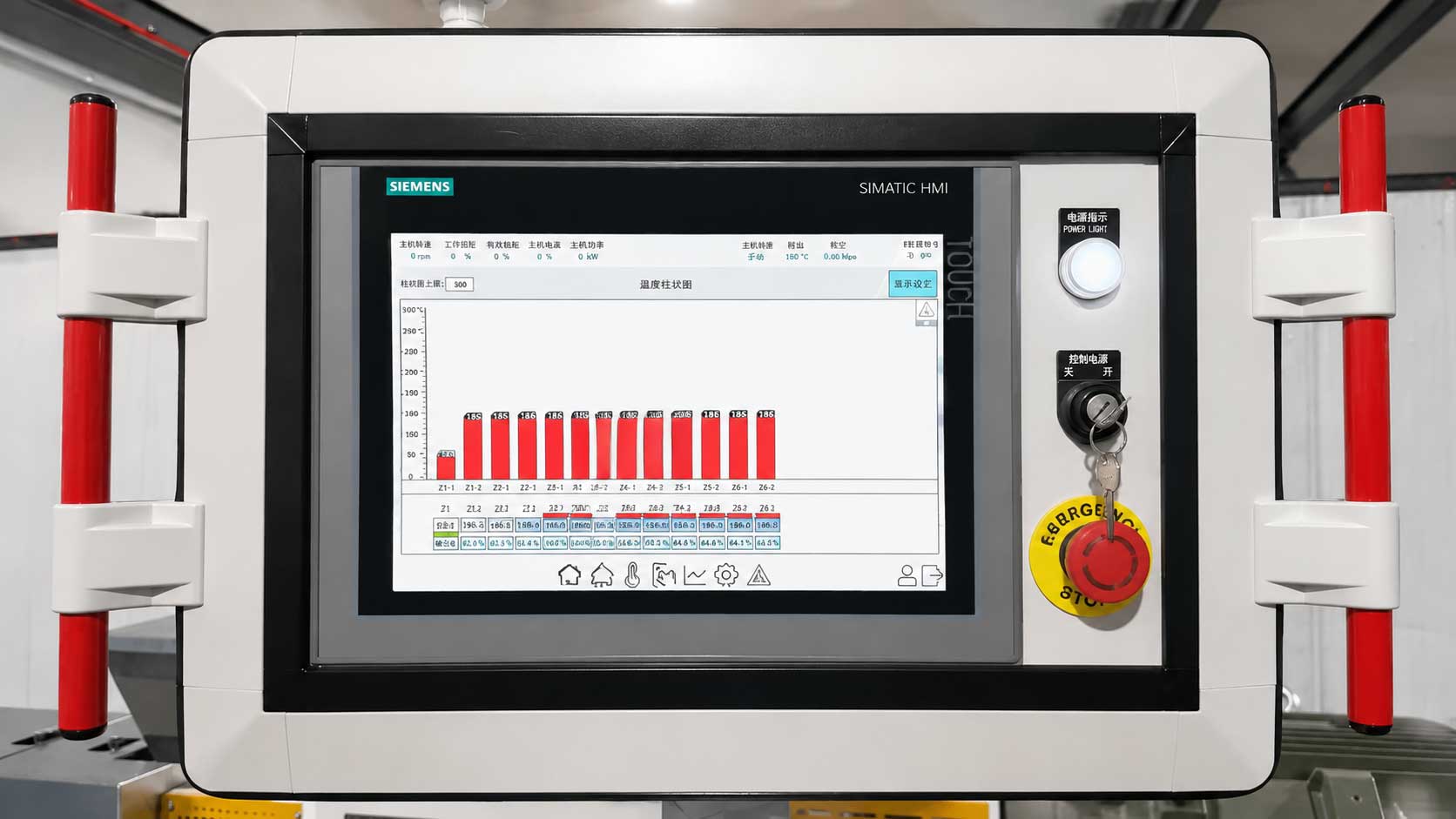
Thermoset compounding temperature should be controlled with low material temperature, strong barrel cooling, mild shear, short residence time, and fast discharge. The purpose is to mix resin, curing agents, fillers, and fibers evenly before premature crosslinking starts.
Temperature control is critical because thermoset materials can undergo irreversible crosslinking when heat, pressure, curing agents, and residence time reach a reactive condition. Once the material cures inside the barrel, it cannot be melted again like a thermoplastic.
Thermoset materials include epoxy resin, phenolic resin, polyurethane, and unsaturated polyester resin. These materials are valued for bonding strength, insulation, abrasion resistance, heat resistance, chemical resistance, and reinforced composite performance. But their curing behavior also creates a narrow processing window.
During compounding, the machine must distribute resin, fillers, fibers, curing agents, and additives evenly. At the same time, it must avoid local overheating. Poor temperature control can cause gel lumps, shaft sticking, blocked discharge, black specks, fiber damage, unstable output, and difficult cleaning.
In thermoset extrusion, temperature control is not only a heating problem. It is also a cooling, shear, residence time, and discharge problem.
The main goal is to keep the material warm enough for flow and distribution, but cool enough to prevent early curing.
A thermoset premix does not need the same aggressive melting strategy used for many thermoplastics. The resin only needs to reach a workable flow state. Fillers, fibers, curing agents, and additives must be blended without forcing the material into a curing reaction inside the process section.
A good temperature strategy should achieve:
Stable resin viscosity
No premature polymerization or crosslinking
No high-temperature gel lumps
Uniform filler and fiber distribution
Mild material movement through the barrel
Stable discharge before curing begins
Fast cooling after discharge
The safest rule is to use the lowest material temperature that still allows smooth distribution and stable discharge.
The barrel setpoint is only one part of the real material temperature. The actual material temperature is also affected by screw speed, shear force, filler loading, resin viscosity, cooling capacity, residence time, and discharge pressure.
Important temperature-related factors include:
| Factor | How It Affects Temperature |
|---|---|
| Barrel setpoint | Provides the basic heating or cooling condition |
| Screw speed | Adds frictional heat when speed or shear increases |
| Screw design | Strong kneading can create local hot spots |
| Filler loading | High filler content increases friction and resistance |
| Resin viscosity | High viscosity raises torque and heat generation |
| Cooling water flow | Removes heat from each barrel zone |
| Residence time | Longer time increases heat exposure |
| Die resistance | High pressure near discharge can raise outlet temperature |
| Dead zones | Stagnant material can cure earlier than moving material |
For this reason, a stable temperature profile must be developed together with screw configuration, feed sequence, cooling design, and discharge method.
The barrel should be set with a low-temperature compounding profile. Each section should have its own temperature control because feeding, mixing, and discharge zones have different functions.
The feeding section should support stable intake without heating the material too early. The mixing section should help the resin flow and wet fillers, but it should not create strong heat buildup. The discharge section should keep the material moving out quickly with low pressure and low resistance.
A practical barrel design often focuses on these zones:
| Barrel Section | Temperature Control Purpose | Main Risk |
|---|---|---|
| Feeding zone | Keep feeding stable and avoid early reaction | Bridging, sticking, uneven feed |
| Wetting zone | Let resin contact fillers and additives | Poor wetting or local heating |
| Distribution zone | Blend resin, fillers, fibers, and curing agents | Frictional heat, fiber breakage |
| Discharge zone | Move premix out quickly | Pressure-induced temperature rise |
| Cooling stage | Remove heat after discharge | Continued reaction after extrusion |
The correct profile depends on resin type, curing system, filler loading, fiber type, screw speed, and expected residence time. It should be confirmed through process data and product performance, not by barrel setpoint alone.
Barrel cooling is one of the most important controls in thermoset compounding. A circulating cold water system helps remove frictional heat and stabilize resin viscosity. It also helps reduce high-temperature gel lumps.
Thermoset materials can generate heat during mixing because resin, fillers, fibers, and curing agents are forced through the screw channel. If the barrel cannot remove heat fast enough, the material may reach curing conditions before it leaves the extruder.
Channel-type water-cooled barrels are useful because they provide stronger and faster temperature response than simple external cooling. Each section should be controlled separately, so the process can remove heat where friction is highest.
Cooling should be checked when the line shows rising torque, gel formation, black specks, discharge instability, or shaft sticking. These symptoms may come from material reaction, but weak cooling capacity can be the hidden cause.
Internal link: Thermoset Application
Screw design affects temperature because it controls shear, friction, pressure, and residence time. In thermoset compounding, a high-shear screw can make the process unstable even when the barrel temperature setpoints look correct.
Thermoset materials need mild shear with strong distributive mixing. The screw should divide, spread, and recombine the material gently. It should not rely on aggressive kneading blocks that create local heat.
A temperature-safe screw design should support:
Stable conveying
Gentle wetting of fillers
Strong distribution under low shear
Minimal frictional heat
No dead corners
Narrow residence time distribution
Low-pressure discharge
Easy cleaning after production
LEMIX thermoset processing focuses on “weak shear with strong distribution.” This helps resin, fillers, curing agents, and fibers mix evenly while reducing the risk of local overheating and premature crosslinking.
Internal link: Twin Screw Extruder
High-shear kneading should be avoided because it can create frictional heat. Local heat is dangerous in thermoset processing because curing can start in a small area before the rest of the material is ready.
Once cured particles form, they may stick to the screw or barrel. These particles can become harder during the run and cause black specks, gel lumps, shaft sticking, pressure rise, and cleaning difficulty.
High shear can also damage reinforcing fibers. Glass fiber, carbon fiber, hemp fiber, and flax fiber can lose length or mechanical value if the screw design is too aggressive.
For thermoset premixing, the purpose is not to break material apart with high force. The purpose is to distribute each component evenly under controlled temperature.
Residence time means how long the material stays inside the extruder. Thermoset materials need short and consistent residence time because reaction risk increases with heat exposure.
If some material stays longer than the rest, it may cure early. This can happen in dead corners, low-flow zones, high-pressure discharge areas, or poorly designed screw sections. These areas create uneven heat history and uneven reaction progress.
A narrow residence time distribution means most material passes through the process section under similar time, temperature, and shear conditions. This is important for stable premix quality.
Shorter L/D designs are often used for thermoset processing because they reduce total heating time inside the barrel. The length must still allow enough material distribution, but it should not keep reactive material inside longer than needed.
Discharge design affects temperature because pressure creates heat. If the die or outlet has high resistance, the material can heat up near the end of the process. This is risky because the material has already received heat and shear inside the barrel.
Low-pressure rapid discharge is preferred. The material should leave the barrel quickly and enter cooling equipment as soon as possible. The discharge path should avoid unnecessary restriction, long hold-up, and dead areas.
Fast discharge helps prevent:
Pressure-induced temperature rise
Curing near the outlet
Gel formation at the die
Blocked discharge
Unstable strip or sheet shape
Difficult cleaning after production
After discharge, the extruded sheet, strip, or premix should enter a cooling conveyor belt, cooling rolls, or another forced cooling system. Cooling after discharge helps slow the reaction and protect downstream forming quality.
Fillers and fibers should be added in a way that reduces unnecessary friction and shear. Thermoset formulations may contain 30% to 70% auxiliaries, additives, or fiber fillers. High filler loading can increase torque and heat generation.
If all materials enter the front feeding section, abrasive or bulky materials travel through the full screw length. This can increase wear, friction, and temperature. A segmented open-barrel design allows some fillers or fibers to enter in the middle or rear sections.
A practical feeding plan can follow this logic:
| Feeding Position | Common Material | Temperature Control Benefit |
|---|---|---|
| Front section | Resin and main base material | Builds stable conveying |
| Middle section | Selected fillers or additives | Reduces full-length friction |
| Rear section | Fibers or sensitive components | Reduces fiber breakage and heat exposure |
| Open barrel section | High-loading fillers | Improves feeding access and cleaning |
Correct feeding sequence helps reduce temperature rise, protect fibers, improve distribution, and reduce premature curing risk.
The process may be too hot when the material shows curing behavior, hard deposits, or unstable discharge. These signs should be checked quickly because thermoset curing inside the barrel can become serious fast.
Common high-temperature signs include:
| Process Sign | Possible Meaning |
|---|---|
| Gel lumps | Local curing or overheated resin |
| Shaft sticking | Material cured around screw elements |
| Black specks | Burnt or cured residue |
| Rising torque | Viscosity increase or partial curing |
| Pressure fluctuation | Blocked flow or unstable reaction |
| Strong odor | Resin degradation or excessive heat |
| Fiber damage | Excessive shear or local overheating |
| Difficult cleaning | Cured material remained inside the process section |
| Output instability | Material reaction changed flow behavior |
When these signs appear, the team should check barrel cooling, screw speed, screw configuration, discharge resistance, residence time, and feeding sequence. Lowering the setpoint alone may not solve the cause.
Temperature can also be too low. If the resin does not reach a workable flow state, distribution may be poor. Fillers and curing agents may not blend evenly with the matrix.
Common low-temperature signs include:
Poor wetting of fillers
Uneven premix
Agglomeration
High motor load from poor flow
Rough strip or sheet surface
Poor downstream forming
Unstable discharge shape
Visible fiber or filler clusters
A low-temperature process may look safer at first, but poor distribution can create product quality problems. The correct temperature is not simply the lowest possible setpoint. It is the lowest stable temperature that still allows uniform premix quality.
Cooling channels affect temperature stability because they control how fast heat can be removed from the barrel. If channels are blocked, scaled, or uneven, the barrel may not respond correctly to temperature changes.
A controller may show that the setpoint is stable, but the material may still experience heat drift if actual cooling capacity is weak. This can happen during long production runs, high-filler processing, or formulas with strong frictional heat.
Cooling channel problems can lead to:
Slow temperature response
Uneven barrel temperature
Local gel formation
Rising torque during long runs
Curing in high-friction zones
More frequent cleaning
Poor batch consistency
LEMIX provides PRO-CLEAN Water Cooling Channel Cleaning Machine as part of its Extruder Maintenance Device range. Cooling channel maintenance helps protect temperature control and long-term process stability.
Internal link: PRO-CLEAN Water Cooling Channel Cleaning Machine
Barrel wear can change temperature control indirectly. When the screw-to-barrel clearance changes, the material may not be conveyed and distributed in the same way. This can change friction, filling level, pressure, and residence time.
A worn barrel may create areas where material moves too slowly or stays longer than expected. In thermoset processing, this can increase curing risk. Wear can also reduce process repeatability, making the same temperature profile behave differently over time.
Barrel wear should be checked when the process shows new instability under the same formula and same settings. PROMAC-S Barrel Wear Measurement Device uses inside laser equipment and a 360° rotating laser sensor to measure barrel wear, diameter changes, and inner surface condition. This helps maintenance teams find whether process drift is linked to barrel condition.
Internal link: Barrel Wear Measurement Device PROMAC-S
A clear process record helps connect temperature settings with premix quality. It also helps reduce random adjustments between shifts.
Useful records include:
Resin type
Curing agent type
Filler type and loading percentage
Fiber type
Barrel zone setpoints
Actual barrel temperature trend
Cooling water temperature
Cooling water flow condition
Screw speed
Torque trend
Discharge pressure
Residence time estimate
Feeding sequence
Premix appearance
Gel lump or black speck occurrence
Cleaning result after production
Thermoset compounding should be managed by trend data, not by one temperature number. A stable process usually shows stable torque, stable discharge, clean premix, and no signs of early curing.
LEMIX supports thermoset temperature control through twin screw extrusion systems designed for precise segmented temperature control, channel-type water cooling, mild shear, strong material distribution, short residence time, low-pressure rapid discharge, and immediate cooling after extrusion.
For thermoset applications, LEMIX emphasizes:
Low material temperature compounding
Strong barrel cooling capacity
Weak shear with strong distribution
Modular segmented screw design
Dead-zone reduction
Narrow residence time distribution
Segmented open barrel for high filler or fiber feeding
Rapid discharge and cooling
Wear-resistant and corrosion-resistant coating
Short L/D design to reduce heat exposure
These features help process epoxy resin, phenolic resin, polyurethane, unsaturated polyester resin, and reinforced thermoset compounds with lower curing risk and more stable premix quality.
Relevant pages:
Temperature control during thermoset compounding depends on more than barrel setpoints. It requires low material temperature, strong cooling, mild shear, narrow residence time, low-pressure discharge, and fast downstream cooling.
The process should keep resin fluid enough for distribution, but not hot enough to trigger premature curing. High shear, poor cooling, long residence time, blocked cooling channels, worn barrels, and high discharge resistance can all raise the real material temperature.
LEMIX thermoset twin screw extrusion systems support this process through segmented temperature control, channel-type water-cooled barrels, modular low-shear screw design, open-barrel feeding, rapid discharge, and maintenance devices for cooling channel cleaning and barrel wear inspection.