
Search LEMIX Products
Learn how to scale up pharmaceutical hot melt extrusion from lab to production by transferring screw design, feed rate, shear, residence time, temperature, vacuum, cooling, PAT, and GMP records.
Category:Pharmaceutical Extrusion Technology
Author:LEMIX Admin
Date:2026-08-05
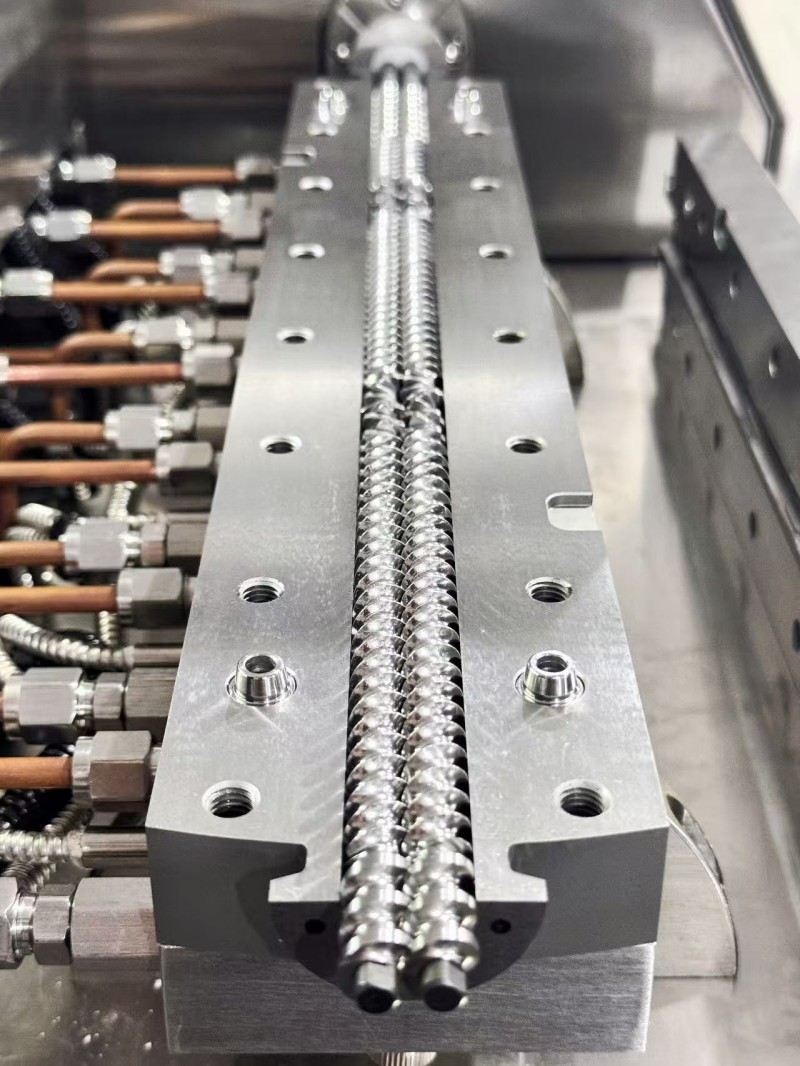
Pharmaceutical hot melt extrusion is scaled up by transferring the same process logic from lab to pilot and production: material compatibility, screw configuration, feed rate, screw speed, fill level, shear, residence time, melt temperature, vacuum devolatilization, cooling, PAT monitoring, and GMP records.
Scale-up in pharmaceutical hot melt extrusion means moving a formulation from a small laboratory extruder to a pilot or commercial twin screw extrusion line while keeping the same product quality and process behavior.
In pharmaceutical HME, scale-up is not only increasing output. It must preserve the relationship between API, polymer, excipient, temperature, shear, residence time, vacuum, cooling, and final drug performance.
A successful scale-up should keep the formulation inside a safe processing window. The process must still support thermal stability, uniform mixing, amorphous stability, impurity control, and reproducible product quality.
Internal link: Pharmaceutical Extrusion
Pharmaceutical HME scale-up is difficult because a larger extruder does not behave exactly like a small lab machine. Screw diameter, barrel volume, heat transfer, fill level, torque, residence time, and cooling behavior all change with equipment size.
A lab trial may use only a small amount of API and polymer. The material may pass through the barrel quickly and be collected in short runs. In production, the process must run longer, feed continuously, maintain stable torque, control vacuum, generate batch records, and meet GMP expectations.
Common scale-up risks include:
API degradation
Poor content uniformity
Higher impurity level
Crystallization after cooling
Residence time change
Different shear history
Vent flooding
Incomplete devolatilization
Torque overload
Poor strand or pellet quality
Cleaning and validation difficulty
Batch-to-batch variation
The practical scale-up question is not “Can a larger extruder make more material?” The real question is “Can the larger extruder reproduce the same critical material state?”
Before scale-up, the formulation and process window should be understood at lab scale. A weak lab process usually becomes more unstable at pilot or production scale.
Important lab-stage checks include:
| Check Item | Why It Matters |
|---|---|
| API thermal stability | Confirms whether the API can tolerate HME temperature |
| Polymer compatibility | Supports amorphous dispersion and stability |
| Excipient function | Affects viscosity, flow, plasticization, and dissolution |
| Melting window | Defines safe barrel temperature range |
| Screw configuration | Controls mixing, shear, venting, and residence time |
| Feed stability | Affects content uniformity and batch consistency |
| Torque trend | Shows material resistance and overload risk |
| Residence time | Controls thermal exposure and mixing time |
| Vacuum need | Removes moisture, solvent, or low-molecular impurities |
| Cooling method | Affects amorphous stability and crystallization risk |
| Cleaning behavior | Affects GMP operation and cross-contamination control |
A lab trial should create transferable process knowledge, not only a successful sample.
The most important scale-up parameters are the ones that control product quality, not only the ones shown on the machine screen.
Key transferable parameters include:
Screw configuration logic
Screw speed
Feed rate
Feed rate per screw revolution
Fill level
Torque percentage
Specific mechanical energy
Residence time
Melt temperature
Barrel temperature profile
Vacuum level
Melt pressure
Cooling or quenching rate
API-polymer mixing quality
Impurity profile
Dissolution behavior
Cleaning and hold-up behavior
In LEMIX pharmaceutical extrusion guidance, core process parameters such as shear rate, fill level, and specific mechanical energy can be transferred across small-volume research machines, pilot-scale systems, and commercial production lines.
Screw diameter should be scaled according to material volume, target output, residence time, torque demand, and downstream capacity.
A small screw diameter is suitable for formulation screening because API quantity is limited and material cost is high. A pilot screw diameter is suitable for process confirmation and longer runs. A production screw diameter is selected after the formulation and process window are more stable.
LEMIX PROMIX series covers lab, pilot, and production ranges:
| Model | Screw Diameter | L/D | Output Range |
|---|---|---|---|
| PROMIX-11 | 11 mm | 40:1 | 0.2–2.5 kg/h |
| PROMIX-16 | 16 mm | 40:1 | 0.5–20 kg/h |
| PROMIX-26S | 25.7 mm | 40:1 | 50–200 kg/h |
| PROMIX-32S | 31.8 mm | 40:1 | 60–250 kg/h |
| PROMIX-40S | 40.3 mm | 40:1 | 80–300 kg/h |
| PROMIX-50S | 50.3 mm | 40:1 | 100–350 kg/h |
These model ranges provide a practical path from low-material-consumption trials to higher-output commercial manufacturing.
Internal links:
L/D ratio affects scale-up because it defines how much process length is available for feeding, melting, mixing, vacuum devolatilization, pressure building, and discharge.
A consistent L/D framework can help maintain similar process logic between lab, pilot, and production machines. LEMIX PROMIX models listed above use 40:1 L/D, which gives process space for multi-section pharmaceutical extrusion development.
However, the same L/D ratio does not automatically guarantee the same result. Larger screws have different free volume, heat transfer behavior, torque capacity, and cooling response. The screw configuration, fill level, residence time, and specific mechanical energy still need to be compared during scale-up.
A practical rule: L/D ratio provides the process framework; screw configuration decides how that framework is used.
Screw configuration should be scaled by preserving process function, not by copying each element blindly.
The lab screw configuration usually defines where the material is fed, melted, mixed, degassed, pressurized, and discharged. During scale-up, the same functional zones should be preserved as much as possible.
Key screw sections include:
| Screw Section | Scale-Up Purpose |
|---|---|
| Feeding section | Maintains stable intake of API, polymer, and excipients |
| Conveying section | Controls material transport and fill level |
| Melting section | Creates polymer softening without excessive heat |
| Mixing section | Supports API-polymer distribution |
| Kneading section | Provides required dispersive mixing |
| Vacuum section | Removes moisture, residual solvents, and volatiles |
| Discharge section | Builds pressure before die or downstream shaping |
The strongest screw is not always the best pharmaceutical screw. A successful configuration gives the required content uniformity with the lowest effective heat and shear exposure.
Internal link: Screw Elements for TSE
Feed rate should be scaled with screw speed, fill level, residence time, and torque. Simply increasing kg/h can change the material state inside the barrel.
In pharmaceutical HME, feeding accuracy is critical because API, polymer, and excipient ratios must stay stable during continuous operation. If feeding becomes unstable, the extrudate may show content variation, torque movement, pressure fluctuation, and inconsistent drug release behavior.
A scale-up review should check:
API feed accuracy
Polymer feed stability
Excipient feeding behavior
Powder flowability
Hopper bridging
Material segregation
Loss-in-weight feeder trend
Feed rate per screw revolution
Long-run feeding stability
LEMIX pharmaceutical extrusion solutions use high-precision loss-in-weight feeding to reduce material stratification and segregation, support uniform residence time, and improve batch-to-batch consistency.
Screw speed should be scaled according to shear rate, fill level, residence time, torque, and mixing quality. The same rpm on a larger extruder does not create the same process behavior as the same rpm on a small extruder.
If screw speed is too high, the process may create more shear heat, shorter residence time, weaker venting, and higher degradation risk. If screw speed is too low, the barrel may become overfilled or residence time may become too long.
Scale-up should compare:
Screw speed
Tip speed
Fill level
Specific mechanical energy
Torque percentage
Residence time
Melt temperature
API content uniformity
Impurity trend
For heat-sensitive APIs, the safest scale-up direction is usually controlled shear, stable fill level, and enough mixing without unnecessary mechanical energy.
Residence time is one of the most important HME scale-up factors. It controls how long the formulation is exposed to heat and shear.
If residence time becomes shorter during scale-up, API-polymer mixing may become incomplete. If residence time becomes longer, API degradation, impurity formation, or crystallization risk may increase.
A scale-up study should evaluate:
Average residence time
Residence time distribution
Dead-zone risk
Material hold-up
Discharge delay
Start-up and shutdown material
Residence time at different feed rates
Residence time after screw configuration changes
For pharmaceutical HME, a narrow and repeatable residence time distribution is often more important than a single average number. Material retained in dead zones may receive a different thermal history and create quality risk.
Temperature should be scaled by controlling actual material temperature, not only barrel setpoints.
A larger extruder may generate different shear heat and hold more material. Heat removal can also differ because of larger metal mass and longer production time. Therefore, the same barrel setpoints from lab scale may not give the same melt temperature at pilot or production scale.
Temperature scale-up should check:
Barrel zone setpoints
Actual barrel temperature response
Melt temperature if measurable
Torque-related heat generation
Cooling capacity
Residence time
API degradation risk
Impurity profile
Extrudate appearance
Downstream cooling rate
LEMIX pharmaceutical extrusion solutions use independently controlled multi-zone temperature regulation and ±1°C temperature control accuracy to support heat-sensitive, oxidation-sensitive, and chirally unstable APIs.
Vacuum devolatilization should be scaled by preserving melt surface exposure, vent-zone fill level, vacuum stability, and residence time before and after the vent section.
A vacuum section that works in the lab may not automatically work in production. Higher feed rate can increase vapor load. Larger material volume can change fill level. If the vent zone becomes overfilled, material can flood the vacuum port.
Scale-up should review:
Moisture or solvent content
Vacuum port position
Large-pitch venting section
Fill level near the vent
Vacuum level
Vacuum fluctuation
Vent flooding risk
Residual solvent level
Bubbles or voids in extrudate
Pressure rebuilding after venting
LEMIX pharmaceutical extrusion solutions use a dedicated large-pitch vacuum section with a multistage high-vacuum system to remove moisture, residual solvents, and low-molecular-weight impurities.
Cooling or quenching should be scaled because amorphous stability can depend on how quickly the extrudate solidifies after discharge.
In amorphous solid dispersion production, slow or uneven cooling may allow API recrystallization or phase separation. Faster, controlled cooling can help preserve the desired solid-state structure.
Scale-up should check:
Extrudate temperature at die exit
Cooling method
Cooling rate
Strand thickness
Pelletizing or cutting method
Residence time after die exit
Risk of recrystallization
Final dissolution behavior
Storage stability
LEMIX pharmaceutical extrusion guidance emphasizes rapid quenching post-treatment to help ensure amorphous product stability.
PAT supports scale-up by connecting process data with product quality. It helps engineers understand whether the larger process is still inside the validated operating window.
PAT and process monitoring can track:
Feed rate
Screw speed
Torque
Barrel temperature
Melt pressure
Vacuum level
Extrudate quality
Moisture or residual solvent trend
API distribution indicators
Cooling behavior
Batch-to-batch consistency
The practical value of PAT is that it turns scale-up into a data-supported transfer process. Instead of relying only on final testing, the process can monitor critical parameters during production.
LEMIX pharmaceutical extrusion systems support PAT online monitoring and GMP full-life-cycle verification for process control and reproducibility.
GMP data should show that the scaled process is controlled, traceable, repeatable, and suitable for validation.
Important GMP data includes:
| Data Area | What Should Be Recorded |
|---|---|
| Recipe data | Approved process settings and material ratios |
| Batch records | Production history and parameter trends |
| Feeding records | API, polymer, and excipient feed accuracy |
| Temperature data | Setpoints, actual trends, and alarms |
| Torque and pressure | Mechanical load and melt flow stability |
| Vacuum records | Moisture and volatile removal control |
| Cleaning records | Cleaning method, inspection, and validation support |
| User actions | Parameter changes and operator activity |
| PAT data | Online process and quality signals |
| Deviations | Any out-of-limit events and corrective actions |
LEMIX GMP Twin Screw Extruder supports data acquisition, status monitoring, user authority management, audit trail, electronic signature, recipe management, batch record reporting, encrypted database files, and traceable operation.
Internal link: GMP Twin Screw Extruder
Scale-up should compare critical quality attributes across lab, pilot, and production batches. Machine parameters alone are not enough.
Important quality attributes include:
API content uniformity
Assay result
Impurity profile
Residual solvent level
Moisture level
Amorphous stability
Crystallinity
Dissolution behavior
Extrudate appearance
Strand or pellet density
Mechanical handling behavior
Thermal stability
Long-term storage stability
The scale-up process should confirm that any change in equipment size does not change the critical quality behavior of the formulation.
Common failures happen when lab parameters are copied without understanding why they worked.
| Scale-Up Failure | Common Cause | Better Check |
|---|---|---|
| API degradation | Higher melt temperature or longer residence time | Melt temperature, impurity profile, residence time |
| Poor content uniformity | Weak mixing or feeding instability | Feeder trend, screw configuration |
| Crystallization | Poor cooling or weak polymer compatibility | Cooling rate, solid-state testing |
| High torque | Higher viscosity or overfilled barrel | Feed rate, screw speed, temperature |
| Vent flooding | Wrong fill level near vacuum section | Vent-zone design, feed rate, vacuum trend |
| Residual solvent issue | Weak devolatilization | Vacuum level, residence time, vent design |
| Poor dissolution | Changed API-polymer dispersion | Mixing, cooling, solid-state form |
| Scale-up discontinuity | Poor transfer of SME, fill level, shear | Process mapping |
| GMP data gap | Insufficient batch records or audit trail | Control system and documentation |
| Cleaning problem | Higher material hold-up or sticky polymer | Cleaning method and validation plan |
The most reliable scale-up method compares process signals and product results together.
A practical scale-up sequence should move step by step from formulation understanding to GMP manufacturing.
Confirm API-polymer compatibility and thermal stability.
Define the lab-scale processing window.
Select initial screw configuration.
Record feed rate, screw speed, torque, temperature, pressure, and residence time.
Evaluate extrudate quality and dissolution behavior.
Confirm vacuum devolatilization need.
Test cooling or quenching conditions.
Move to pilot-scale equipment with comparable process logic.
Match fill level, shear, residence time, and specific mechanical energy.
Compare impurity profile, content uniformity, and amorphous stability.
Confirm cleaning and hold-up behavior.
Build GMP recipe, batch record, PAT, and validation documentation.
Transfer to commercial production with controlled monitoring.
This sequence reduces the risk of repeating parameter development at every machine size.
LEMIX supports pharmaceutical HME scale-up through lab-scale extruders, pilot trial systems, GMP twin screw extruders, modular screw and barrel design, vacuum devolatilization, low-temperature and low-shear processing, PAT-ready control logic, and process documentation support.
| Scale-Up Need | LEMIX Support |
|---|---|
| Formulation screening | PROMIX-11 Lab Scale Twin Screw Extruder |
| Pilot process confirmation | PROMIX-16 and PROMIX-26S systems |
| Commercial production | PROMIX-40S and PROMIX-50S systems |
| Pharmaceutical GMP processing | GMP Twin Screw Extruder |
| API-polymer mixing | Modular screw configuration |
| Devolatilization | Large-pitch vacuum section and high-vacuum system |
| Temperature-sensitive APIs | Segmented temperature control and low-shear design |
| Process transfer | Comparable scale-up parameters across equipment range |
| GMP records | Audit trail, recipe management, batch record reporting |
| Long-term operation | Spare Parts, cleaning, and technical support |
Relevant pages:
Pharmaceutical hot melt extrusion should be scaled up by transferring material behavior, screw function, shear, fill level, residence time, temperature history, vacuum performance, cooling rate, PAT data, and GMP records from lab to pilot and production.
The goal is not only higher output. The goal is to preserve thermal stability, uniform API-polymer mixing, amorphous stability, impurity control, and reproducibility across equipment sizes.
LEMIX supports this scale-up path with PROMIX lab, pilot, and production twin screw extrusion systems, GMP extrusion equipment, modular screw and barrel design, high-vacuum devolatilization, low-temperature low-shear processing, PAT-ready monitoring, batch records, audit trail, and pharmaceutical process support.