
Search LEMIX Products
Learn how PEEK is compounded with a twin screw extruder, covering high-temperature melting, side feeding, fiber dispersion, shear control, vacuum devolatilization, pellet inspection, barrel wear, and LEMIX support.
Category:Materials & Applications
Author:LEMIX Admin
Date:2026-08-06
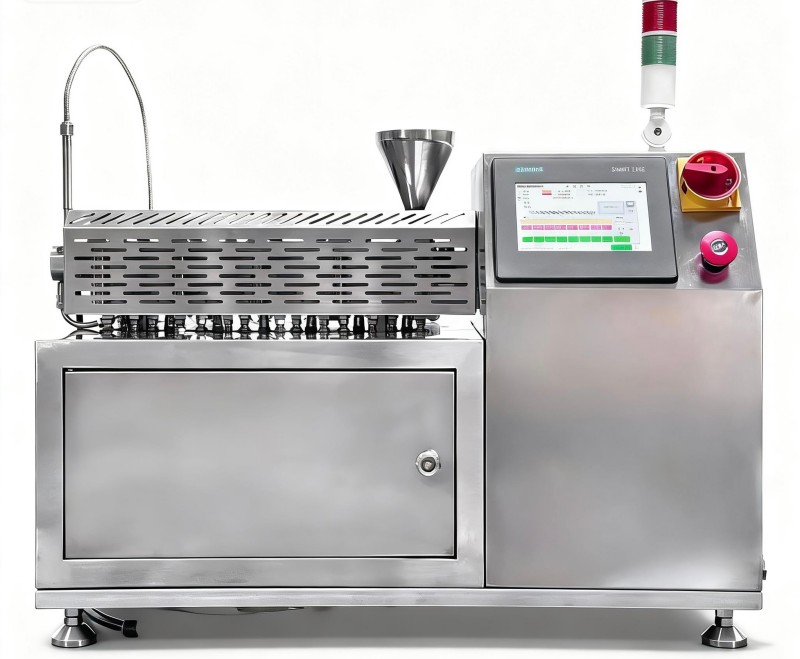
PEEK is compounded with a Twin Screw Extruder by feeding PEEK resin, melting it under high temperature, adding fibers or additives through controlled feeding, applying shear mixing, vacuum devolatilization, pressure stabilization, pelletizing, inspection, and cooling to produce high-performance PEEK compounds.
PEEK compounding is the process of modifying polyetheretherketone resin with reinforcing materials, fillers, lubricants, pigments, or functional additives to improve performance.
Pure PEEK already has strong thermal, mechanical, and chemical properties, but it may still need modification for applications that require higher wear resistance, impact resistance, dimensional stability, friction control, or strength under demanding conditions.
Common PEEK compound types include:
Glass fiber reinforced PEEK
Carbon fiber reinforced PEEK
Wear-resistant PEEK
Lubricated PEEK
Mineral-filled PEEK
Conductive PEEK
High-strength engineering PEEK
Special application PEEK compounds
The goal of PEEK compounding is not only to mix materials together. The goal is to create stable reinforcement distribution while protecting the polymer from excessive heat, shear, residence time, contamination, and degradation.
Internal link: Special Engineering Plastics - PEEK
Twin screw extrusion is used for PEEK compounding because PEEK has high melt viscosity and requires strong but controlled mixing at high processing temperature.
A twin screw extruder can combine several process steps in one continuous system:
| Process Need | Twin Screw Extruder Function |
|---|---|
| High-temperature melting | Segmented barrel heating and temperature control |
| Fiber or filler addition | Side feeding after the resin is melted |
| Strong dispersion | Kneading and mixing screw elements |
| Gentle fiber handling | Adjustable screw configuration |
| Moisture and volatile removal | Vacuum devolatilization section |
| Stable discharge | Pressure-building screw section |
| Pellet quality control | Downstream pelletizing and inspection |
| Long-term operation | Wear-resistant screw and barrel design |
For PEEK, the machine must do more than reach a high temperature. It must keep melting, shear, torque, fiber distribution, vacuum removal, and pellet quality stable during continuous production.
Internal link: Twin Screw Extruder
PEEK is difficult to compound because it is processed at high temperature and has very high melt viscosity. This puts strong demands on the screw, barrel, gearbox, motor, vacuum system, feeding system, and downstream equipment.
Main processing challenges include:
High melting and processing temperature
High melt viscosity
High torque demand
Risk of fiber breakage
Need for high-temperature barrel and die control
Need for wear-resistant screw and barrel materials
Need for effective vacuum devolatilization
Risk of degradation during long residence time
Difficulty cleaning high-temperature residue
Higher cost of raw materials and scrap
A practical production rule is: PEEK compounding should be controlled as a high-temperature, high-viscosity, high-value process, not as ordinary plastic compounding.
A typical PEEK compounding process includes resin preparation, feeding, melting, side feeding, mixing, degassing, pressure building, pelletizing, inspection, and packaging.
The process can be summarized as:
Dry PEEK resin and additives if required.
Feed PEEK resin into the main feeding port.
Melt the resin under high barrel temperature.
Add glass fiber, carbon fiber, or other reinforcing materials through a side feeder.
Use controlled screw elements to distribute fibers and additives.
Remove moisture and volatiles through vacuum devolatilization.
Stabilize melt pressure before discharge.
Extrude strands or use a suitable pelletizing method.
Cool and dry the pellets.
Inspect pellet quality.
Package and store the finished PEEK compound.
For high-value PEEK materials, every step should be recorded because small process drift can create expensive quality loss.
High-temperature control is important because PEEK requires a very high processing window. The LEMIX PEEK application page notes that PEEK processing melting temperature can range from 340°C to 380°C, and the barrel and die system may need accurate control above 400°C.
At this level, poor temperature control can cause serious problems:
Incomplete melting
High torque
Poor fiber wetting
Pressure fluctuation
Material degradation
Black specks
Unstable pellet quality
Die buildup
Difficult cleaning
Reduced mechanical performance
PEEK temperature control should not only focus on setpoints. The process should check actual material behavior through torque, melt pressure, strand quality, pellet appearance, and defect trend.
PEEK screw configuration should balance strong dispersion with controlled shear. The process must disperse fibers and additives, but excessive shear can break fibers, raise melt temperature, and increase wear.
A PEEK screw layout usually needs:
| Screw Section | Main Purpose |
|---|---|
| Main feeding section | Introduces PEEK resin steadily |
| Conveying section | Moves resin forward before full melting |
| Melting section | Softens and melts high-viscosity PEEK |
| Side-feeding section | Adds glass fiber, carbon fiber, or fillers |
| Mixing section | Distributes fibers and additives |
| Vacuum section | Removes moisture and low-molecular volatiles |
| Pressure-building section | Stabilizes melt flow before discharge |
| Discharge section | Supports strand or pelletizing stability |
The strongest screw design is not always the best. For fiber-reinforced PEEK, too much kneading can shorten fibers and reduce reinforcement value. The better design is a screw configuration that gives enough wetting and distribution while keeping fiber length, torque, and temperature under control.
Internal link: Screw Elements for TSE
Side feeding is important because glass fiber and carbon fiber can be damaged if they are introduced too early into the main feeding zone.
If fibers enter before PEEK resin is properly melted, several problems may appear:
Fiber bridging
Feeding instability
High torque
Poor fiber wetting
Excessive fiber breakage
Screw and barrel wear
Unstable output
Poor mechanical performance
By feeding fibers through a side feeder after the PEEK resin has already melted, the process can improve wetting and reduce unnecessary mechanical damage.
A practical rule for reinforced PEEK is: melt the resin first, then feed the fiber into a controlled receiving zone, then apply enough mixing to distribute it without destroying it.
Shear affects PEEK compounding by helping melt the polymer, wet fibers, disperse additives, and build a uniform compound. However, excessive shear can create problems.
Controlled shear can help:
Improve fiber wetting
Break additive agglomerates
Distribute fillers evenly
Improve melt uniformity
Stabilize pellet quality
Excessive shear can cause:
Fiber length loss
Melt temperature rise
Higher torque
More screw and barrel wear
Black specks
Material degradation
Lower final mechanical properties
For PEEK, the purpose of shear is not to make the process more aggressive. The purpose is to apply mechanical energy only where it improves the compound.
PEEK needs high torque because its melt viscosity is high, especially when glass fiber, carbon fiber, mineral filler, or functional additives are added.
High torque capacity helps the extruder maintain stable operation when resistance increases inside the barrel. Without enough torque reserve, the line may show overload, shutdown, unstable screw speed, incomplete melting, or long residence time at high temperature.
High torque is especially important when processing:
Carbon fiber reinforced PEEK
Glass fiber reinforced PEEK
High filler loading PEEK
Wear-resistant PEEK compounds
High-viscosity PEEK grades
Low-flow specialty formulas
In real production, torque should not be pushed close to the limit for long periods. A stable PEEK process needs torque reserve because material batches, fiber loading, feeding behavior, and temperature response can change during operation.
Vacuum devolatilization is used to remove residual moisture, trapped air, low-molecular volatiles, and small gas-phase impurities during high-temperature PEEK compounding.
This step helps reduce:
Bubbles
Internal voids
Odor
Strand breakage
Pellet density variation
Poor mechanical performance
Surface defects
Downstream molding or extrusion instability
PEEK is often used in demanding applications, so hidden voids or volatile-related defects can become serious quality risks. Vacuum should be applied after the polymer reaches a suitable melt state, and the screw section near the vent should avoid overfilling or vent flooding.
Internal link: How Does Vacuum Degassing Work in Twin Screw Extrusion?
Barrel and screw materials are important because PEEK compounding runs at high temperature and may include abrasive fibers or fillers.
The LEMIX PEEK application page highlights the need for bimetallic barrel and screw materials that can withstand high temperature and corrosion. For reinforced PEEK, wear resistance is also critical because glass fiber, carbon fiber, and mineral fillers can accelerate screw and barrel wear.
A suitable system should consider:
High-temperature strength
Wear resistance
Corrosion resistance
Surface treatment
Screw element durability
Barrel liner condition
Shaft strength
Gearbox torque capacity
Long-term maintenance cost
A poorly selected screw or barrel may run during early trials but lose process stability after long-term production.
Barrel wear changes screw-to-barrel clearance. When clearance increases, the extruder may lose conveying efficiency, mixing stability, pressure control, and residence time repeatability.
In PEEK compounding, wear can show up as:
Lower output at the same screw speed
More torque fluctuation
Poor fiber distribution
Unstable pressure
More black specks
More gels
Irregular pellet size
Longer cleaning time
Reduced process repeatability
Because PEEK and reinforced PEEK are high-value materials, wear should not be checked only after defects become serious. Preventive measurement is safer.
LEMIX PROMAC-S Barrel Wear Measurement Device uses inside laser equipment and a 360° rotating laser sensor to measure barrel wear, diameter changes, and inner surface condition. It supports preventive inspection and maintenance decisions based on measurement data.
Internal link: Barrel Wear Measurement Device PROMAC-S
PEEK pellet defects should be monitored because small pellet issues can indicate high-temperature processing problems, contamination, poor dispersion, or downstream instability.
Important defects include:
| Defect | Possible Cause |
|---|---|
| Black specks | Carbonized residue, overheating, dead zones |
| Gels | Poor melting, degradation, unmixed material |
| Fiber agglomerates | Poor side feeding or weak distribution |
| Bubbles | Moisture or weak vacuum devolatilization |
| Yellowing or discoloration | Excessive heat or long residence time |
| Irregular pellet size | Pressure fluctuation or cutting instability |
| Fines and dust | Brittle strands or poor pelletizer setting |
| Cross contamination | Incomplete screw or die cleaning |
| Surface roughness | Volatile release or unstable cooling |
LEMIX in-Line Plastic Pellet Inspection supports real-time and continuous pellet inspection and sorting. It can detect defects such as burnt material, gels, size and cutting problems, cross contamination, yellowing, and color deviation.
Internal link: in-Line Plastic Pellet Inspection
Screw cleaning is important because PEEK residue can remain on screws, die plates, breaker plates, shafts, nozzles, and other extrusion components after high-temperature processing.
If residue is not removed properly, the next run may show:
Black specks
Carbonized particles
Color contamination
Gel defects
Pressure fluctuation
Longer purging time
Poor restart stability
Cross contamination
Higher maintenance risk
Traditional flame burning or harsh manual cleaning can damage screw surfaces, cause oxidation, change hardness, or deform precision components. This is especially risky for high-value screw elements and wear-resistant surfaces.
LEMIX PRO-COOL Screw Cleaning Machine provides non-destructive cleaning for extrusion screws and components. It removes polymer residue and contaminants without flame burning, manual brushing, toxic smoke, or surface damage.
Internal link: PRO-COOL Screw Cleaning Machine
PEEK compounding should be supported by process data because high-temperature compounds are sensitive to small changes.
Important data includes:
PEEK resin grade and batch
Filler or fiber type
Fiber loading
Material drying condition
Feed rate
Side feeder rate
Screw speed
Torque trend
Barrel temperature profile
Die temperature
Melt pressure trend
Vacuum level
Screw configuration
Residence time estimate
Pelletizing condition
Pellet defect trend
Barrel wear history
Screw cleaning record
Final mechanical performance
A useful production record should connect quality defects with time-based process changes. If black specks appear after torque rises, the cause may be residence time, residue, or overheating. If fiber distribution becomes unstable after a side feeder adjustment, feeding and screw fill level should be checked first.
Lab trials should be used to define the safe processing window before moving to pilot or commercial production.
A PEEK lab trial should evaluate:
Melting behavior
Screw configuration
Fiber addition point
Mixing quality
Torque level
Melt pressure
Temperature stability
Vacuum need
Pellet appearance
Cleaning difficulty
Wear risk
Final material performance
LEMIX product range includes lab scale, pilot trial, pilot scale production, and commercial production twin screw extruders. This supports a staged development path from small material trials to larger PEEK compounding lines.
Internal links:
Common mistakes in PEEK compounding usually come from treating PEEK like a normal engineering plastic instead of a high-temperature, high-viscosity specialty material.
Avoid these mistakes:
Using insufficient temperature control
Adding fibers too early
Using excessive kneading that breaks fibers
Ignoring torque reserve
Running with weak vacuum devolatilization
Using screw and barrel materials with poor wear resistance
Ignoring cooling and pelletizing stability
Checking pellets only by manual sampling
Delaying barrel wear inspection
Cleaning screws with damaging methods
Scaling up without lab or pilot data
The most expensive PEEK defects often begin as small process signals: torque drift, pressure movement, pellet discoloration, black specks, or side feeder instability.
LEMIX supports PEEK compounding through twin screw extrusion equipment, screw elements, pellet inspection, maintenance devices, and Spare Parts.
| PEEK Compounding Need | LEMIX Support |
|---|---|
| Lab formula trials | PROMIX-11 Lab Scale Twin Screw Extruder |
| Pilot process development | PROMIX-16 / PROMIX-26 systems |
| Commercial production | PROMIX-40 / PROMIX-50 systems |
| High-temperature compounding | Twin Screw Extruder |
| Fiber and additive distribution | Screw Elements for TSE |
| Pellet quality monitoring | in-Line Plastic Pellet Inspection |
| Barrel wear measurement | PROMAC-S / PROMAC-X |
| Screw residue removal | PRO-COOL Screw Cleaning Machine |
| Long-term maintenance | Barrels, shafts, gearboxes, die plates, breaker plates |
Relevant pages:
PEEK is compounded with a twin screw extruder by controlling high-temperature melting, screw shear, side feeding, fiber distribution, vacuum devolatilization, torque, wear resistance, pelletizing, inspection, and cleaning.
The key challenge is not only reaching the required processing temperature. The real challenge is keeping a high-viscosity PEEK melt stable while fibers, fillers, and additives are distributed without excessive fiber breakage, degradation, contamination, or wear.
LEMIX supports PEEK compounding with lab, pilot, and commercial twin screw extruders, modular screw elements, high-temperature process design, side-feeding support, vacuum devolatilization, in-line pellet inspection, barrel wear measurement, screw cleaning, and long-term spare parts support.