
Search LEMIX Products
Learn how temperature and residence time affect API stability during HME, including degradation risk, screw speed, screw design, vacuum control, scale-up, and process optimization.
Category:Process Control & Troubleshooting
Author:LEMIX Admin
Date:2026-08-19
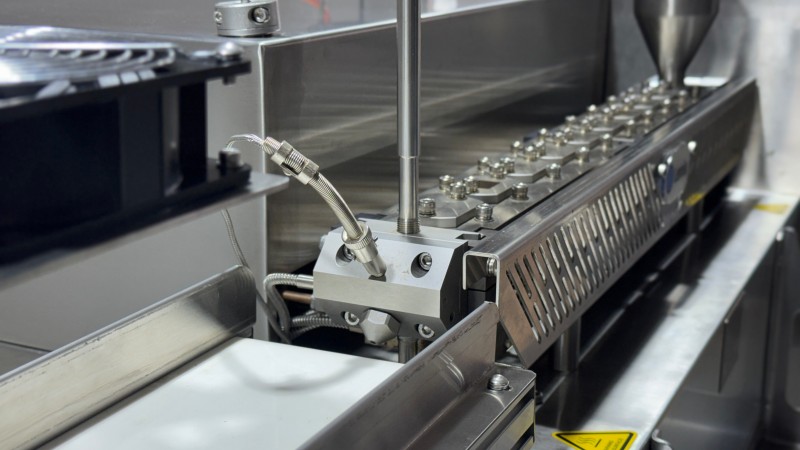
Temperature and residence time directly affect API stability during hot melt extrusion by controlling thermal exposure, degradation risk, molecular interactions, and final drug performance. Proper process control helps maintain API integrity and product consistency.
Temperature is one of the most important factors affecting API stability during pharmaceutical hot melt extrusion.
During HME processing, the polymer must reach a molten state so that the API can be uniformly dispersed. However, excessive temperature exposure may cause chemical or physical changes to the active pharmaceutical ingredient.
The temperature window must balance two requirements:
Enough heat to melt and mix the polymer system
Low enough thermal exposure to protect API stability
A suitable processing temperature helps achieve:
Uniform API distribution
Stable amorphous solid dispersion
Consistent dissolution performance
Reduced degradation products
Repeatable batch quality
If the temperature is too low, incomplete melting and poor mixing may occur. If the temperature is too high, API degradation or polymer breakdown may increase.
Pharmaceutical HME involves direct interaction between heat, mechanical energy, polymers, and APIs. Unlike conventional polymer processing, pharmaceutical extrusion requires tighter control because small process changes may influence drug performance.
Temperature affects:
Polymer viscosity
API solubility in polymer matrix
Melt flow behavior
Mixing efficiency
Residence time
Degradation reactions
Final solid-state properties
A stable temperature profile across the barrel helps create predictable processing conditions.
Typical temperature control zones include:
| Extrusion Zone | Main Purpose |
|---|---|
| Feeding zone | Stable material introduction |
| Melting zone | Polymer softening and melting |
| Mixing zone | API and polymer homogenization |
| Vacuum zone | Removal of moisture and volatiles |
| Metering zone | Stable pressure and discharge |
Each zone requires suitable temperature settings according to the formulation.
Excessive temperature increases the risk of API degradation during HME.
Possible effects include:
Chemical degradation
Formation of impurities
Reduced drug potency
Changes in dissolution behavior
Loss of therapeutic performance
Reduced batch consistency
Thermal sensitivity varies between APIs. Some compounds can tolerate higher processing temperatures, while others require a narrow processing window.
The actual risk depends on:
API structure
Polymer type
Plasticizer content
Processing time
Shear energy
Moisture level
Oxygen exposure
Therefore, temperature selection should be based on formulation testing rather than a fixed value.
Low processing temperature can also create stability problems because the polymer system may not achieve proper melting and mixing conditions.
Possible problems include:
Incomplete polymer melting
Poor API dispersion
Uneven drug distribution
High torque
Increased pressure fluctuation
Poor extrudate appearance
A pharmaceutical HME process requires enough thermal energy to create a uniform melt phase.
The goal is not the lowest possible temperature. The goal is the lowest temperature that achieves stable melting and mixing.
Residence time is the period that material remains inside the extruder barrel during processing.
It determines how long the API and polymer are exposed to:
Heat
Mechanical shear
Pressure
Mixing energy
Residence time affects:
API degradation risk
Mixing quality
Amorphous dispersion formation
Volatile removal
Product consistency
A properly designed HME process requires controlled residence time because both insufficient and excessive residence times can affect product quality.
Long residence time increases the duration of thermal and mechanical exposure.
Potential risks include:
API degradation
Polymer degradation
Impurity formation
Unwanted chemical reactions
Color change
Reduced product stability
Long residence time may occur because of:
Low screw speed
Excessive barrel filling
Strong restrictive screw elements
Incorrect screw configuration
Low output rate
However, longer residence time is not always negative. Some formulations may require sufficient time for:
Complete polymer melting
API dispersion
Homogeneous mixing
The correct residence time depends on formulation requirements.
Short residence time reduces thermal exposure but may create insufficient processing conditions.
Possible problems include:
Poor API distribution
Incomplete polymer melting
Insufficient mixing
Lower amorphous dispersion quality
Batch variation
A short residence time is beneficial only when the formulation can achieve complete mixing within that period.
The ideal residence time provides enough processing energy without creating unnecessary API exposure.
Screw speed directly influences residence time during HME.
Increasing screw speed usually:
Reduces residence time
Increases mixing intensity
Increases mechanical energy input
May increase melt temperature
Reducing screw speed usually:
Increases residence time
Reduces throughput
Increases thermal exposure time
The relationship must be carefully balanced.
| Parameter Change | Possible Effect |
|---|---|
| Higher screw speed | Shorter residence time, higher shear |
| Lower screw speed | Longer residence time, lower throughput |
| Higher feed rate | Higher filling level, shorter processing opportunity |
| Lower feed rate | Lower throughput, different mixing behavior |
The best operating point depends on API sensitivity, polymer characteristics, and target product quality.
Screw configuration determines how materials move and mix inside the extruder.
Different screw elements influence:
Material transport
Mixing intensity
Pressure development
Residence time distribution
Temperature generation
Important screw elements include:
Conveying elements
Kneading blocks
Reverse elements
Transition elements
Degassing elements
For pharmaceutical HME:
Strong mixing sections improve API distribution.
Excessive restrictive elements may increase residence time.
Proper conveying sections help maintain stable flow.
Suitable degassing zones improve volatile removal.
LEMIX provides modular screw element solutions that allow process engineers to adjust screw configuration according to different pharmaceutical formulations.
Internal link:
Vacuum degassing helps remove unwanted substances during HME processing.
It can remove:
Moisture
Residual solvents
Trapped air
Low molecular weight compounds
Moisture and volatile components may affect:
Polymer stability
API distribution
Extrusion consistency
Final product performance
A properly designed vacuum section requires:
Suitable screw configuration
Stable melt condition
Controlled filling level
Reliable vacuum performance
LEMIX pharmaceutical extrusion systems use dedicated vacuum sections and high-vacuum systems to support stable devolatilization during processing.
Internal link:
API-polymer compatibility determines how much thermal energy can be applied during HME.
A suitable polymer carrier should:
Dissolve or disperse API effectively
Maintain stability during processing
Support desired drug release behavior
Temperature selection should consider:
Polymer melting temperature
API degradation temperature
Glass transition temperature
API solubility
Drug release requirements
A temperature suitable for one formulation may not be suitable for another.
Optimization usually begins with laboratory-scale extrusion trials.
The development process includes:
Selecting suitable polymer and API combinations
Testing processing temperature range
Evaluating torque and pressure behavior
Measuring residence time
Checking API stability
Testing dissolution performance
Confirming scale-up parameters
Important process data includes:
Barrel temperature profile
Melt temperature
Screw speed
Feed rate
Torque
Pressure
Vacuum level
Residence time
Product testing results
This data helps identify the processing window where API stability and extrusion performance are both acceptable.
Scaling from laboratory HME to production requires careful evaluation because larger equipment changes heat transfer, material volume, and residence behavior.
The same temperature setting does not always create the same material condition on different extruders.
Scale-up should compare:
Residence time distribution
Specific mechanical energy
Melt temperature
Torque level
Mixing efficiency
API stability
Final product properties
LEMIX provides laboratory, pilot, and production twin screw extrusion systems to support pharmaceutical development and scale-up.
Relevant pages:
API stability should be evaluated together with extrusion process data.
Important monitoring parameters include:
| Parameter | Influence |
|---|---|
| Barrel temperature | Controls thermal exposure |
| Melt temperature | Shows actual material condition |
| Screw speed | Influences shear and residence time |
| Feed rate | Controls filling level |
| Torque | Indicates material processing resistance |
| Pressure | Shows flow stability |
| Vacuum level | Controls volatile removal |
| Residence time | Determines exposure duration |
Monitoring these parameters helps identify whether instability comes from temperature, residence time, material variation, or equipment settings.
LEMIX provides pharmaceutical hot melt extrusion solutions designed for formulation development, scale-up, and GMP production.
The solutions support:
Thermal stability control
Uniform API-polymer mixing
Amorphous solid dispersion development
Vacuum degassing
Process monitoring
GMP documentation
Reproducible production
LEMIX pharmaceutical extrusion systems include:
Lab-scale Twin Screw Extruders
Pilot extrusion systems
GMP twin screw extruders
Modular screw elements
Process monitoring solutions
Maintenance equipment
Relevant pages:
Temperature and residence time are two key factors affecting API stability during pharmaceutical hot melt extrusion.
Temperature controls the balance between polymer melting and API protection, while residence time determines the duration of heat and shear exposure.
A successful HME process requires coordinated control of screw configuration, temperature profile, screw speed, feed rate, vacuum degassing, and equipment scale.
By maintaining a stable processing window, pharmaceutical manufacturers can improve API stability, product consistency, and production repeatability.