
Search LEMIX Products
Learn how to choose the right extruder machine for plastic compounding by material, filler loading, torque, screw design, feeding, venting, downstream equipment, maintenance, and LEMIX support.
Category:Extruder Technology & Selection
Author:LEMIX Admin
Date:2026-08-05
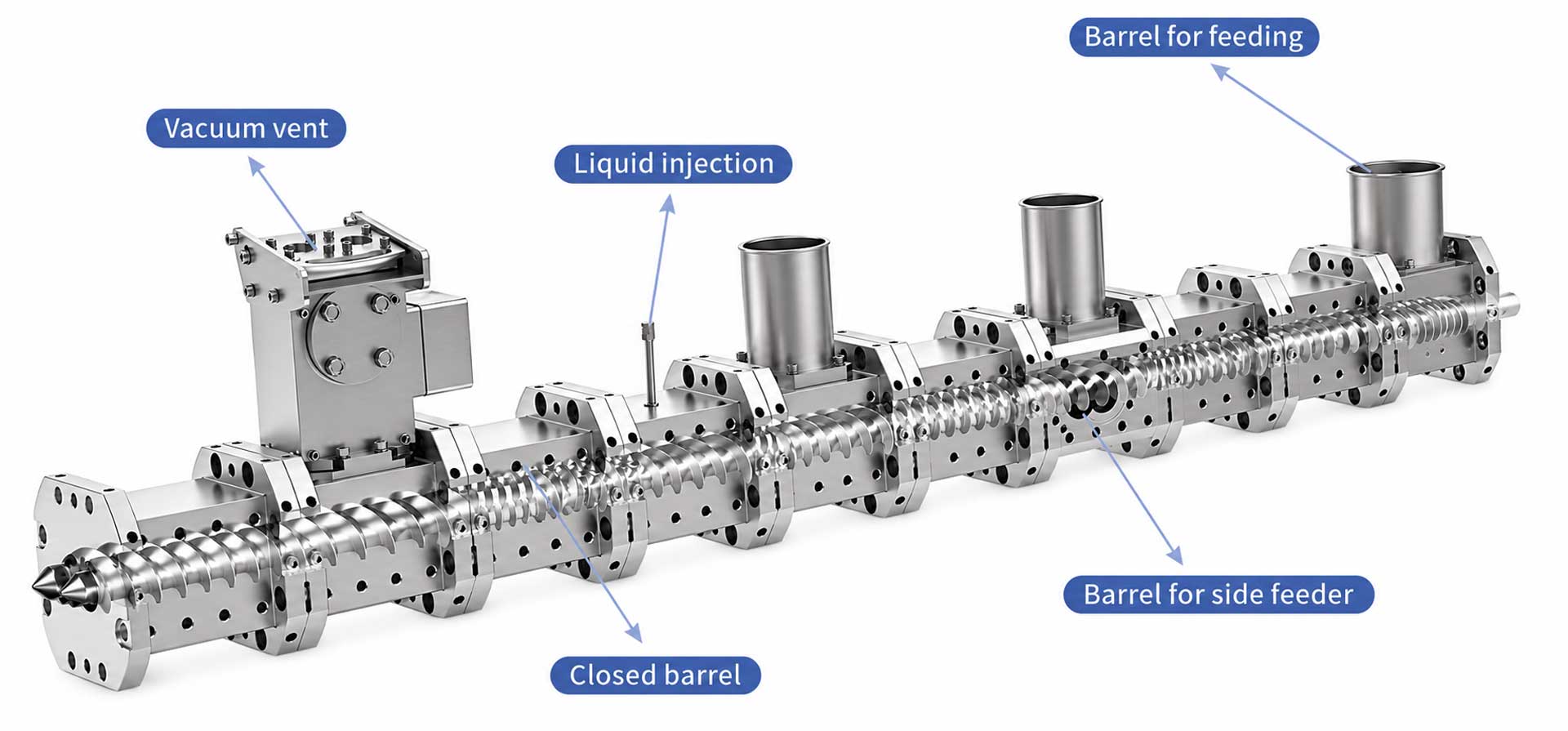
Choose the right extruder machine for plastic compounding by matching material type, filler loading, viscosity, output target, torque demand, screw design, feeding method, venting need, temperature control, downstream equipment, maintenance plan, and scale-up data.
Plastic compounding is the process of mixing a base polymer with additives, fillers, fibers, pigments, flame retardants, stabilizers, plasticizers, compatibilizers, or functional ingredients to create a material with specific performance.
The goal may be higher strength, better flexibility, improved flame resistance, better color, higher heat resistance, better conductivity, easier processing, lower cost, or better long-term stability.
Plastic compounding is not only melting plastic. It is a controlled material modification process. The machine must feed, melt, wet, mix, disperse, vent, pressurize, cool, and pelletize the material in a stable way.
A co-rotating Twin Screw Extruder is usually the preferred machine for plastic compounding because it provides stronger mixing, better process flexibility, staged feeding, vacuum venting, and more controllable residence time than a simple melting system.
Plastic compounding often involves more than one material form. A formulation may include pellets, powders, flakes, liquid additives, mineral fillers, glass fiber, carbon fiber, pigments, or flame retardants. These materials do not always feed or melt at the same rate.
A twin screw extruder can use modular screw elements and barrel openings to match the actual formula. This makes it suitable for plastic modification, PVC granulation, rubber and plastic recycling granulation, cable compounds, bio-plastic compounds, TPE/TPU, PEEK, thermosets, masterbatch, and other specialty compounds.
Internal link: Twin Screw Extruder
A single screw extruder may be enough when the material is already compounded and only needs melting, conveying, pressure building, and shaping.
It is commonly suitable for pipe, film, sheet, profile, coating, and simple remelting applications. If the input material is already a stable pellet and no additional filler dispersion, pigment mixing, side feeding, or vacuum devolatilization is needed, a single screw system can be simpler and more cost-effective.
However, for true compounding, a single screw extruder is often limited. It does not provide the same mixing flexibility, self-cleaning effect, staged feeding ability, or venting control as a twin screw extruder.
A practical rule is simple: single screw extrusion fits prepared materials; twin screw extrusion fits materials that still need to be built, modified, mixed, degassed, or stabilized.
The first selection step is to understand the material, not the machine catalog.
The supplier should know what polymer will be processed, how it flows, how much filler it contains, whether it is heat-sensitive, whether moisture is present, and what final pellet quality is required.
Useful material information includes:
| Material Information | Why It Matters |
|---|---|
| Base polymer | Decides melting range, viscosity, temperature profile, and screw design |
| Material form | Pellets, powder, flakes, regrind, liquid, or fiber feed differently |
| Filler or fiber loading | Affects torque, wear, mixing, and output |
| Moisture content | Affects drying, vacuum venting, bubbles, and degradation |
| Heat sensitivity | Decides shear level, residence time, and cooling demand |
| Viscosity | Affects torque, pressure, and output stability |
| Additive type | Decides feeding position and mixing intensity |
| Final product requirement | Decides dispersion, pellet quality, and inspection needs |
Without this information, the machine selection may become a guess. A good compounding extruder should be selected around the formula behavior.
Different polymers need different extrusion conditions.
PP and PE compounds may focus on output, filler wetting, masterbatch dispersion, and cost control. PA, PC, PET, PBT, PPS, and PEEK may require stronger drying, higher torque, tighter temperature control, and better devolatilization. TPE and TPU may require controlled shear, oil absorption, vacuum venting, and stable pellet shape. PVC and cable compounds may need careful temperature control and low degradation risk.
The machine should match the processing window of the polymer. If the polymer has high viscosity, the extruder needs enough torque. If the polymer is heat-sensitive, the extruder needs stronger cooling and shorter residence time control. If the polymer carries moisture or volatiles, the machine needs proper venting.
The wrong machine may still produce pellets, but it may not produce stable pellets over a long run.
Filler loading has a major effect on extruder selection. High filler content increases friction, torque, wear, feeding difficulty, and dispersion demand.
Common fillers and reinforcements include:
Calcium carbonate
Talc
Glass fiber
Carbon fiber
Carbon black
Flame retardant
Mineral powder
Wood powder
Starch
Bamboo powder
Conductive additives
Ceramic powder
A high-filler compound usually needs a twin screw extruder with enough torque reserve, stable side feeding, wear-resistant screw and barrel materials, good cooling, and suitable screw configuration.
If all filler is forced into the main feed section, the process may show bridging, poor feeding, high torque, poor wetting, and unstable output. Side feeding is often used after the polymer begins to soften so the filler can enter a better process zone.
The target output should be selected as a stable production range, not the highest number shown in a catalog.
Actual output depends on material bulk density, viscosity, filler loading, screw speed, torque limit, melting capacity, venting capacity, die design, cooling, and pelletizing capacity. A machine may reach high output with easy-flowing pellets but run much lower output with fiber-filled or mineral-filled compounds.
A good output decision should ask:
What is the normal target kg/h?
What is the maximum required kg/h?
How much torque reserve is needed?
Can the feeder deliver stable material at that rate?
Can the vent section handle moisture or volatiles?
Can the downstream pelletizer handle the output?
Can the cooling system remove enough heat?
Is future capacity expansion expected?
The right output is the output that stays stable with acceptable torque, pressure, temperature, venting, pellet quality, and maintenance frequency.
Screw diameter affects how much material the extruder can carry per screw revolution. Larger screw diameters usually provide more output potential, but they also need stronger drives, larger feeders, more downstream capacity, and more material during trial and cleaning.
A smaller extruder is better for lab trials, expensive materials, formulation screening, and small-batch development. A larger extruder is better for validated production formulas and long-running commercial output.
LEMIX PROMIX models cover 11 mm, 16 mm, 25.7 mm, 31.8 mm, 40.3 mm, and 50.3 mm screw diameters, with listed output ranges from lab-scale 0.2–2.5 kg/h to production-scale 100–350 kg/h.
Internal link: Twin Screw Extruder
Torque decides whether the machine can process resistant materials without overload. Plastic compounding often requires high torque because the extruder must melt polymer, wet fillers, disperse additives, move high-viscosity material, and build pressure before pelletizing.
High torque is especially important for:
Engineering plastics
PEEK and high-temperature polymers
Glass fiber compounds
Carbon fiber compounds
Mineral-filled compounds
Flame-retardant compounds
PVC cable compounds
Battery material compounds
High-viscosity TPE/TPU
Recycled materials with unstable feed behavior
A larger screw diameter without enough torque reserve can still fail. A smaller but better-torque-supported machine may process certain formulas more reliably.
LEMIX twin screw extruders use a high-power drive solution, high-torque gearbox design, and DIN 5480 involute splines to support high-output and high-load working conditions.
Screw configuration should be selected according to the material task.
A compounding screw is built from different elements. Conveying elements move material forward. Kneading elements increase dispersion. Mixing elements improve distribution. Reverse or restriction elements build pressure and residence time. Venting sections open space for moisture or volatile removal.
Different formulas need different screw logic:
| Compounding Task | Screw Configuration Focus |
|---|---|
| Color masterbatch | Strong pigment wetting and dispersion |
| Filler masterbatch | Stable filler feeding and distributive mixing |
| Glass fiber compound | Side feeding and controlled fiber length |
| Flame-retardant compound | Good additive distribution with limited degradation |
| TPE/TPU | Oil absorption, venting, and controlled temperature |
| PVC cable compound | Low degradation and stable temperature control |
| Engineering plastics | High torque, strong wetting, and vacuum venting |
| Bio-plastics | Moisture control and gentle processing |
| Thermoset premix | Low shear, short residence time, and rapid discharge |
The best screw is not always the most aggressive screw. Too much shear can raise temperature, break fibers, cause degradation, and increase torque. The right screw gives enough mixing without damaging the material.
The barrel system is important because it decides where materials can be fed, where gases can be removed, how temperature is controlled, and how the screw design is supported.
A modular barrel system is useful for plastic compounding because it allows openings or inserts for feeding, degassing, and venting. This helps match the barrel layout with the screw configuration.
For example, a high-filler compound may need side feeding in the middle section. A moisture-sensitive material may need vacuum venting after melting. A heat-sensitive material may need stronger cooling in high-shear zones. A formula with liquid additives may need a specific injection position.
LEMIX twin screw extruders use modular screw and barrel systems. The screw material and screw combination can be customized according to materials and formulas, while barrel openings can be arranged for feeding, degassing, and venting.
Temperature control should be evaluated by the material’s real process window, not only the number of heating zones.
In compounding, material temperature comes from both barrel heating and shear heat. A high-filler or high-viscosity compound can generate extra frictional heat. A heat-sensitive polymer may degrade if the process holds it too hot for too long. A low-temperature setting may also create high torque and poor dispersion if the resin cannot wet additives properly.
The right extruder should provide:
Independent zone temperature control
Fast heating response
Strong cooling capacity
Stable temperature feedback
Pressure and temperature sensors
Suitable cooling valve control
Enough cooling for high-output operation
LEMIX twin screw extruders include heating, cooling, pressure and temperature sensors, HMI control, and enhanced cooling design. The cooling system is especially important for wider processing windows in demanding formulas.
Vacuum venting is needed when the material contains moisture, trapped air, residual solvent, odor, low-molecular volatiles, or reaction by-products.
Weak venting can cause bubbles, voids, strand breakage, pressure movement, odor, pellet defects, and unstable product quality.
Venting is commonly important for:
Recycled plastics
Moisture-sensitive engineering plastics
Bio-plastic compounds
PVC and cable compounds
TPE/TPU
Pharmaceutical hot melt extrusion
Filled compounds with trapped air
Materials with residual solvent or low-molecular volatiles
The venting section must be matched with screw filling. If the vent zone is overfilled, material may flood the vent. If the material is not fully melted before the vent, devolatilization may be weak.
For pharmaceutical extrusion, LEMIX uses a dedicated large-pitch vacuum section and multistage high-vacuum system to remove moisture, residual solvents, and low-molecular impurities.
Internal link: Pharmaceutical Extrusion
Feeding systems should be selected by material form and formula accuracy.
Stable feeding is essential because the extruder cannot produce stable output if material enters unevenly. Pellets, powders, fibers, flakes, liquids, and additives all need different feeding methods.
Common feeding options include:
| Material Form | Feeding Concern |
|---|---|
| Pellets | Stable main feeding and drying |
| Powder | Bridging, flooding, segregation |
| Low-bulk-density filler | Side feeding and hopper design |
| Glass fiber | Bridging and fiber breakage |
| Liquid additive | Pulsation and injection position |
| Regrind or flakes | Uneven flow and moisture |
| API-polymer blend | Ratio accuracy and traceability |
For pharmaceutical extrusion, LEMIX emphasizes high-precision loss-in-weight feeding to reduce material stratification and segregation and support stable residence time and batch-to-batch consistency.
Internal link: GMP Twin Screw Extruder
Downstream equipment must match the extruder output and material behavior. A properly sized extruder can still fail to run well if cooling, strand handling, pelletizing, drying, conveying, or inspection is too weak.
Downstream equipment affects:
Strand stability
Pellet shape
Pellet size
Cooling speed
Surface moisture
Fines generation
Color defect visibility
Production continuity
Packaging quality
For pellet production, in-line inspection can help verify whether the compounding process is stable at the selected output.
LEMIX in-Line Plastic Pellet Inspection provides real-time and continuous pellet inspection and sorting for compounding lines, cable extruder lines, and high-throughput resin lines. It can help identify burnt material, gels, size and cutting defects, cross contamination, yellowing, and color deviation.
Internal link: in-Line Plastic Pellet Inspection
A lab type twin screw extruder should be chosen when the formula is still being developed, material cost is high, sample volume is limited, or scale-up data is needed before production investment.
LEMIX offers 11 mm and 16 mm lab type twin screw extruders for R&D and trial applications. These models are suitable for pharmaceutical trials and for rubber and plastics compounding research, development, and testing.
A lab extruder helps test:
Melting window
Screw configuration
Material drying
Filler feeding point
Screw speed and feed rate
Torque response
Vacuum venting
Pellet appearance
Color and dispersion
Cleaning difficulty
Scale-up direction
A lab trial cannot replace production validation, but it can reduce the risk of choosing the wrong production machine.
Internal link: Lab Type Twin Screw Extruder
A GMP twin screw extruder is needed when the extrusion process is used for pharmaceutical applications, medical material development, or any process requiring strict cleaning, traceability, validation, and data integrity.
Pharmaceutical hot melt extrusion is not the same as normal plastic compounding. It processes APIs, polymers, and excipients under controlled temperature and pressure. The process may affect drug dispersion, dissolution, impurity control, amorphous stability, and product uniformity.
LEMIX GMP Twin Screw Extruder supports hot melt extrusion, granulation, lipid extrusion, transdermal preparations, implantable preparations, and pharmaceutical 3D printing extrusion. Its control system supports data acquisition, status monitoring, audit trail, electronic signature, recipe management, batch record reporting, and traceable operation.
Internal link: GMP Twin Screw Extruder
Maintenance should be considered before the machine is purchased. Plastic compounding can be abrasive, sticky, heat-sensitive, or contamination-sensitive. The machine should be easy to clean, inspect, dismantle, and repair.
Maintenance-related selection points include:
Can screw elements be removed safely?
Are screw and barrel materials suitable for abrasion?
Can the barrel cooling channels be maintained?
Can the screw be cleaned without surface damage?
Are spare screw elements, barrels, shafts, and gearboxes available?
Can barrel wear be measured during preventive maintenance?
Is the machine suitable for frequent formula changes?
Can process records support troubleshooting?
LEMIX supports long-term extrusion reliability with screw cleaning machines, screw dismantling machines, barrel wear measurement devices, water cooling channel cleaning machines, and Spare Parts such as screw elements, barrels, shafts, and gearboxes.
Internal link: Extruder Maintenance Device
The most common mistake is choosing by output or price alone. A cheaper or larger machine may still be wrong if it cannot match the formula.
Avoid these selection mistakes:
Choosing output before checking torque
Ignoring filler loading
Ignoring material moisture
Choosing a screw diameter without checking feeding capacity
Using aggressive screw design for heat-sensitive compounds
Forgetting side feeding for fillers or fibers
Ignoring vacuum venting
Ignoring downstream pelletizing capacity
Ignoring cleaning and maintenance
Skipping lab trials for expensive or new materials
Treating pharmaceutical extrusion like normal plastic compounding
A reliable selection should reduce process risk, not only reduce equipment cost.
The best selection sequence starts from material behavior and ends with long-term operation.
A practical sequence is:
Define the base polymer and formula.
Confirm filler, fiber, pigment, and additive loading.
Check moisture, viscosity, heat sensitivity, and degradation risk.
Define target output and acceptable output reserve.
Choose screw diameter and torque level.
Decide L/D ratio and screw configuration.
Confirm main feeding, side feeding, liquid feeding, and venting.
Check temperature control and cooling capacity.
Match die, cooling, pelletizing, conveying, and inspection.
Review cleaning, wear, spare parts, and preventive maintenance.
Run lab or pilot trials when the formula is new or high value.
Record scale-up parameters for production.
This sequence is useful because it avoids a common trap: starting with a machine model before understanding the material problem.