
Search LEMIX Products
Learn how PVC and XLPE cable compounds are produced with twin screw extrusion, covering feeding, temperature, shear, venting, liquid injection, moisture control, pellet inspection, and LEMIX equipment support.
Category:Materials & Applications
Author:LEMIX Admin
Date:2026-08-08
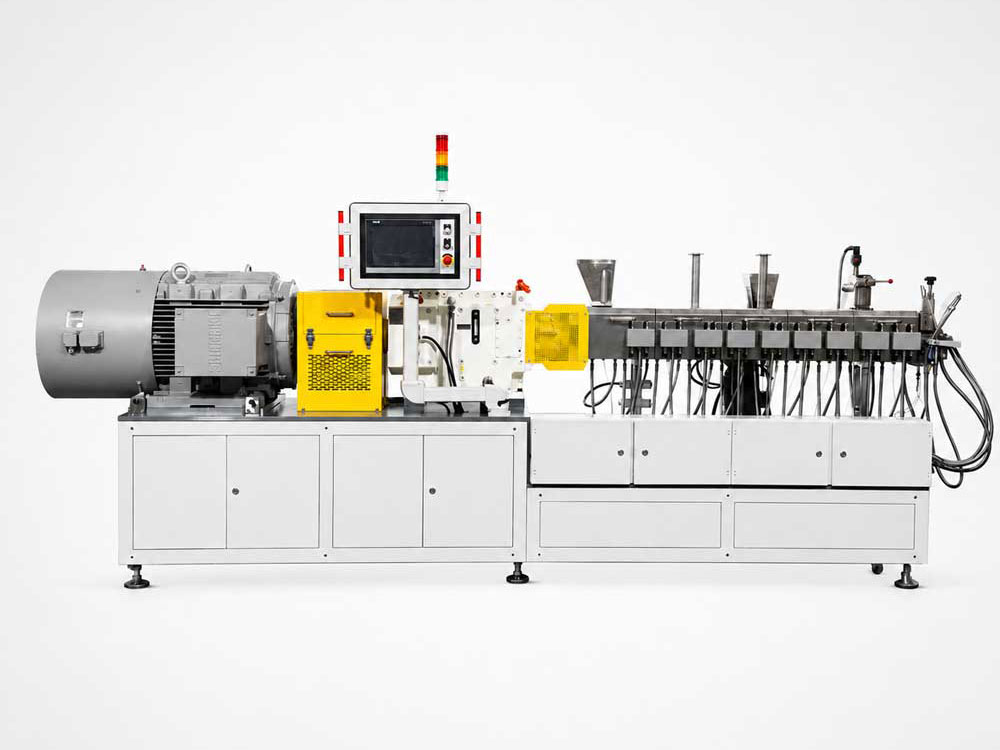
PVC and XLPE cable compounds are produced by feeding resin, plasticizers, stabilizers, fillers, silane systems, catalysts, and additives into a Twin Screw Extruder, then controlling mixing, temperature, shear, venting, moisture, pelletizing, inspection, and storage to protect insulation and sheathing performance.
Cable compounds are polymer materials used to produce insulation layers, sheathing layers, protective jackets, and functional layers for wires and cables. They are not simple plastic pellets. They are formulated materials designed for electrical, mechanical, thermal, aging, and processing performance.
Common cable compound types include:
PVC cable compounds
XLPE cable compounds
PE-based insulation compounds
Halogen-free flame-retardant cable compounds
Soft flexible sheathing compounds
Low-smoke cable compounds
Flame-retardant masterbatch systems
Color and functional cable material compounds
For twin screw extrusion, PVC and XLPE are two important cable compound groups because they need controlled mixing, temperature management, devolatilization, and stable pellet quality.
Internal links:
Twin screw extrusion is used because cable compounds need uniform ingredient distribution, controlled shear, stable temperature, accurate feeding, vacuum devolatilization, and repeatable pellet quality.
Cable materials often contain resin, plasticizer, stabilizer, lubricant, filler, pigment, flame retardant, silane, peroxide, catalyst, or other functional additives. These ingredients must be mixed evenly. If the compound is not uniform, cable extrusion may later show bubbles, rough surface, poor insulation performance, electrical breakdown risk, unstable hardness, or inconsistent aging behavior.
A co-rotating twin screw extruder is useful because it can combine several process steps:
| Process Need | Twin Screw Function |
|---|---|
| Powder and resin intake | Controlled feeding and conveying |
| Plasticizer absorption | Wetting and distributive mixing |
| Filler dispersion | Kneading and mixing elements |
| Temperature control | Segmented barrel heating and cooling |
| Moisture removal | Vacuum venting section |
| Liquid additive injection | Segmented barrel openings |
| Pellet quality | Stable discharge and downstream pelletizing |
| Formula flexibility | Modular screw and barrel design |
LEMIX twin screw extruders are used for cable compounds such as XLPE and PVC, and the equipment platform includes gearbox, barrel, side feeder, cooling system, heating system, pressure and temperature sensors, HMI, modular screw system, and modular barrel system.
Internal link: Twin Screw Extruder
PVC cable compounds are usually produced by mixing PVC resin with plasticizers, stabilizers, lubricants, fillers, pigments, and functional additives, then compounding and pelletizing them through a controlled extrusion process.
A typical PVC cable compound process includes:
Cold and hot mixing of PVC resin and additives.
Plasticizer absorption into the PVC dry blend.
Cooling of the premix before extrusion.
Starve feeding into a co-rotating twin screw extruder.
Low-temperature plasticization and distributive mixing.
Vacuum devolatilization to remove moisture and volatiles.
Transfer to discharge or second-stage pressure-building system.
Pelletizing and cooling.
Pellet inspection, drying, and packaging.
The key point is not maximum shear. PVC is heat-sensitive, so the process must promote full plasticization while preventing shear overheating, discoloration, charring, and decomposition.
The most important control point is melt temperature. PVC cable compounds need enough heat for plasticization, but too much heat can cause rapid degradation.
For PVC cable compounds, the practical processing logic is:
Use low-temperature overall processing.
Avoid excessive screw speed.
Control shear heat in the melting section.
Keep material residence time short and stable.
Use cooling water where frictional heat becomes high.
Maintain strong vacuum venting.
Prevent black specks, yellowing, and plasticizer volatilization.
LEMIX PVC cable compound guidance notes that the actual melt temperature should generally be controlled between 165°C and 180°C, and that PVC can decompose rapidly when melt temperature exceeds 185°C.
This is why PVC cable compound production should not be treated like normal high-output plastic compounding. A stable PVC line is built around thermal stability first, then output.
Vacuum venting removes moisture, trapped air, plasticizer volatiles, and small molecular substances from the compound. If vacuum venting is weak, the final cable extrusion process may show bubbles, rough surface, pinholes, poor density, or unstable insulation and sheathing quality.
For PVC cable compounds, the vacuum degree at the exhaust port should remain stable. If the vacuum is insufficient, tiny pores may remain inside the pellets. These pores can later create bubbles or rough surfaces during wire and cable extrusion.
A practical production rule is this: if the cable compound looks acceptable as pellets but creates bubbles during later cable coating, the venting and moisture record during compounding should be reviewed first.
XLPE cable compounds are usually produced from polyethylene-based materials such as LLDPE, LDPE, or HDPE, modified with silane systems or crosslinking-related additives. After cable extrusion and moisture exposure, the material forms a crosslinked network that improves heat resistance and insulation performance.
For silane cross-linkable cable compounds, two manufacturing routes are common:
| Route | Basic Logic |
|---|---|
| One-step method | Resin, silane, peroxide, catalyst, and additives are processed in one integrated route |
| Two-step method | Compound A and Compound B are produced separately, then used in the cable process |
LEMIX XLPE cable compound guidance focuses mainly on the two-step production process:
Compound A: silane-grafted PE base resin
Compound B: catalyst masterbatch
The twin screw extruder is used to support grafting reaction control, liquid injection, distributive mixing, temperature accuracy, and moisture prevention.
Internal link: XLPE Cable Compounds
The key challenge is controlling the silane grafting reaction while preventing premature crosslinking.
In XLPE cable compound production, silane molecules are grafted onto polymer chains under controlled temperature and residence time. If the process is too weak, grafting may be incomplete. If the process is too hot, wet, or poorly controlled, scorch, gel formation, pellet agglomeration, or premature self-crosslinking may occur.
XLPE compounding should control:
Silane-peroxide liquid injection position
Temperature profile
Residence time
Distributive mixing
Moisture exposure
Catalyst masterbatch quality
Pellet cooling and drying
Packaging moisture protection
A useful process view is that XLPE compounding is both a mixing process and a reaction-control process. This makes temperature, liquid injection, moisture control, and residence time more important than simple output.
Liquid injection is important because silane and peroxide systems must enter the polymer melt at the correct process position. If injected too early, too late, or unevenly, grafting stability and compound uniformity may suffer.
A segmented twin screw barrel allows liquid additives to be injected directly into molten polymer at optimized barrel sections. Once the liquid enters, the screw elements must distribute it quickly and evenly without excessive local heat.
The benefits include:
More uniform silane distribution
Better grafting stability
Lower scorch risk
Reduced material adhesion to the barrel wall
Better use of short processing sections
More consistent final cable insulation performance
For XLPE cable compounds, this is one of the clearest reasons to use a modular twin screw system rather than a simple melting extruder.
PVC and XLPE both need careful temperature control, but the reason is different.
PVC is mainly limited by thermal degradation and discoloration risk. Excessive melt temperature can cause rapid decomposition, charring, yellowing, black specks, odor, and poor cable material quality.
XLPE is mainly limited by reaction control and premature crosslinking risk. Excessive temperature, moisture, or residence time can create scorch, gels, pellet agglomeration, and unstable later cable extrusion.
| Compound Type | Main Temperature Risk | Process Goal |
|---|---|---|
| PVC cable compound | Degradation, discoloration, plasticizer volatilization | Full plasticization without overheating |
| XLPE cable compound | Scorch, premature crosslinking, unstable grafting | Controlled grafting without early self-crosslinking |
A practical field distinction is useful: PVC temperature control protects the resin from degradation; XLPE temperature control protects the reaction from happening at the wrong time.
Screw configuration controls how material is conveyed, plasticized, mixed, vented, compressed, and discharged. Cable compound production needs enough mixing, but not uncontrolled shear.
For PVC cable compounds, the screw should support low-shear plasticization, stable conveying, strong distribution, and vacuum devolatilization. Excessive kneading or high screw speed can create shear heat, leading to yellowing, black specks, or charring.
For XLPE cable compounds, the screw should support liquid injection, fast distributive mixing, residence time control, and moderate shear. Strong mixing is needed after liquid injection, but the process should avoid hot spots and long stagnation zones.
A suitable screw design should consider:
Resin type
Plasticizer level
Filler loading
Stabilizer system
Silane and peroxide addition
Catalyst masterbatch design
Vacuum venting need
Discharge pressure
Pelletizing method
Cleaning difficulty
LEMIX twin screw extruders use a modular screw system. Screw material and screw combination can be customized according to materials and formulas.
The barrel system supports feeding, liquid injection, degassing, venting, cooling, and process section arrangement.
Cable compounds often need different barrel openings for different operations. PVC may need feeding, venting, and cooling-focused sections. XLPE may need liquid injection at optimized positions and moisture-controlled discharge. A modular barrel layout helps match the screw configuration with the required process.
LEMIX modular barrel systems can be customized with openings or inserts according to technological requirements. These openings are used for feeding, degassing, and venting, so the barrel and screw can work together.
For cable compounds, barrel design should be considered early because later formula changes may require different side feeding, venting, or liquid injection positions.
Feed rate and screw speed should be balanced to control filling level, torque, shear heat, residence time, and output stability.
For PVC cable compounds, starve feeding is commonly used. Output is determined by the feeder, and screw speed must be matched with feed rate and torque. Excessive screw speed can create strong shear heat and cause PVC charring.
For soft PVC cable compounds, medium-low screw speed is usually preferred. LEMIX PVC guidance notes a typical 120–250 rpm range, adjusted according to screw diameter and output. It also recommends keeping the filling rate around 60%–75% and torque percentage stable around 65%–80%.
For XLPE cable compounds, screw speed and feed rate must also control residence time. Too short a residence time may reduce grafting quality. Too long a residence time may increase scorch or gel risk.
Torque shows how much mechanical resistance the material creates inside the extruder. In cable compounds, torque is affected by viscosity, filler loading, plasticizer absorption, temperature, screw speed, screw design, venting, and discharge pressure.
High torque may indicate:
Feed rate is too high
Melt temperature is too low
Filler loading is high
Screw design is too restrictive
Discharge path is blocked
PVC is not plasticized well
XLPE reaction is becoming unstable
Residue buildup is increasing load
Barrel cooling is uneven
Low torque may indicate underfilling, high material temperature, weak mixing, or poor feeding. The target is not the lowest torque. The target is stable torque inside the safe operating range.
LEMIX twin screw extruders use a high-torque gearbox design and DIN 5480 involute splines to support high-output and high-load working conditions.
After compounding, the melt is discharged and pelletized. The pelletizing method depends on material softness, temperature, stickiness, and downstream requirements.
PVC cable compounds may use underwater or water ring pelletizing to prevent soft pellets from sticking together. Cooling must be strong enough to stabilize pellet shape, but not so aggressive that water carryover becomes a quality problem.
XLPE cable compounds need careful pellet cooling, dewatering, air cooling, drying, and moisture-protected packaging. This is critical because moisture can trigger premature hydrolysis and self-crosslinking before the material is used in cable extrusion.
A good pelletizing stage should produce:
Uniform pellet size
Smooth surface
Low fines
No sticking
Low moisture
No bubbles
No black specks
No color deviation
Good flow for later cable extrusion
Moisture is a hidden risk in silane cross-linkable XLPE cable compounds. Moisture can trigger premature hydrolysis and self-crosslinking before the pellets are used.
This can cause:
Pellet agglomeration
Surface speckles
Strand breakage
Poor later cable extrusion
Finished product rejection
Shorter storage life
Unstable processing behavior
For XLPE cable compounds, moisture control should cover raw material storage, feeding, extrusion, pellet cooling, dewatering, drying, packaging, storage, and transportation.
A practical quality habit is to treat packaging as part of the process, not only the last warehouse step. Good extrusion can still fail if pellets absorb moisture before use.
PVC cable compound quality should be checked through both material tests and processing behavior.
Important indicators include:
| Indicator | Why It Matters |
|---|---|
| Shore A hardness | Affects cable softness and flexibility |
| Tensile strength | Shows mechanical durability |
| Elongation at break | Shows flexibility and stretch resistance |
| Volume resistivity | Important for insulation-grade materials |
| Thermal aging result | Shows retained properties after heat exposure |
| Brittleness temperature | Shows low-temperature flexibility |
| Pellet appearance | Reveals black specks, bubbles, or poor mixing |
| Processing stability | Shows whether later cable extrusion will run smoothly |
For insulation-grade PVC cable compounds, volume resistivity is a critical indicator. The LEMIX PVC page notes a typical requirement above 10¹²–10¹⁴ Ω·cm.
XLPE cable compound quality should be checked by both compound performance and later cable extrusion behavior.
Important indicators include:
Grafting stability
Crosslinking performance
Heat resistance
Voltage withstand performance
Insulation capacity
Pellet moisture level
Pellet cleanliness
Gel and scorch level
Catalyst masterbatch uniformity
Storage stability
Later cable extrusion surface quality
Electrical testing result
For XLPE-insulated cable, contamination can create serious electrical testing risk. LEMIX in-Line Plastic Pellet Inspection notes that one contaminated pellet can disqualify a complex and expensive product.
Internal link: in-Line Plastic Pellet Inspection
In-line pellet inspection helps detect defects that may not be caught by manual sampling. Cable compounds are often used in applications where small pellet defects can become large downstream losses.
LEMIX in-Line Plastic Pellet Inspection can be used on compounding lines, cable extruder lines, and high-throughput resin lines. It supports real-time continuous pellet inspection and sorting.
It can help identify:
Burnt material
Gels
Size and cutting defects
Cross contamination
Yellowing
Color deviation
Foreign particles
Defects linked to cutting or cooling
For cable compounds, this is especially valuable because later cable extrusion may amplify small pellet problems into surface defects, bubbles, electrical breakdown, or rejected cable batches.
Screw cleaning affects cable compound quality because PVC, XLPE, pigments, plasticizers, fillers, stabilizers, and degraded residues can remain on screws and extrusion components after production.
Poor cleaning can cause:
Black specks
Color contamination
Gel particles
Burnt material
Formula cross-contamination
Pressure fluctuation
Longer changeover time
Lower confidence in later cable extrusion
LEMIX PRO-COOL Screw Cleaning Machine is designed for non-destructive cleaning of extruder screws and extrusion components. It removes polymer residue and contaminants without flame burning, manual brushing, toxic smoke, or surface damage.
Internal link: PRO-COOL Screw Cleaning Machine
Barrel wear changes screw-to-barrel clearance. This can reduce conveying efficiency, mixing stability, pressure control, and residence time repeatability.
Cable compound production may involve fillers, pigments, stabilizers, flame retardants, and other additives that can increase wear. As wear develops, the same recipe and settings may no longer produce the same pellet quality.
Warning signs include:
Lower output at the same screw speed
More torque fluctuation
Poor dispersion
More black specks
Pressure movement
Uneven pellet quality
Longer purging time
More unstable hardness or color
A barrel wear measurement device can help maintenance teams confirm whether process drift is connected to inner bore wear instead of only changing process settings.
Internal link: Barrel Wear Measurement Device PROMAC-S