
Search LEMIX Products
Learn how screw speed, feed rate, and torque work together in twin screw extrusion, and how LEMIX equipment supports stable output, mixing, residence time, and process control.
Category:Process Control & Troubleshooting
Author:LEMIX Admin
Date:2026-08-03
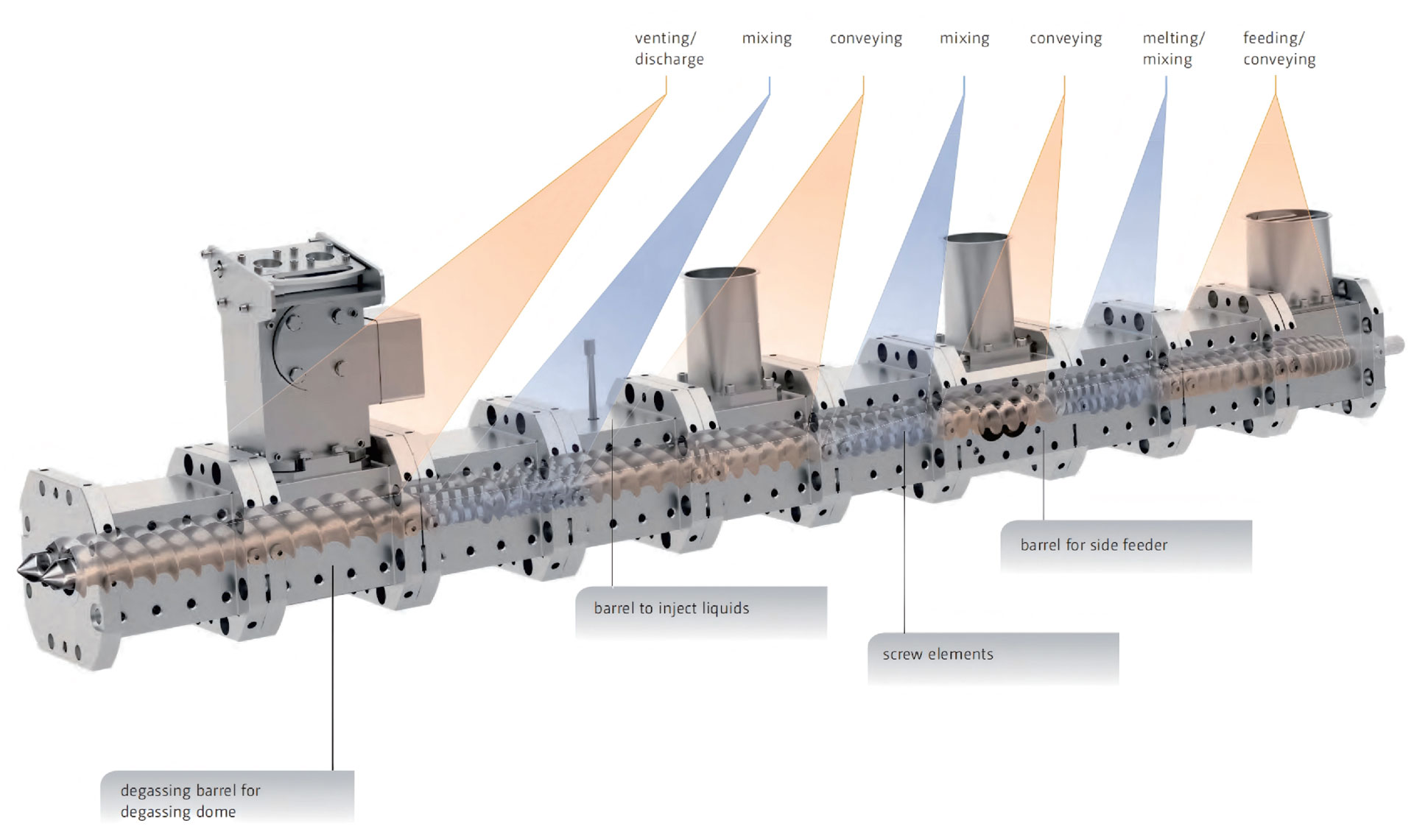
Screw speed, feed rate, and torque should be balanced as one control system. Screw speed sets shear and residence time. Feed rate sets barrel filling and output. Torque shows process resistance. Stable extrusion needs all three to move together without overload, underfilling, overheating, or pressure fluctuation.
Screw speed controls how fast the screws rotate inside the barrel. It affects conveying, shear input, mixing intensity, residence time, melt temperature, pressure building, and final output.
When screw speed increases, the material usually moves faster through the process section. Mixing energy also increases. This can improve dispersion for fillers, pigments, APIs, or additives. But higher screw speed can also create more frictional heat. It may reduce residence time and make venting less effective if the feed rate and screw design are not adjusted.
When screw speed is too low, the material may stay in the barrel too long. This can increase heat exposure, especially in heat-sensitive polymers and pharmaceutical hot melt extrusion. Low screw speed can also reduce distributive mixing if the screw is not sufficiently filled.
A useful production rule is simple: screw speed should not be judged by rpm alone. It should be judged by torque response, melt pressure, material temperature, product quality, and feed stability.
Feed rate controls how much material enters the extruder per unit time. It affects screw filling level, throughput, torque, pressure, residence time, and mixing quality.
If feed rate is too high, the screw may become overfilled. This can cause high torque, pressure rise, poor melting, material buildup at the feed throat, vent flooding, or unstable discharge. If feed rate is too low, the screws may run underfilled. This can reduce mixing efficiency, weaken pressure stability, and create a process that looks fast but does not produce stable quality.
Feed rate is especially important when processing powders, dry blends, low-bulk-density materials, pharmaceutical blends, high-filler compounds, TPE/TPU, PVC, or recycled materials. These materials may not feed like uniform pellets.
For pharmaceutical extrusion, LEMIX uses high-precision loss-in-weight feeding to help reduce material stratification and segregation. This supports stable residence time and stronger batch-to-batch consistency.
Internal link: Pharmaceutical Extrusion
Torque shows the mechanical load on the screw drive. It reflects how much resistance the material creates inside the barrel.
High torque may mean the material is too viscous, the temperature is too low, the feed rate is too high, the screw is overfilled, the screen or die is restricted, or the screw design is too aggressive. Low torque may mean the barrel is underfilled, the temperature is too high, the feed rate is too low, or the screw is not doing enough useful mixing.
Torque is not only a safety number. It is one of the clearest process health signals. A stable torque trend often means the feeding, melting, mixing, and discharge sections are working in a repeatable way. A moving torque trend usually means something upstream or inside the process has changed.
In field troubleshooting, the torque value itself is not always the key point. The more useful clue is when torque changes and what changes at the same time.
These three parameters work together through barrel filling and energy input.
Screw speed changes how quickly the material is moved and sheared. Feed rate changes how full the screw channels are. Torque shows how difficult that filled screw channel is to turn.
When feed rate increases at the same screw speed, the screw filling level usually rises. Torque may rise because more material is being moved. Output may rise if the machine still has enough torque, melting capacity, venting capacity, and discharge capacity.
When screw speed increases at the same feed rate, residence time may become shorter. Torque may fall if the barrel becomes less filled, or it may rise if shear heat and material resistance increase. The result depends on the material, screw design, temperature profile, and downstream restriction.
The practical control point is not only screw speed or feed rate. It is their relationship. A stable line usually has a stable material feed per screw revolution, stable torque, stable melt pressure, and stable product quality.
Feed rate per screw revolution is a useful way to judge whether the extruder is underfilled, properly filled, or overloaded. It shows how much material each screw revolution must carry.
If the feed rate is increased but screw speed stays low, each revolution must carry more material. The line may show higher torque, higher pressure, stronger melting load, and more risk of overload. If screw speed is increased but feed rate stays low, each revolution carries less material. The screws may run underfilled, and mixing may become weaker.
This ratio is useful because two lines can run at the same screw speed but have very different process behavior. A 400 rpm setting with low feed rate can be gentle and underfilled. A 400 rpm setting with high feed rate can be heavily loaded and close to torque limit.
A practical process review should always compare:
| Parameter Relationship | What It Often Shows |
|---|---|
| Higher feed rate with same screw speed | Higher filling, higher torque, higher output risk |
| Higher screw speed with same feed rate | Shorter residence time, lower filling, possible weaker mixing |
| Higher screw speed and higher feed rate together | More output if torque, melting, venting, and cooling allow it |
| Stable feed per revolution | More repeatable residence time and process behavior |
| Sudden change in torque at same ratio | Material, temperature, wear, or blockage may have changed |
High screw speed with low feed rate can make the barrel underfilled. The machine may look active, but the material may not receive consistent mixing because the screw channels are not filled enough.
Possible signs include:
Low torque
Lower-than-expected output
Poor distributive mixing
Inconsistent residence time
Poor pressure building
More air entrainment
Unstable pellet shape
Weak process repeatability
This condition can happen during lab trials, low-dose pharmaceutical development, expensive material trials, or cautious start-up. It is not always wrong. It may be useful when material is limited. But the data should not be treated like full production behavior unless the filling level is understood.
LEMIX Lab Type Twin Screw Extruder is suitable for R&D and trial applications, but trial data should still be interpreted through screw speed, feed rate, torque, and residence time together.
Internal link: Lab Type Twin Screw Extruder
High feed rate with low screw speed can overload the screw channel. The material may not have enough conveying, melting, or venting capacity for the amount being pushed into the barrel.
Common signs include:
High torque
Torque warning or trip
Feed throat buildup
Poor melting
Pressure rise
Vent flooding
Strand fluctuation
Overheating from friction
Poor dispersion
Die instability
This condition is common when a factory tries to raise output only by increasing feed rate. Output may increase for a short time, but process stability can become worse if the screw speed, temperature profile, vacuum section, and downstream equipment cannot match the higher load.
A stable high-output process needs enough torque capacity, screw volume, cooling capacity, and pressure control. LEMIX twin screw extruders use high-power drive solutions, modular screw systems, modular barrel systems, and enhanced cooling designs to support higher-load processing.
Internal link: Twin Screw Extruder
Torque should be used as a trend signal, not only as a limit alarm. The best practice is to record torque before and after each process change.
When feed rate is raised, torque should rise in a controlled way. When screw speed is adjusted, torque should settle into a new stable range. When temperature is raised, torque often drops because melt viscosity becomes lower. When material moisture, filler loading, or viscosity changes, torque may move even when the settings stay the same.
A practical torque review can follow this logic:
| Torque Trend | Likely Meaning | First Check |
|---|---|---|
| Slowly rising torque | Screen blockage, material buildup, cooling drift, viscosity rise | Pressure, temperature, screen, material batch |
| Fast torque spike | Overfeeding, unmelted material, blockage, wrong screw condition | Feed system, die, screw rotation, safety limit |
| Torque moving up and down | Feeding fluctuation or material flow instability | Main feeder, side feeder, powder flow |
| Low torque with poor mixing | Underfilled barrel or excessive temperature | Feed rate, screw speed, filling level |
| High torque with poor output | Overload, poor melting, die restriction, wear issue | Temperature, pressure, barrel condition |
A useful field habit is to compare torque with time. If torque changes before pressure changes, the cause may be feeding or melting. If pressure changes before torque changes, the cause may be die, screen, or downstream restriction.
Temperature changes material viscosity. Viscosity changes torque. This means temperature can make the same screw speed and feed rate behave differently.
If the barrel temperature is too low, the material may resist movement. Torque rises. Pressure may also rise. Poor melting may create rough extrudates, gels, or strand breakage. If temperature is too high, torque may drop, but product quality may suffer through degradation, yellowing, odor, weak melt strength, or poor dispersion.
In twin screw extrusion, real material temperature is not only the barrel setpoint. It also comes from shear heat. Higher screw speed, high filler loading, tight screw elements, and poor cooling can raise the actual melt temperature.
For pharmaceutical HME, this is critical. LEMIX pharmaceutical extrusion guidance focuses on low-temperature and low-shear processing, independently controlled multi-zone temperature regulation, and ±1°C temperature control accuracy to protect heat-sensitive APIs and limit impurity formation.
Internal link: GMP Twin Screw Extruder
Screw configuration changes how speed and feed rate become torque, shear, pressure, and mixing. The same rpm and kg/h can behave very differently with another screw layout.
Conveying elements move material forward with lower shear. Kneading elements increase mixing and shear. Reverse elements increase residence time and pressure. Venting sections help remove moisture and volatiles. Side-feeding sections allow fillers, fibers, liquids, or sensitive ingredients to enter after the polymer has softened.
A screw with strong kneading may show higher torque at the same feed rate. A screw with more conveying capacity may reduce torque but may also reduce dispersion. A screw with poor vent-zone design may flood under higher feed rate. A screw with too much restriction near the discharge may raise pressure and torque.
The best screw configuration should fit the material, not only the target output. For high-filler compounds, the screw must balance torque and filler wetting. For TPE/TPU, it must balance oil absorption and temperature control. For pharmaceutical HME, it must balance uniform mixing and API protection.
Residence time is affected by screw speed, feed rate, screw filling, screw design, and material viscosity. It is the time that material stays inside the extruder.
Higher screw speed usually shortens residence time. Higher feed rate can also shorten residence time in some filled systems because material pushes through the barrel faster. But if feed rate overloads the screw, residence time distribution may become wider and less predictable.
Residence time matters because material quality depends on time under heat and shear. Too short a residence time can cause poor melting, poor mixing, weak devolatilization, or unstable discharge. Too long a residence time can cause degradation, color change, impurity growth, or premature curing in reactive systems.
For pharmaceutical hot melt extrusion, residence time affects API stability, content uniformity, amorphous dispersion, impurity control, and dissolution behavior. This is why screw speed and feed rate must be developed together, not separately.
In pharmaceutical hot melt extrusion, screw speed, feed rate, and torque directly affect critical process goals: thermal stability, uniform mixing, amorphous stability, and impurity control.
The material system may include API, polymer carrier, plasticizer, and excipients. If feed rate is unstable, API content uniformity can be affected. If screw speed is too high, shear heat may increase degradation risk. If torque is too high, the formulation may be too viscous or the process may be overloaded. If torque is too low, the barrel may be underfilled and mixing may be weak.
A GMP process should not rely on final sample testing alone. It should use process trend data. LEMIX pharmaceutical extrusion systems support data acquisition, status monitoring, audit trail, electronic signature, recipe management, and batch record reporting. These functions help connect screw speed, feed rate, torque, pressure, temperature, and product quality in one traceable process record.
Internal link: Pharmaceutical Extrusion
Output should be adjusted step by step. The safest method is to increase feed rate and screw speed together while watching torque, pressure, temperature, vacuum, strand appearance, and pellet quality.
A practical output adjustment sequence:
Confirm material drying and feeder stability.
Record the current screw speed, feed rate, torque, and pressure.
Increase feed rate slightly.
Watch torque response.
Adjust screw speed only if filling, melting, or pressure needs correction.
Check whether vacuum venting remains stable.
Check die flow, strand shape, and pellet quality.
Wait for the line to stabilize before another change.
Record the final stable ratio between screw speed and feed rate.
Random adjustment creates confusion. A controlled adjustment shows whether the process is limited by feeding, torque, melting, cooling, venting, die pressure, or downstream cutting.
A stable balance does not mean torque never changes. It means torque, pressure, temperature, and output stay within a predictable process window.
Stable balance usually shows:
Steady feeder trend
Stable screw speed
Torque in a safe and repeatable range
No sudden torque spikes
Stable melt pressure
No vent flooding
Smooth strand or discharge
Consistent pellet size
No new bubbles, gels, black specks, or color drift
Similar results when the same recipe is repeated
For high-value materials, product inspection should also be used. LEMIX in-Line Plastic Pellet Inspection can help detect burnt material, gels, size and cutting defects, cross contamination, yellowing, and color deviation during pellet production.
Internal link: in-Line Plastic Pellet Inspection
| Process Symptom | Likely Parameter Issue | What to Check First |
|---|---|---|
| High torque | Feed rate too high, temperature too low, viscosity too high | Feed rate, temperature, material batch |
| Low torque and poor mixing | Barrel underfilled or screw speed too high for feed | Feed rate per screw revolution |
| Pressure fluctuation | Poor melting, unstable feeding, die restriction | Torque trend, feeder trend, screen, die |
| Vent flooding | Overfilled vent zone or weak screw design | Feed rate, screw speed, vent-zone filling |
| Bubbles | Moisture, poor venting, too short residence time | Drying, vacuum level, screw speed |
| Black specks | Residue, dead zones, overheating | Screw cleaning, temperature, screw design |
| Strand breakage | Poor melt strength or unstable discharge | Temperature, pressure, cooling, feed stability |
| Output drops over time | Wear, cooling drift, screen buildup | Barrel wear, cooling channels, screen pack |
| Product variation between batches | Feed or material variation | Material lot, feeder trend, residence time |
This table should be used with trend timing. If the defect appears after a feed change, the feeder is the first suspect. If it appears after long running time, cooling drift, screen buildup, or wear may be more likely.
Yes. Screw and barrel wear can change torque behavior. A worn barrel changes clearance. A worn screw changes conveying and mixing efficiency. The line may need more screw speed to achieve the same output, or torque may become less predictable.
Wear can also create dead zones where material moves slowly. In heat-sensitive, filled, or pharmaceutical processes, this can lead to degradation, black specks, pressure movement, and inconsistent product quality.
When the same formula and same settings no longer produce the same torque and output, component condition should be checked. LEMIX PROMAC-S Barrel Wear Measurement Device uses 360° rotating laser inspection to measure barrel wear, diameter changes, and inner surface condition.
Internal link: Barrel Wear Measurement Device PROMAC-S
Yes. Residue buildup can make the relationship between screw speed, feed rate, and torque unstable. Old polymer, carbonized material, pigments, gels, and deposits can create hidden resistance inside the screw channel or die area.
The line may show higher torque, pressure waves, black specks, color contamination, or sudden quality drift. The operator may try to change screw speed or temperature, but the true cause may be old material left inside the system.
LEMIX PRO-COOL Screw Cleaning Machine uses non-destructive high-pressure water cleaning for screws and extrusion components. It helps remove residue without flame burning, manual brushing, toxic smoke, or surface damage.
Internal link: PRO-COOL Screw Cleaning Machine
Process data should be recorded in a way that shows parameter relationships, not isolated numbers.
Useful records include:
Material name and batch
Moisture or drying condition
Screw configuration
Screw speed
Feed rate
Feed rate per screw revolution
Torque trend
Melt pressure trend
Barrel temperature trend
Vacuum level
Die condition
Cooling condition
Pellet or product defects
Time of each adjustment
Operator notes
Cleaning history
Barrel wear history
The most useful troubleshooting note is often a time-based one: what changed first, what followed, and what defect appeared last. This type of record makes future adjustment faster and reduces random trial-and-error.
LEMIX supports parameter balance through extrusion equipment, GMP systems, lab machines, inspection systems, and maintenance devices.
| Process Need | LEMIX Product Support |
|---|---|
| High-load processing and output stability | Twin Screw Extruder |
| Lab trials and parameter development | Lab Type Twin Screw Extruder |
| Pharmaceutical HME and GMP data control | GMP Twin Screw Extruder |
| Pellet quality feedback | in-Line Plastic Pellet Inspection |
| Barrel condition and wear checking | PROMAC-S Barrel Wear Measurement Device |
| Screw and component cleaning | PRO-COOL Screw Cleaning Machine |
| Cooling channel stability | PRO-CLEAN Water Cooling Channel Cleaning Machine |
| Long-term Spare Parts support | Screw elements, barrels, shafts, gearboxes |
Screw speed, feed rate, and torque work together through filling level, residence time, shear input, and material resistance. Screw speed changes movement and energy input. Feed rate changes how full the screws are. Torque shows whether the process is running within a safe and stable load range.
A stable twin screw extrusion process should not chase the highest screw speed or highest feed rate. It should keep the right feed per screw revolution, stable torque, stable pressure, controlled material temperature, effective venting, and consistent product quality.
LEMIX twin screw extrusion systems, GMP extrusion equipment, lab machines, pellet inspection systems, barrel wear measurement devices, screw cleaning machines, and cooling channel maintenance tools help factories control these relationships from development to long-term production.