
Search LEMIX Products
Learn how screw configuration affects pharmaceutical hot melt extrusion, including mixing, shear, residence time, vacuum degassing, API dispersion, scale-up, and process stability.
Category:Pharmaceutical Extrusion Technology
Author:LEMIX Admin
Date:2026-08-12
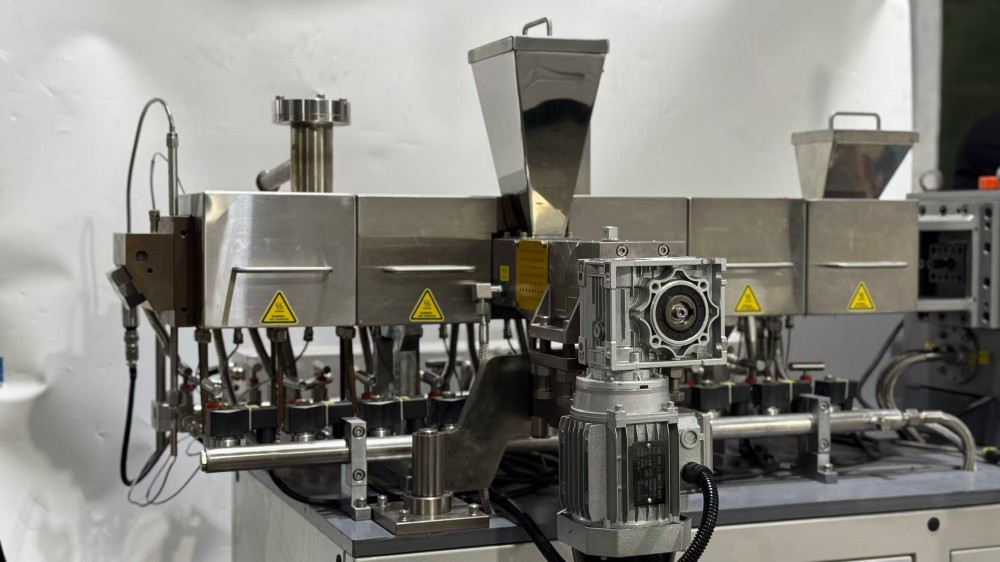
Screw configuration affects pharmaceutical hot melt extrusion by controlling melting, mixing, shear, residence time, vacuum degassing, temperature exposure, and API-polymer uniformity. A suitable screw design helps achieve stable processing and consistent drug performance.
Screw configuration is one of the most important factors in pharmaceutical hot melt extrusion because it determines how materials move, melt, mix, and leave the extruder.
In pharmaceutical HME, the extruder usually processes a combination of active pharmaceutical ingredients, polymers, plasticizers, stabilizers, and other excipients. These materials often require precise control because excessive heat, shear, or residence time can affect API stability.
A Twin Screw Extruder uses different screw elements arranged in sections. Each section has a specific function:
| Screw Section | Main Function |
|---|---|
| Feeding section | Introduces polymer, API, and excipients into the barrel |
| Conveying section | Transfers material forward with controlled filling |
| Melting section | Creates a uniform polymer melt |
| Mixing section | Distributes API and excipients evenly |
| Kneading section | Provides controlled dispersive and distributive mixing |
| Vacuum section | Removes moisture and volatile components |
| Pressure-building section | Stabilizes melt pressure before discharge |
A pharmaceutical screw configuration is not designed for maximum mixing intensity. It is designed to achieve sufficient mixing while protecting sensitive ingredients from unnecessary thermal and mechanical stress.
Pharmaceutical hot melt extrusion has stricter requirements than general polymer compounding because the final product quality depends on API distribution, solid-state properties, and dissolution behavior.
A poor screw configuration may cause:
Incomplete API dispersion
Excessive API degradation
Poor amorphous solid dispersion
High torque fluctuation
Unstable residence time
Incomplete melting
Excessive shear heat
Residual solvent problems
Poor batch consistency
A suitable screw configuration helps control:
Material transport
Polymer melting
API-polymer interaction
Mixing intensity
Residence time
Temperature history
Vacuum efficiency
Final extrudate quality
For pharmaceutical applications, the best screw design is the one that creates stable and repeatable processing conditions.
Conveying elements control material movement through the extruder. They are usually used in feeding zones, transport zones, and sections where stable material flow is required.
In pharmaceutical HME, conveying elements help maintain:
Stable feeding
Controlled barrel filling
Predictable residence time
Smooth material transfer
Reduced material backflow
However, excessive conveying length without enough mixing elements may reduce dispersion efficiency. The API and polymer may pass through the barrel without enough interaction.
The position of conveying elements should match the material behavior. Powders, polymers, and heat-sensitive pharmaceutical formulations may require different conveying designs.
Kneading elements provide intensive mixing by creating controlled deformation and shear inside the melt.
They are important for:
API dispersion
Polymer homogenization
Additive distribution
Breaking small agglomerates
Improving melt uniformity
However, pharmaceutical materials are often sensitive to mechanical energy. Excessive kneading intensity may increase:
Melt temperature
Torque
API degradation risk
Residence time variation
Polymer degradation
The angle, length, number, and position of kneading blocks should be selected according to formulation requirements.
A pharmaceutical screw configuration should balance mixing efficiency and product protection.
API-polymer mixing is one of the main purposes of pharmaceutical hot melt extrusion.
A suitable screw configuration helps achieve:
Uniform API distribution
Stable amorphous dispersion
Consistent drug release behavior
Reduced concentration variation
Better batch repeatability
Poor mixing may occur when:
The polymer is not fully melted before API addition
Mixing zones are too short
Shear energy is insufficient
Feed rate is too high
Residence time is too short
Screw filling is unstable
The screw design should create the correct sequence:
Polymer feeding
Polymer melting
API introduction or premixed feeding
Controlled mixing
Devolatilization if required
Stable discharge
Changing the order of these process zones can significantly affect final product quality.
Residence time determines how long pharmaceutical materials stay inside the extruder under heat and shear.
A longer residence time may improve mixing, but it can also increase the risk of:
API degradation
Polymer degradation
Impurity formation
Unwanted chemical reactions
A shorter residence time may protect sensitive materials but may result in:
Poor melting
Incomplete mixing
Unstable product quality
Screw configuration affects residence time through:
Conveying efficiency
Kneading intensity
Reverse elements
Screw filling level
Screw speed
Barrel volume
Material viscosity
During scale-up, residence time should be compared between lab, pilot, and production machines because the same screw speed does not always create the same material history.
Reverse elements create resistance to material flow. They increase filling level and mixing intensity by slowing material movement.
They can improve:
Melt homogenization
API dispersion
Mixing efficiency
Residence time control
However, excessive reverse conveying can create:
Higher torque
Higher melt temperature
Longer residence time
Material degradation risk
Pressure instability
In pharmaceutical HME, reverse elements are normally used carefully because the process requires controlled mixing rather than maximum restriction.
Vacuum degassing removes moisture, residual solvents, trapped air, and volatile compounds from the melt.
The screw configuration around the vacuum zone is important because the material needs sufficient surface exposure for effective gas removal.
A suitable vacuum section requires:
Proper fill level
Stable melt surface
Correct screw element arrangement
Controlled material pressure
Enough space for vapor release
Poor screw design near the vacuum port may cause:
Vent flooding
Poor solvent removal
Bubble formation
Residual moisture
Unstable extrusion pressure
LEMIX pharmaceutical extrusion solutions use dedicated vacuum sections and high-vacuum systems to support moisture and volatile removal during pharmaceutical processing.
Internal link: Pharmaceutical Extrusion
Shear energy generated by screw elements directly affects melt temperature.
Higher shear can improve mixing, but excessive shear may create unwanted heat.
The relationship can be summarized:
| Screw Condition | Possible Result |
|---|---|
| Low shear | Poor mixing and incomplete dispersion |
| Balanced shear | Uniform mixing and stable processing |
| Excessive shear | High temperature and degradation risk |
For pharmaceutical HME, screw configuration should provide enough energy to form a uniform dispersion while avoiding unnecessary thermal exposure.
Temperature should always be evaluated together with:
Torque
Screw speed
Residence time
Material viscosity
API stability
Polymer properties
Different formulations require different screw designs because materials have different melting behavior, viscosity, thermal stability, and mixing requirements.
Examples:
| Formulation Type | Screw Configuration Focus |
|---|---|
| Heat-sensitive API | Lower shear, shorter residence time |
| High-viscosity polymer | Stronger melting and conveying ability |
| High drug loading formulation | Better distributive mixing |
| Moisture-sensitive formulation | Effective vacuum section |
| Amorphous solid dispersion | Stable melting and controlled cooling |
| Difficult polymer system | Longer mixing section |
There is no universal screw configuration for all pharmaceutical HME applications. The design should be based on formulation testing and process data.
Screw configuration is a key factor when transferring pharmaceutical HME from laboratory machines to production systems.
During scale-up, the goal is not simply copying the same screw elements. The goal is maintaining similar process behavior.
Important scale-up comparisons include:
Filling level
Mixing intensity
Residence time
Specific mechanical energy
Torque trend
Melt temperature
Vacuum performance
API distribution
Final product quality
LEMIX provides lab-scale, pilot-scale, and production twin screw extrusion systems to support pharmaceutical process development and scale-up.
Internal links:
The screw configuration directly influences final pharmaceutical product properties.
A suitable design helps improve:
Drug content uniformity
Amorphous stability
Dissolution performance
Batch consistency
Processing repeatability
Poor screw design may lead to:
API concentration variation
Crystallization risk
Thermal degradation
Unstable dissolution
Batch rejection
For pharmaceutical manufacturers, screw configuration is not only an equipment selection decision. It is part of the formulation development strategy.
Common twin screw elements used in pharmaceutical HME include:
| Element Type | Function |
|---|---|
| Conveying elements | Material transport |
| Kneading blocks | Mixing and dispersion |
| Transition elements | Flow and pressure adjustment |
| Special elements | Specific process requirements |
| Degassing elements | Vacuum-assisted volatile removal |
| Side feeder elements | Controlled additive feeding |
LEMIX provides modular screw element solutions for twin screw extrusion systems. Modular design allows process engineers to adjust mixing, conveying, and degassing performance according to different formulations.
Internal link:
Screw configuration should always be evaluated together with process parameters.
Important monitoring points include:
Screw speed
Feed rate
Torque
Melt pressure
Barrel temperature
Melt temperature
Vacuum level
Residence time
Extrudate appearance
API distribution
Dissolution behavior
A screw design that works in one formulation may not perform the same way when material viscosity, API loading, polymer grade, or production scale changes.
Continuous monitoring helps identify whether problems come from screw design, material variation, or operating conditions.
Screw condition affects pharmaceutical extrusion stability because worn or contaminated components can change mixing behavior and introduce defects.
Common maintenance concerns include:
Screw surface wear
Barrel wear
Material residue
Dead zones
Damaged screw elements
Contamination after material changeover
These issues may cause:
Poor dispersion
Black specks
Batch inconsistency
Pressure fluctuation
Longer cleaning time
LEMIX provides extrusion maintenance solutions including screw cleaning machines and barrel wear measurement devices to support stable long-term operation.
Relevant pages:
PRO-COOL Screw Cleaning Machine
Barrel Wear Measurement Device PROMAC-S
LEMIX supports pharmaceutical hot melt extrusion with lab-scale, pilot-scale, and GMP twin screw extrusion systems designed for formulation development, scale-up, and commercial production.
The solutions include:
Lab twin screw extruders
GMP twin screw extruders
Modular screw elements
Vacuum degassing systems
Temperature control systems
Process monitoring
Screw cleaning equipment
Barrel wear measurement
Spare Parts support
These systems support pharmaceutical HME requirements including thermal stability, uniform mixing, amorphous stability, impurity control, PAT monitoring, and GMP process verification.
Internal links:
Screw configuration affects pharmaceutical hot melt extrusion by controlling material melting, mixing, shear, residence time, vacuum degassing, and product consistency.
A suitable screw design does not simply maximize mixing intensity. It creates the right balance between dispersion efficiency and protection of sensitive pharmaceutical ingredients.
By selecting appropriate conveying elements, kneading sections, vacuum zones, and pressure-building sections, pharmaceutical manufacturers can improve API-polymer uniformity, process stability, and production repeatability.