
Search LEMIX Products
Learn what causes unstable twin screw extrusion output, from feeding and material variation to temperature, venting, wear, residue, downstream cutting, and LEMIX equipment support for reliable process control long-term production.
Category:Process Control & Troubleshooting
Author:LEMIX Admin
Date:2026-08-02
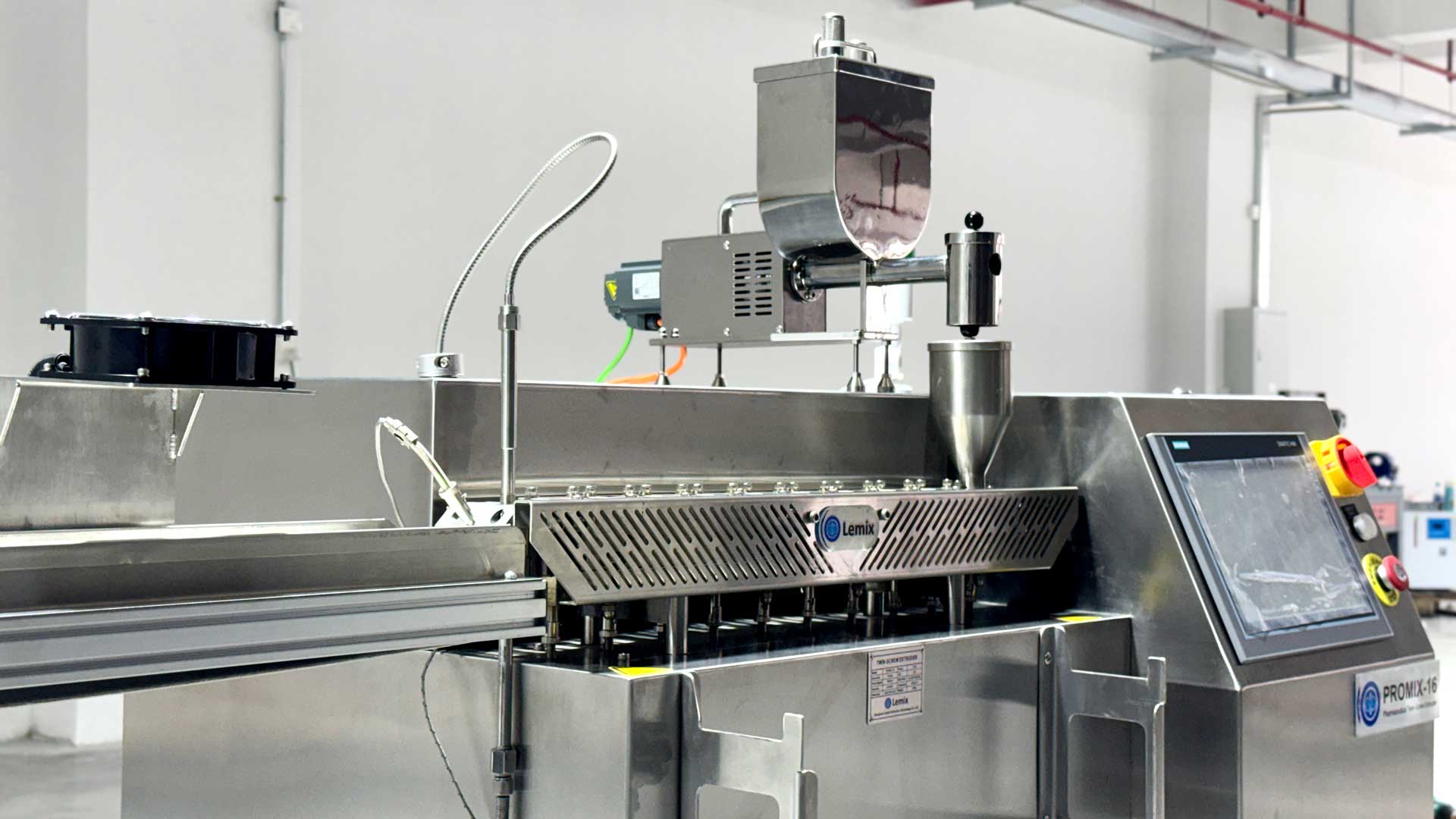
Unstable output in twin screw extrusion is usually caused by feeding fluctuation, material variation, poor melting, screw wear, barrel wear, blocked cooling channels, weak venting, residue buildup, or unstable downstream cutting. The fastest way to find the cause is to compare feeder trend, torque, melt pressure, temperature, and product defects on one timeline.
Unstable output means the extrusion line cannot hold a consistent throughput, melt flow, pressure, torque, or product quality under the same target settings. The problem may appear as a moving kg/h value, pressure waves, torque fluctuation, strand breakage, pellet size variation, color drift, bubbles, black specks, or irregular discharge from the die.
A useful production view is this: output instability is rarely one isolated problem. It is usually a signal chain. A small feeding change can create a torque change. A torque change can create melt temperature change. Melt temperature change can create pressure movement. Pressure movement can create pellet or product variation.
This is why the machine screen alone does not always show the real cause. The first question should be where the fluctuation starts, not which number looks bad at the end.
Feeding fluctuation is one of the most common causes. A Twin Screw Extruder can only deliver stable output when material enters the screws at a stable rate and with stable bulk behavior.
Feeding problems may come from powder bridging, poor flowability, low bulk density, inconsistent pellets, wet flakes, fiber feeding fluctuation, side feeder overload, liquid feeding pulsation, or material segregation in the hopper. In pharmaceutical hot melt extrusion, feed stability is even more important because the API, polymer, and excipients must remain uniform during continuous operation.
A high-precision feeding system helps reduce material stratification and segregation. In LEMIX pharmaceutical extrusion guidance, high-precision loss-in-weight feeding is used to support extended operation, uniform residence time, and batch-to-batch consistency.
Internal link: Pharmaceutical Extrusion
Material variation can change flow behavior even when the extruder settings remain the same. Resin lot, moisture, particle size, filler loading, additive level, lubricant level, viscosity, thermal stability, and powder density can all affect output.
In real production troubleshooting, one practical sign is timing. If the line becomes unstable soon after a new material batch, new bag, new powder blend, or new side-feeder material enters the process, material variation should be checked before changing the screw configuration.
Common material-related causes include:
| Material Change | Effect on Output |
|---|---|
| Higher moisture | Bubbles, venting load, strand breakage |
| Lower bulk density | Reduced feeding rate and poor screw filling |
| Higher viscosity | Higher torque and pressure fluctuation |
| More filler | More friction, wear, and feeding resistance |
| Poor powder flow | Hopper bridging and cyclic feeding |
| Different additive balance | Changed melt behavior and die pressure |
| Material segregation | Content variation and unstable discharge |
For pharmaceutical HME, material matching with the hot-processing window is the foundation. Poor matching can affect thermal stability, mixing, amorphous stability, and impurity control.
Screw speed affects conveying rate, shear input, residence time, mechanical heat, mixing, and pressure building. If the screw speed is too high for the formula, the material may not have enough time for melting, venting, or pressure stabilization. If the speed is too low, residence time may become too long and output may drop.
Screw speed should not be adjusted alone. It should be checked together with feed rate, torque, melt pressure, barrel temperature, and final product quality.
A practical rule is to observe the response after a small change:
If screw speed rises and output does not rise, feeding may be limiting the line.
If screw speed rises and torque becomes unstable, the process may be over-sheared or under-filled.
If screw speed rises and melt pressure swings, melting, venting, or die flow may be unstable.
If screw speed rises and product defects increase, the material may be receiving too much shear or heat.
LEMIX twin screw extruders use high-torque gearbox design, modular screw systems, and modular barrel systems. These features allow the screw configuration, feeding, venting, and process sections to be matched to different materials and formulas.
Internal link: Twin Screw Extruder
Screw configuration controls how material is conveyed, melted, mixed, vented, compressed, and discharged. If the screw design does not match the material, output can fluctuate even when the motor, feeder, and temperature settings look normal.
A screw with too little conveying capacity may not fill consistently. A screw with too much kneading may create frictional heat and torque peaks. A screw with weak melting sections may send partially melted material to the die. A screw with poor vent design may allow bubbles or vapor to disturb melt flow.
Common screw-related causes include:
| Screw Design Issue | Output Problem |
|---|---|
| Weak conveying section | Poor filling and output drop |
| Excessive kneading | High torque and overheating |
| Poor melting length | Unmelted particles and pressure waves |
| Wrong side-feeding position | Filler surge and unstable load |
| Poor vacuum section design | Bubbles and strand breakage |
| Dead zones | Degradation, black specks, contamination |
| Excessive reverse elements | Pressure buildup and torque fluctuation |
A modular screw system is useful because screw elements can be adjusted for material behavior. LEMIX screw configurations can be customized by material and formula, using conveying, kneading, intermeshing, and mixing elements for different process needs.
Temperature control affects melt viscosity, torque, pressure, mixing, and degradation risk. A small temperature drift can change the real flow rate through the die.
Output instability may appear when one zone is too cold, too hot, slow to respond, or unevenly cooled. The control panel may show a stable setpoint, but the material temperature can still move because of shear heat, barrel wear, filler friction, blocked cooling channels, or poor heat transfer.
High temperature can cause low viscosity, weak melt strength, degradation, yellowing, odor, or die drool. Low temperature can cause high torque, poor melting, pressure waves, rough strands, or incomplete dispersion.
For pharmaceutical extrusion, temperature is more critical because APIs and excipients may be heat-sensitive. LEMIX pharmaceutical extrusion systems use independently controlled multi-zone temperature regulation with ±1°C temperature control accuracy to support low-temperature and low-shear processing.
Blocked or scaled cooling channels can reduce heat exchange efficiency inside the barrel. This can make the process drift during long production runs.
The machine may still show normal barrel setpoints, but the real response becomes slower. This is common when the process changes from start-up stability to long-run fluctuation. The line may run well for the first period, then torque, pressure, or product quality begins to move.
Cooling channel problems can cause:
Barrel temperature drift
Slow correction after heat rise
Local overheating
Viscosity change
Torque movement
Pressure fluctuation
Degradation or yellowing
Batch-to-batch variation
LEMIX PRO-CLEAN Water Cooling Channel Cleaning Machine is designed to inspect and clean cooling water channels without dismantling the full barrel. It can check water channel volume, flow rate, and leakage, helping maintain accurate barrel temperature control.
Internal link: PRO-CLEAN Water Cooling Channel Cleaning Machine
Vacuum venting removes moisture, air, residual solvents, odor, and low-molecular volatiles from the melt. Weak venting can create bubbles, internal voids, strand breakage, unstable pellet shape, and pressure movement.
In pharmaceutical extrusion, vacuum devolatilization is part of impurity and product quality control. LEMIX pharmaceutical extrusion guidance describes a dedicated large-pitch vacuum section and multistage high-vacuum system for removing moisture, residual solvents, and low-molecular-weight impurities.
Venting problems should be checked when output instability appears together with:
Bubbles in the strand
Foam-like discharge
Popping at the die
Internal voids
Odor increase
Moisture-related defects
Vacuum level fluctuation
Melt flooding at the vent port
The root cause may not be the vacuum pump alone. It may be material moisture, wrong screw filling near the vent, excessive feed rate, poor melting, or local temperature setting.
Yes. Screw and barrel wear can change conveying efficiency, pressure building, residence time, mixing quality, and discharge stability.
As the barrel bore wears, screw-to-barrel clearance changes. The screw may no longer move material forward with the same efficiency. The line may need higher screw speed to maintain the same output. Torque may move. Pressure may become less stable. Product quality may begin to drift.
Wear should be considered when the same machine, same formula, and same settings no longer give the same output as before.
Warning signs include:
Lower output at the same screw speed
More pressure fluctuation
Reduced mixing quality
More black specks
Unstable pellet size
Higher material temperature drift
More frequent cleaning difficulty
Repeated quality complaints
LEMIX PROMAC-S Barrel Wear Measurement Device uses inside laser equipment and 360° rotating laser inspection to measure barrel wear, diameter changes, and inner surface condition. It helps locate maximum wear areas and supports preventive maintenance decisions.
Internal link: Barrel Wear Measurement Device PROMAC-S
Residue buildup can create hidden instability. Old polymer, carbonized material, pigment, filler, gel, or partially degraded residue may remain on screw roots, kneading blocks, die plates, breaker plates, vent blocks, nozzles, or mandrels.
As production continues, these deposits can break loose or disturb melt flow. The result may be black specks, pressure movement, color contamination, local overheating, and unstable discharge.
In high-value production, residue is not only a cleaning issue. It becomes a process stability issue. This is especially important for pharmaceutical extrusion, engineering plastics, cable compounds, powder coating, and material-change operations.
LEMIX PRO-COOL Screw Cleaning Machine uses non-destructive high-pressure water cleaning to remove polymer residue and contaminants from screws and extrusion components without flame burning, manual brushing, toxic smoke, or surface damage.
Internal link: PRO-COOL Screw Cleaning Machine
Sometimes the extruder is stable, but the downstream line makes the output look unstable. Cooling water, strand bath temperature, air knife, pelletizer speed, cutter blade condition, die holes, and conveying system can all affect final product appearance.
If melt pressure and torque are stable but pellet size is unstable, the downstream system should be checked. If strands break after leaving the die, the problem may be cooling, strand support, die temperature, melt strength, or cutter setup.
Common downstream causes include:
| Downstream Issue | Visible Result |
|---|---|
| Uneven die flow | Different strand thickness |
| Poor cooling | Sticky pellets or strand deformation |
| Cutter blade wear | Long tails or irregular pellet size |
| Wrong cutter speed | Fines or oversize pellets |
| Water carryover | Pellet surface defects |
| Blocked die holes | Pressure rise and strand loss |
For pellet production, in-line inspection can help separate true output fluctuation from downstream quality fluctuation.
Pellet inspection helps identify instability that may not be obvious from machine data alone. A process can hold target output while still producing defective pellets.
LEMIX in-line plastic pellet inspection provides real-time continuous pellet inspection and sorting for compounding lines, cable extruder lines, and high-throughput resin lines. It can detect defects such as burnt material, gels, size and cutting problems, cross contamination, yellowing, and color deviation.
This is useful because defect timing can point to the cause. For example:
Burnt material may point to dead zones or residue.
Gels may point to poor melting or degradation.
Size defects may point to cutting or pressure instability.
Yellowing may point to temperature drift.
Color deviation may point to feeding or dispersion issues.
Cross contamination may point to poor cleaning.
Internal link: in-Line Plastic Pellet Inspection
The best troubleshooting sequence is to find where the first unstable signal appears. This is more useful than adjusting many settings at once.
A practical sequence can follow this order:
Check whether feeder output is stable.
Check whether material batch, moisture, or bulk density changed.
Compare torque trend with feed trend.
Compare melt pressure trend with torque trend.
Check whether temperature drift follows screw speed or cooling delay.
Inspect vacuum level and vent behavior.
Check die, screen, and downstream cutting.
Review pellet defects by time.
Check screw residue and cleaning condition.
Measure barrel wear if the same problem repeats.
Review screw configuration if the formula or output target changed.
Record the final stable setting and defect cause.
The unique value of this sequence is time alignment. The cause is often found by matching when the defect appears with what changed just before it.
In pharmaceutical extrusion, unstable output is more than a production problem. It can affect content uniformity, residence time, impurity profile, dissolution behavior, amorphous stability, and GMP documentation.
For hot melt extrusion, the key process goals are thermal stability, uniform mixing, amorphous stability, and impurity control. The controllable parameters include raw material processing window, segmented temperature control, screw shearing, vacuum devolatilization, rapid quenching, PAT online monitoring, and GMP verification.
When output fluctuates in pharmaceutical HME, the process should check:
API and polymer feed stability
Powder segregation risk
Barrel temperature trend
Screw speed and torque
Residence time distribution
Vacuum devolatilization
Melt pressure
Cooling or quenching
PAT data
Batch record and recipe consistency
LEMIX GMP Twin Screw Extruder supports continuous extrusion, feeding, melting, venting, discharging, data acquisition, status monitoring, audit trail, electronic signature, recipe management, and batch record reporting.
Internal link: GMP Twin Screw Extruder
A good record makes troubleshooting faster. The record should not only include the final defect. It should include the trend before the defect.
Useful data includes:
Material batch number
Moisture or drying condition
Feeder trend
Side feeder trend
Liquid feeder trend
Screw speed
Torque trend
Melt pressure trend
Barrel setpoint and actual temperature
Cooling water condition
Vacuum level
Die temperature
Screen or filter change time
Pelletizer speed
Pellet defect type
Defect time
Cleaning history
Barrel wear history
Screw configuration
This type of record gives the production team a repeatable troubleshooting method. It also helps avoid random changes that make the real cause harder to find.
LEMIX supports output stability through extrusion equipment, inspection systems, and maintenance devices.
The suitable products include:
| Stability Issue | LEMIX Product Support |
|---|---|
| Feeding, mixing, venting, pressure control | Twin Screw Extruder |
| Pharmaceutical continuous production | GMP Twin Screw Extruder |
| Pellet defect monitoring | in-Line Plastic Pellet Inspection |
| Barrel wear and clearance change | PROMAC-S Barrel Wear Measurement Device |
| Cooling channel blockage | PRO-CLEAN Water Cooling Channel Cleaning Machine |
| Screw and component residue | PRO-COOL Screw Cleaning Machine |
| R&D process confirmation | Lab Type Twin Screw Extruder |
| Screw, barrel, shaft, gearbox condition | Spare Parts and technical support |
Relevant pages:
Unstable output in twin screw extrusion is usually caused by a chain of process and equipment factors. The most common causes include unstable feeding, material variation, poor melting, unsuitable screw configuration, temperature drift, weak vacuum venting, screw or barrel wear, blocked cooling channels, residue buildup, die restriction, and downstream cutting problems.
The best troubleshooting method is to compare feeder trend, torque, pressure, temperature, vacuum, defect timing, and product quality in one timeline. This helps identify the first unstable signal instead of only reacting to the final defect.
LEMIX supports stable twin screw extrusion through high-torque extruders, GMP extrusion systems, pellet inspection, barrel wear measurement, cooling channel maintenance, non-destructive screw cleaning, and extrusion spare parts. These solutions help production teams reduce random adjustment, improve process repeatability, and keep output more stable during long-term operation.