
Search LEMIX Products
Learn what L/D ratio means in twin screw extrusion, how it affects mixing, shear, residence time, venting, output, scale-up, and how LEMIX uses 40:1 configurations for temperature control and process design.
Category:Maintenance & Quality Control
Author:LEMIX Admin
Date:2026-08-03
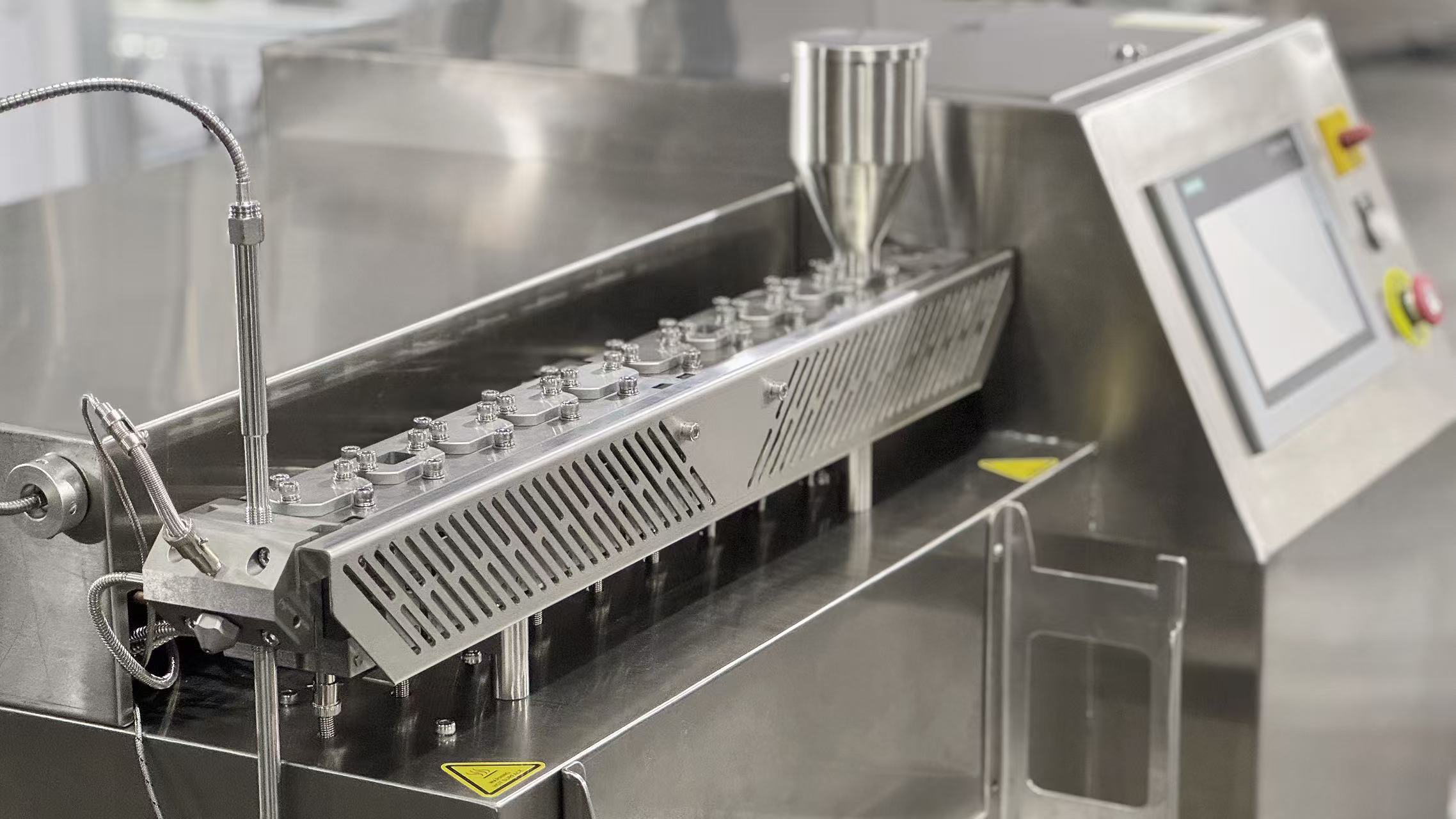
In twin screw extrusion, L/D ratio means screw working length divided by screw diameter. A 40:1 L/D means the process section is 40 times longer than the screw diameter. It affects feeding, melting, mixing, venting, residence time, shear, temperature control, and scale-up.
L/D ratio means length-to-diameter ratio. In twin screw extrusion, it describes the relationship between the effective screw processing length and the screw diameter.
The formula is simple:
L/D Ratio = Effective Screw Length / Screw Diameter
For example, if a Twin Screw Extruder has an 11 mm screw diameter and a 440 mm effective screw length, the L/D ratio is about 40:1. This means the screw processing length is 40 times the screw diameter.
L/D ratio does not describe machine size alone. It describes how much process length is available for feeding, melting, mixing, side feeding, venting, pressure building, and discharge.
L/D ratio is important because twin screw extrusion is a continuous process. Material must complete several processing steps while moving through the barrel.
A suitable L/D ratio gives enough process length for:
Stable feeding
Polymer melting or softening
Additive wetting
Filler and fiber distribution
API-polymer mixing
Vacuum devolatilization
Pressure stabilization
Die discharge
Residence time control
Scale-up consistency
A short process section may not give enough time or space for mixing, venting, or pressure building. A long process section may increase residence time, shear exposure, temperature history, and cleaning difficulty if the material is sensitive.
The practical value of L/D ratio is not “longer is always better.” The value is whether the screw length matches the material and process task.
A 40:1 L/D ratio means the screw processing length is 40 times the screw diameter. It is commonly used in twin screw compounding because it provides enough length for multiple process sections.
In practical extrusion, a 40:1 layout can support:
| Process Section | Typical Function |
|---|---|
| Main feeding | Introduces resin, powder, polymer blend, or premix |
| Conveying | Moves material forward and controls filling level |
| Melting | Softens or melts polymer under heat and shear |
| Mixing | Distributes additives, fillers, pigments, APIs, or excipients |
| Side feeding | Adds fillers, fibers, or sensitive materials after melting |
| Vacuum venting | Removes moisture, air, residual solvent, or volatiles |
| Pressure building | Stabilizes melt flow before discharge |
| Discharge | Sends material to die, cooling, pelletizing, or downstream forming |
LEMIX PROMIX series models, including PROMIX-11, PROMIX-16, PROMIX-26S, PROMIX-32S, PROMIX-40S, and PROMIX-50S, use a 40:1 L/D design across the listed model range.
Internal link: Twin Screw Extruder
No. A higher L/D ratio is not always better. It gives more process length, but it can also increase heat exposure, residence time, friction, cleaning time, and equipment cost.
A longer L/D may help when the process needs:
More mixing zones
More devolatilization
More side feeding
Higher filler wetting
More residence time
More pressure stabilization
More process flexibility
But a longer L/D may create risk when the material is:
Heat-sensitive
Shear-sensitive
Reactive
Easy to degrade
Easy to crosslink
Difficult to clean
High value and low batch volume
Sensitive to residence time distribution
A useful field rule is this: choose the L/D ratio for the process window, not for appearance. A longer screw that creates degradation, dead zones, or unnecessary residence time is not a better screw.
L/D ratio affects feeding because it decides how much downstream length remains after the feeding section. The feed section must introduce material smoothly before melting and mixing begin.
For pellets, feeding may be simple. For powders, flakes, fibers, low-bulk-density fillers, APIs, excipients, or recycled materials, feeding can become the first stability problem.
A suitable L/D ratio should leave enough room after feeding for material to become stable before strong mixing begins. If mixing starts too early, powder can surge, fillers can bridge, and torque can fluctuate.
Feeding-related process signs include:
| Sign | Possible Meaning |
|---|---|
| Feed throat buildup | Poor feeding, overfilling, or weak conveying |
| Torque fluctuation | Feeding pulses or material bridging |
| Output drift | Feeder instability or bulk density change |
| Vent flooding later | Too much material entering the process |
| Poor mixing | Underfilled screw or unstable feed rate |
For pharmaceutical hot melt extrusion, stable feeding is especially important because API, polymer, and excipient ratios must remain controlled during continuous processing.
L/D ratio affects melting by deciding how much length is available for the material to soften or melt before it reaches mixing, side feeding, venting, or discharge sections.
If the melting section is too short, the process may show:
Unmelted particles
High torque
Pressure fluctuation
Poor additive wetting
Filler agglomerates
Weak dispersion
Strand instability
Pellet defects
If the melting section is too long or too aggressive, the process may show:
Excessive material temperature
Yellowing
Degradation
Black specks
API impurity increase
PVC decomposition
Thermoset premature curing
Unnecessary energy consumption
In twin screw extrusion, melting is not controlled by L/D alone. Screw configuration, barrel temperature, screw speed, feed rate, torque, and material viscosity all work together. L/D only provides the available process length.
L/D ratio affects mixing because a longer process section can provide more space for distributive and dispersive mixing.
Distributive mixing spreads ingredients evenly through the material. It is important for color, additives, APIs, plasticizers, stabilizers, and excipients.
Dispersive mixing breaks agglomerates, particles, droplets, or clusters into smaller structures. It is important for pigments, fillers, APIs, flame retardants, and high-performance compounds.
However, mixing quality is not decided only by L/D. A 40:1 extruder with a weak screw configuration may mix poorly. A shorter extruder with a well-designed screw may perform better for a simple formula.
The correct question is:
Does the L/D ratio provide enough length for the right screw elements in the right positions?
For this reason, screw configuration and L/D ratio must be selected together.
Internal link: Screw Elements for TSE
L/D ratio affects shear indirectly. A longer screw gives more opportunity for shear, but actual shear is created mainly by screw speed, screw element type, fill level, material viscosity, and screw configuration.
A longer L/D may allow more kneading blocks or mixing zones. This can improve dispersion, but it can also increase:
Mechanical energy input
Frictional heat
Torque
Material temperature
Fiber breakage
API degradation risk
Polymer degradation
Screw and barrel wear
For heat-sensitive materials, a long L/D must be used carefully. The process should place shear where it is needed and avoid unnecessary high-shear sections.
A practical rule is: use L/D to create process space, then use screw design to control shear intensity.
Residence time means how long material stays inside the extruder. L/D ratio affects residence time because a longer process section can hold material for a longer period.
Longer residence time may improve:
Melting
Mixing
Filler wetting
API-polymer contact
Devolatilization
Pressure stabilization
But longer residence time may also increase:
Thermal degradation
Yellowing
Black specks
API impurity formation
Crystallization risk
Premature curing
Crosslinking risk
Material retention
Cleaning difficulty
For pharmaceutical HME, residence time must be stable and repeatable. For thermoset processing, residence time should be narrow and short enough to avoid premature curing. For PVC, excessive residence time can increase degradation risk. For engineering plastics, residence time must support melting without overheating.
The key is not only average residence time. The process also needs a narrow residence time distribution, with minimal dead zones and no long-retained material.
L/D ratio affects vacuum venting because venting needs process length before and after the vacuum zone.
Before venting, the material must be melted or softened enough to release moisture, air, residual solvent, or volatiles. At the venting section, the screw must create enough open surface area without flooding the vent. After venting, the screw must rebuild pressure before discharge.
A suitable L/D ratio makes it easier to include:
Melting before venting
Large-pitch venting section
Vacuum port location
Material surface renewal
Pressure rebuilding after venting
Stable discharge after devolatilization
Weak venting can cause bubbles, voids, strand breakage, residual solvent problems, odor, pellet defects, or unstable pressure.
In pharmaceutical extrusion, LEMIX emphasizes a dedicated large-pitch vacuum section and multistage high-vacuum system to remove moisture, residual solvents, and low-molecular impurities.
Internal link: Pharmaceutical Extrusion
L/D ratio affects temperature control because longer residence length means more time under barrel heating, cooling, and shear-generated heat.
A longer L/D may help staged temperature control because different barrel zones can be adjusted for feeding, melting, mixing, venting, and discharge. But a longer process length can also expose sensitive materials to heat for longer.
Temperature risk depends on material type:
| Material Type | Temperature Risk |
|---|---|
| Pharmaceutical APIs | Degradation, impurity formation, stability loss |
| PVC cable compounds | Decomposition, yellowing, black specks |
| Thermosets | Premature curing and gel formation |
| TPE/TPU | Degradation, bubbles, oil bleeding |
| PEEK and engineering plastics | High-temperature load and wear |
| XLPE cable compounds | Scorch and premature crosslinking |
| Bio-plastics | Moisture and thermal sensitivity |
L/D should support enough temperature zones for control, but the screw design should avoid unnecessary heat history.
L/D ratio does not directly determine output. Output is mainly affected by screw diameter, screw speed, torque, feed rate, material viscosity, feeding stability, venting capacity, die resistance, cooling, and downstream equipment.
However, L/D affects whether that output can remain stable.
A higher output may need enough length for:
Complete melting
Stronger mixing
Better filler wetting
Devolatilization
Pressure stabilization
Cooling or temperature correction
Downstream pellet quality
If output is pushed higher than the process length can support, defects may appear:
Poor melting
Bubbles
High torque
Pressure fluctuation
Vent flooding
Poor dispersion
Irregular pellet size
More black specks
Unstable product quality
A high-output extruder should not only have a large screw diameter. It should also have enough L/D and screw configuration space to complete the process.
L/D ratio affects scale-up because lab, pilot, and production machines must preserve the key process actions that control product quality.
In scale-up, the goal is not simply to make the machine larger. The goal is to keep comparable process behavior.
Important scale-up factors include:
Screw diameter
L/D ratio
Screw configuration
Screw speed
Feed rate
Fill level
Shear rate
Specific mechanical energy
Residence time
Melt temperature
Vacuum devolatilization
Cooling rate
Product quality
LEMIX pharmaceutical extrusion guidance notes that small-volume research machines, pilot-scale systems, and commercial production lines can transfer core process parameters such as shear rate, fill level, and specific mechanical energy across equipment scales.
Internal links:
LEMIX PROMIX twin screw extruders listed on the product specification table use a 40:1 L/D ratio across the PROMIX-11 to PROMIX-50S range.
| Model | Screw Diameter | Barrel Length | L/D | Listed Output Range |
|---|---|---|---|---|
| PROMIX-11 | 11 mm | 460 mm | 40:1 | 0.2–2.5 kg/h |
| PROMIX-16 | 16 mm | 670 mm | 40:1 | 0.5–20 kg/h |
| PROMIX-26S | 25.7 mm | 1000 mm | 40:1 | 50–200 kg/h |
| PROMIX-32S | 31.8 mm | 1260 mm | 40:1 | 60–250 kg/h |
| PROMIX-40S | 40.3 mm | 1620 mm | 40:1 | 80–300 kg/h |
| PROMIX-50S | 50.3 mm | 1980 mm | 40:1 | 100–350 kg/h |
This 40:1 design gives process space for feeding, melting, mixing, venting, and discharge across lab, pilot, and commercial production equipment.
Internal link: LEMIX Products
Lab, pilot, and production extruders may use similar L/D ratios to help preserve process logic during scale-up.
When the L/D structure remains comparable, it becomes easier to transfer:
Feeding sequence
Screw configuration logic
Melting section design
Mixing section length
Venting section position
Residence time trend
Shear distribution
Pressure-building strategy
Cooling and discharge logic
This does not mean scale-up is automatic. A production line has larger screw volume, different heat transfer behavior, higher material throughput, and stronger downstream requirements. But a consistent L/D framework helps reduce scale-up discontinuity.
For R&D teams, this is useful because lab test results can guide pilot and commercial process design more reliably.
Pharmaceutical hot melt extrusion usually needs an L/D ratio that supports accurate feeding, controlled melting, API-polymer mixing, vacuum devolatilization, stable residence time, and GMP process monitoring.
The key requirement is not the longest screw. The key requirement is a screw length that can create uniform API-polymer dispersion while controlling degradation risk.
A suitable pharmaceutical HME process should support:
Low-temperature and low-shear processing
Segmented temperature control
High mixing accuracy
Short and stable residence time
Vacuum devolatilization
Rapid cooling or quenching
PAT online monitoring
GMP traceability
Scale-up repeatability
LEMIX Pharmaceutical Extrusion guidance defines four major HME goals: thermal stability, uniform mixing, amorphous stability, and impurity control. L/D ratio should support these goals without creating unnecessary residence time or shear history.
Internal link: Pharmaceutical Extrusion
L/D ratio affects pharmaceutical product quality through residence time, mixing opportunity, temperature history, and devolatilization capacity.
If L/D is too short for the formulation, the process may show:
Incomplete API-polymer mixing
Poor content uniformity
Weak amorphous dispersion
Poor devolatilization
Bubbles or voids
Unstable discharge
Poor downstream cutting or shaping
If L/D is too long or too aggressive for the formulation, the process may show:
API degradation
Impurity increase
Excessive thermal history
Crystallization risk
Material retention
Cleaning difficulty
Wider residence time distribution
For pharmaceutical HME, L/D ratio should be selected together with screw speed, feed rate, torque, barrel temperature, screw configuration, vacuum design, and cooling method.
In plastic compounding, L/D ratio affects how much processing length is available for material modification. Many compounds need more than melting. They need additive wetting, filler dispersion, pigment distribution, devolatilization, and stable pellet quality.
A suitable L/D ratio helps process:
Color masterbatch
Filler masterbatch
Glass fiber compounds
Carbon fiber compounds
TPE/TPU compounds
PVC cable compounds
XLPE cable compounds
Engineering plastics
Bio-plastics
Thermoset premixes
Recycled plastics
Battery compounds
However, each material needs a different screw strategy. A fiber-reinforced compound needs distribution without excessive fiber breakage. A thermoset needs short residence time and low shear. PVC needs low degradation risk. A high-filler compound needs strong wetting and torque capacity.
L/D creates the available length. Screw configuration decides how that length is used.
L/D ratio affects maintenance because a longer screw and barrel create more processing zones, more surfaces, and more parts to inspect and clean.
Longer process sections may require more attention to:
Screw residue
Barrel wear
Dead zones
Cooling channel condition
Vent port cleanliness
Screw element wear
Barrel liner wear
Die and discharge residue
Assembly accuracy
Cleaning time
For high-filler, high-temperature, corrosive, or sticky materials, maintenance planning becomes more important. Wear or residue in one section can change the whole process, even if the L/D ratio was originally suitable.
Relevant LEMIX support includes screw cleaning, barrel wear measurement, screw dismantling, cooling channel cleaning, and Spare Parts.
Internal links:
L/D ratio should be selected by material behavior, process requirements, and scale-up plan.
A practical selection checklist includes:
| Selection Question | Why It Matters |
|---|---|
| Is the material easy to melt? | Decides melting length |
| Does the formula need strong mixing? | Decides kneading and distribution length |
| Is side feeding required? | Needs barrel openings and receiving sections |
| Does the material contain moisture or solvent? | Needs venting length |
| Is the material heat-sensitive? | Limits residence time and shear |
| Is the material high-filler or abrasive? | Needs wetting length and wear control |
| Is pharmaceutical GMP processing required? | Needs process control, traceability, and cleanability |
| Is scale-up planned from lab to production? | L/D consistency helps process transfer |
| Is downstream pelletizing or shaping sensitive? | Needs stable pressure before discharge |
The best L/D ratio is not selected separately. It is selected together with screw diameter, torque, screw configuration, barrel design, feeding, venting, temperature control, and downstream equipment.
Several mistakes are common when comparing twin screw extruders by L/D ratio.
Avoid these assumptions:
A higher L/D is always better.
L/D alone decides mixing quality.
L/D alone decides output.
The same L/D gives the same process behavior on every machine.
A 40:1 extruder can process every formula without screw design changes.
Pharmaceutical HME only needs a long screw.
Heat-sensitive materials always need shorter L/D.
Scale-up only requires the same L/D ratio.
Maintenance risk is unrelated to process length.
L/D ratio is a framework. Real performance depends on how that framework is used through screw configuration, process parameters, and machine design.
LEMIX supports L/D ratio and process design through lab, pilot, and production twin screw extrusion systems, modular screw and barrel design, screw elements, GMP extrusion equipment, maintenance devices, and spare parts.
| Process Need | LEMIX Support |
|---|---|
| Lab trials and low material consumption | PROMIX-11 Lab Scale Twin Screw Extruder |
| Pilot process development | PROMIX-16 and PROMIX-26S systems |
| Commercial compounding | PROMIX-40S and PROMIX-50S systems |
| Pharmaceutical HME | GMP Twin Screw Extruder |
| Screw process design | Screw Elements for TSE |
| Pellet quality feedback | in-Line Plastic Pellet Inspection |
| Barrel wear control | PROMAC-S / PROMAC-X Barrel Wear Measurement Device |
| Screw cleaning | PRO-COOL Screw Cleaning Machine |
| Cooling channel stability | PRO-CLEAN Water Cooling Channel Cleaning Machine |
Relevant pages:
L/D ratio in twin screw extrusion means the effective screw processing length divided by the screw diameter. It helps define how much process space is available for feeding, melting, mixing, side feeding, vacuum venting, pressure building, and discharge.
A 40:1 L/D design, such as the listed LEMIX PROMIX series configuration, provides a flexible process framework across lab, pilot, and production extrusion systems. However, L/D ratio alone does not guarantee output, mixing quality, residence time, or product stability.
The real process result depends on how the L/D length is used through screw configuration, barrel openings, temperature control, feed rate, screw speed, torque, venting, cooling, and downstream equipment. For pharmaceutical HME, plastic compounding, cable compounds, thermosets, engineering plastics, and high-value materials, L/D should always be selected as part of a complete process design.