
Search LEMIX Products
Learn how to scale up from lab extrusion to production, including screw design, temperature, residence time, torque, feeding, pilot testing, and process optimization.
Category:Pharmaceutical Extrusion Technology
Author:LEMIX Admin
Date:2026-08-21
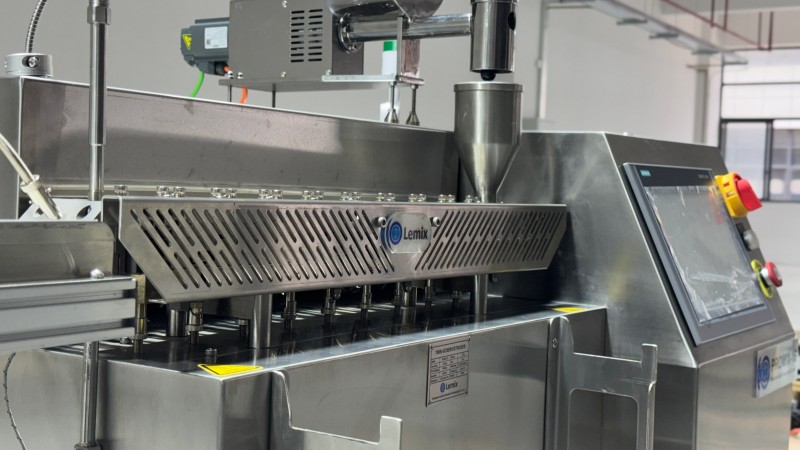
Scaling up from lab extrusion to production requires transferring formulation knowledge, process parameters, screw configuration, and material behavior from small-scale trials to industrial twin screw extrusion systems while maintaining product quality and process stability.
Extrusion scale-up is the process of transferring a material formulation and extrusion process from laboratory equipment to pilot or commercial production systems.
Laboratory extrusion is mainly used for:
Material research
Formula development
Process testing
Small batch evaluation
Parameter optimization
Production extrusion focuses on:
Higher output
Continuous operation
Stable quality
Cost efficiency
Long-term reliability
The challenge during scale-up is that larger extruders do not behave exactly like laboratory machines. Increasing equipment size changes:
Heat transfer
Material volume
Residence time
Screw speed relationship
Mixing behavior
Torque requirements
Pressure conditions
Successful scale-up requires understanding the relationship between equipment design, material characteristics, and process parameters.
A formulation that performs well on a laboratory extruder may show different results during production because processing conditions change with equipment size.
Common differences include:
| Laboratory Extrusion | Production Extrusion |
|---|---|
| Small material volume | Large continuous material flow |
| Faster parameter adjustment | Requires stable long-term operation |
| Limited output | Higher production capacity |
| Short testing cycles | Extended production periods |
| Easier observation | More complex process control |
During scale-up, problems may appear such as:
Different melt temperature
Unstable torque
Poor dispersion
Different residence time
Output fluctuation
Pellet quality variation
These issues do not always mean the formulation is unsuitable. They often indicate that process parameters need optimization for the larger system.
Successful scale-up requires more than matching screw diameter or output rate.
Important process parameters include:
| Parameter | Scale-Up Importance |
|---|---|
| Screw configuration | Controls mixing, conveying, and residence time |
| Screw speed | Affects shear energy and material flow |
| Feed rate | Determines filling level and throughput |
| Torque | Indicates processing load |
| Melt temperature | Reflects actual material condition |
| Pressure | Shows extrusion stability |
| Residence time | Controls thermal and mechanical exposure |
| Vacuum level | Affects moisture and volatile removal |
| Output rate | Determines production efficiency |
The goal is to maintain similar material processing behavior between laboratory and production equipment.
Screw configuration is one of the most important factors during extrusion scale-up.
A Twin Screw Extruder is usually built with modular screw elements, allowing engineers to adjust:
Conveying sections
Kneading zones
Mixing intensity
Degassing areas
Pressure-building sections
During scale-up, simply increasing the screw size without considering screw configuration may create problems.
For example:
A longer mixing section may increase residence time.
Excessive kneading may increase temperature.
Insufficient conveying may reduce output stability.
Poor vent design may reduce degassing efficiency.
A suitable screw configuration should maintain the required balance between:
Mixing performance
Shear level
Thermal control
Material protection
Production stability
LEMIX provides modular screw element solutions for different polymer compounding and pharmaceutical extrusion requirements.
Internal link:
Residence time is one of the most important differences between laboratory and production extrusion.
Residence time determines how long materials remain inside the extruder under:
Heat
Pressure
Mechanical shear
A larger extruder may have different residence time because of:
Larger barrel volume
Different screw design
Different filling level
Different screw speed
Different output rate
Residence time affects:
Polymer degradation
API stability
Additive dispersion
Moisture removal
Product consistency
During scale-up, residence time should be evaluated together with material temperature and shear history.
Torque represents the mechanical load required to process the material.
Torque changes may indicate differences in:
Material viscosity
Filling level
Screw configuration
Temperature profile
Feed stability
During scale-up:
High torque may indicate:
Excessive filling
Insufficient melting
Too much mixing restriction
Low processing temperature
Low torque may indicate:
Poor material feeding
Insufficient mixing
Low barrel filling
Maintaining an appropriate torque range helps achieve stable production.
Temperature control is often one of the biggest challenges when moving from lab to production.
A larger extruder has different:
Heating capacity
Cooling efficiency
Heat transfer behavior
Material residence volume
The same barrel temperature settings may not create the same melt temperature on different machines.
During scale-up, engineers should monitor:
Barrel temperature profile
Actual melt temperature
Cooling performance
Torque changes
Material appearance
The goal is to maintain similar material conditions rather than simply copying laboratory temperature settings.
Stable feeding becomes more important as production output increases.
Laboratory systems may process small amounts of material with manual adjustment. Production systems require continuous and accurate feeding.
Feeding problems can cause:
Composition variation
Output instability
Torque fluctuation
Poor dispersion
Quality variation
Important feeding factors include:
Material flowability
Feeder accuracy
Powder characteristics
Additive loading
Side feeder performance
For formulations containing fillers, fibers, additives, or pharmaceutical ingredients, feeding accuracy directly affects final product performance.
Many extrusion applications require vacuum degassing during scale-up.
Vacuum systems remove:
Moisture
Residual solvents
Trapped air
Volatile compounds
Poor degassing during production may cause:
Bubbles
Surface defects
Density variation
Unstable pellet quality
The vacuum section must be designed according to:
Material characteristics
Screw configuration
Throughput
Volatile content
LEMIX twin screw extrusion solutions provide vacuum systems for applications requiring controlled devolatilization.
Internal link:
Common scale-up challenges include:
| Problem | Possible Cause |
|---|---|
| Lower output than expected | Incorrect screw design or feeding conditions |
| Poor dispersion | Insufficient mixing energy |
| Higher temperature | Excessive shear or poor cooling |
| Torque instability | Feeding or formulation variation |
| Pellet defects | Poor degassing or unstable pressure |
| Color variation | Uneven additive distribution |
| Different mechanical properties | Changed material history |
Each problem requires analysis of material behavior and equipment conditions.
Laboratory extrusion provides important information before commercial production.
Useful laboratory data includes:
Processing temperature window
Screw speed range
Torque behavior
Material viscosity
Mixing performance
Residence time
Pellet appearance
Mechanical properties
This information helps define production targets and reduces development risks.
A laboratory twin screw extruder is not only a testing machine. It is a tool for creating a reliable production process.
Pilot extrusion provides an intermediate step between laboratory development and commercial production.
Pilot systems help verify:
Larger material quantities
Continuous operation
Production screw design
Feeding stability
Process repeatability
Final product performance
Pilot testing reduces risks before investing in full production equipment.
LEMIX provides laboratory and pilot twin screw extrusion systems for material development and process verification.
Internal links:
PROMIX Pilot Twin Screw Extruder
Pharmaceutical hot melt extrusion requires additional control during scale-up because API stability depends on precise processing conditions.
Important scale-up factors include:
API-polymer compatibility
Temperature exposure
Residence time
Mixing uniformity
Vacuum performance
Batch consistency
Laboratory results must be transferred carefully to pilot and GMP production systems.
LEMIX pharmaceutical extrusion systems support:
Formulation development
Process optimization
Scale-up verification
GMP production requirements
Internal link:
Polymer compounding scale-up focuses on maintaining stable dispersion and material properties.
Applications include:
Engineering plastics
TPE and TPU compounds
Cable compounds
WPC materials
Filled polymers
Masterbatch production
Important scale-up considerations include:
Filler dispersion
Polymer melting behavior
Additive distribution
Screw configuration
Output stability
Internal links:
Plastic Compounding Applications
After moving to production, continuous monitoring helps maintain stable operation.
Recommended monitoring includes:
Torque trends
Melt temperature
Pressure changes
Output consistency
Pellet quality
Screw and barrel condition
Equipment maintenance is also important because wear can change extrusion performance over time.
LEMIX provides extrusion maintenance solutions including:
Screw cleaning equipment
Barrel wear measurement devices
Screw elements
Relevant pages:
PRO-COOL Screw Cleaning Machine
Barrel Wear Measurement Device PROMAC-S
LEMIX supports the complete development path from laboratory testing to commercial production.
Solutions include:
| Development Stage | LEMIX Solution |
|---|---|
| Material research | Lab twin screw extruder |
| Process verification | Pilot extrusion system |
| Commercial production | Production twin screw extruder |
| Screw optimization | Modular screw elements |
| Quality monitoring | Pellet inspection systems |
| Equipment maintenance | Cleaning and wear measurement systems |
Relevant pages:
Scaling up from lab extrusion to production requires maintaining similar material behavior, process stability, and product quality across different equipment sizes.
Successful scale-up depends on controlling screw configuration, temperature, residence time, feeding, torque, vacuum performance, and equipment condition.
With laboratory testing, pilot verification, and optimized production systems, manufacturers can reduce development risks and achieve stable commercial extrusion performance.