
Search LEMIX Products
Learn the difference between lab, pilot, and production twin screw extruders, including output, screw diameter, torque, material use, scale-up, HME, plastic compounding, and LEMIX equipment support.
Category:Extruder Technology & Selection
Author:LEMIX Admin
Date:2026-08-10
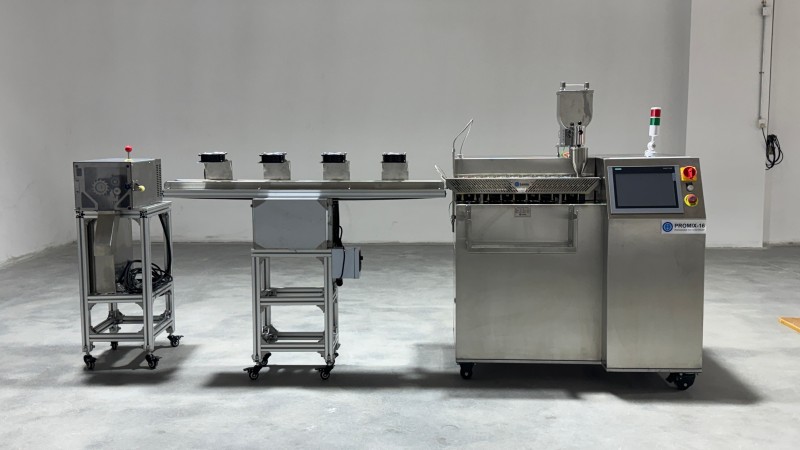
Lab Twin Screw Extruders are used for small trials and formulation screening, pilot extruders verify scale-up and process stability, and production twin screw extruders are built for continuous high-output manufacturing with stronger torque, larger screw diameter, downstream integration, and long-term reliability.
Lab, pilot, and production twin screw extruders are different equipment scales used during material development, process validation, and commercial manufacturing.
A lab twin screw extruder is designed for low material consumption, formulation trials, small-batch testing, and early process research. It helps teams test whether a material can be fed, melted, mixed, vented, discharged, cooled, and pelletized under controlled conditions.
A pilot twin screw extruder is used between lab testing and full production. It confirms whether the process can run longer, handle higher feed rates, support realistic downstream equipment, and generate scale-up data.
A production twin screw extruder is built for continuous manufacturing. It is selected for output, torque reserve, process stability, wear resistance, automation, downstream integration, maintenance planning, and long operating hours.
Internal links:
Extruder scale matters because material behavior changes when screw diameter, free volume, feed rate, torque, heat transfer, residence time, and downstream equipment change.
A formula that works on a small lab machine may not automatically run well on a production line. The larger machine may create different shear history, melt temperature, residence time distribution, pressure response, venting behavior, and cooling demand.
A practical production rule is this: scale-up should transfer process behavior, not only machine settings. The goal is not to copy rpm, temperature, or output directly. The goal is to preserve the material state that created stable quality at the smaller scale.
Important scale-related factors include:
Screw diameter
L/D ratio
Screw configuration
Feed rate
Screw speed
Fill level
Torque
Specific mechanical energy
Residence time
Temperature profile
Vacuum degassing
Pressure stability
Cooling or pelletizing
Cleaning and maintenance
A lab twin screw extruder is used for formulation screening, small-batch material trials, process window development, and early technical decision-making.
It is suitable when material quantity is limited, raw material cost is high, or the formula is still uncertain.
Typical uses include:
Polymer blend testing
Additive screening
Filler dispersion trials
Color masterbatch trials
TPE/TPU formulation tests
Engineering plastic development
Bio-based material testing
Pharmaceutical hot melt extrusion research
API-polymer carrier screening
Screw configuration comparison
Temperature window testing
Small-batch pellet production
LEMIX lab type twin screw extruders include 11mm and 16mm models for R&D and trial applications. These models support pharmaceutical industry research and rubber and plastics compounding, development, and testing.
A pilot twin screw extruder is used to confirm whether a lab-developed process can run at a larger scale before investing in full production.
Pilot equipment is important because lab trials are often short. Production runs are longer, more demanding, and more sensitive to feeding drift, torque trend, vacuum stability, temperature response, cooling capacity, and cleaning workload.
Pilot trials help answer questions such as:
Can the formulation run for longer periods?
Does torque remain stable?
Does feeding stay accurate?
Does vacuum degassing remove moisture or volatiles properly?
Does the material show degradation during longer residence time?
Does pellet quality remain consistent?
Does downstream cooling or pelletizing work?
Is the screw configuration suitable for scale-up?
Does cleaning remain practical?
Can process data support production planning?
A pilot extruder reduces scale-up risk because it creates data under conditions closer to real manufacturing.
Internal link: PROMIX-16 Pilot Trial Twin Screw Extruder
A production twin screw extruder is used for continuous, stable, and repeatable commercial manufacturing.
Production equipment must do more than prove a formula. It must support long runs, stable output, process repeatability, raw material variation, maintenance planning, operator safety, downstream integration, and consistent product quality.
Typical production applications include:
Plastic compounding
Engineering plastic modification
PEEK compounding
TPE/TPU production
PVC and XLPE cable compounds
Filler and color masterbatch
Bio-plastic compounds
Thermoset premixing
Battery materials
Pharmaceutical hot melt extrusion
Food plant-based meat extrusion
High-output resin processing
A production twin screw extruder is selected according to target capacity, torque reserve, screw diameter, downstream equipment, material abrasiveness, temperature range, venting need, and long-term reliability.
The main difference is purpose.
Lab extruders answer whether a formulation can work. Pilot extruders answer whether the process can scale. Production extruders answer whether the process can run continuously with stable output and quality.
| Extruder Scale | Main Purpose | Typical Focus |
|---|---|---|
| Lab twin screw extruder | Formulation screening and R&D | Low material use, flexibility, trial speed |
| Pilot twin screw extruder | Scale-up confirmation | Process stability, longer trials, realistic data |
| Production twin screw extruder | Commercial manufacturing | Output, reliability, torque reserve, automation |
A useful selection view is this: lab equipment protects development cost, pilot equipment protects scale-up decisions, and production equipment protects long-term manufacturing performance.
Screw diameter and output increase from lab to pilot and production scale.
Small screw diameters reduce material consumption and are useful for high-value research. Larger screw diameters increase free volume, throughput, torque demand, and downstream capacity.
LEMIX PROMIX series specifications show this scale change clearly:
| Model | Typical Scale | Screw Diameter | L/D | Output Range |
|---|---|---|---|---|
| PROMIX-11 | Lab scale | 11 mm | 40:1 | 0.2–2.5 kg/h |
| PROMIX-16 | Lab or pilot trial | 16 mm | 40:1 | 0.5–20 kg/h |
| PROMIX-26S | Pilot scale production | 25.7 mm | 40:1 | 50–200 kg/h |
| PROMIX-32S | Pilot or small production | 31.8 mm | 40:1 | 60–250 kg/h |
| PROMIX-40S | Commercial production | 40.3 mm | 40:1 | 80–300 kg/h |
| PROMIX-50S | Commercial production | 50.3 mm | 40:1 | 100–350 kg/h |
These values show why scale selection should begin with trial purpose and target output, not only machine appearance.
Material consumption is one of the biggest differences between lab, pilot, and production extruders.
Lab equipment uses less material, which is important when testing expensive polymers, pharmaceutical APIs, additives, pigments, or new formulations. A small trial can reveal process risks before larger quantities are consumed.
Pilot equipment uses more material but produces data closer to production. It helps verify whether the process remains stable during longer runs.
Production equipment uses the most material and is selected only after the process is mature enough for continuous operation.
| Scale | Material Consumption | Best Use |
|---|---|---|
| Lab | Lowest | Early formula screening |
| Pilot | Medium | Process confirmation and scale-up |
| Production | Highest | Commercial manufacturing |
A practical development sequence is to fail early at lab scale, correct at pilot scale, and only then commit to production scale.
Screw configuration becomes more critical as scale increases. A lab screw layout may prove basic feasibility, but pilot and production layouts must also support longer operation, stable venting, pressure control, cleaning, and wear resistance.
Lab screw configuration usually focuses on:
Melting behavior
Initial mixing
API-polymer contact
Filler wetting
Temperature window
Small-batch discharge
Pilot screw configuration usually focuses on:
Fill level
Residence time
Vacuum degassing
Side feeding
Longer stability
Scale-up data
Production screw configuration usually focuses on:
Continuous throughput
Torque reserve
Wear control
Stable pressure
Downstream pelletizing
Process repeatability
Maintenance interval
The same screw function should be preserved across scale, but the exact element sequence may need adjustment because larger screws change heat transfer, residence time, and material volume.
Internal link: Screw Elements for TSE
Torque requirement increases as output, screw diameter, filler loading, viscosity, and production duty increase.
Lab extruders need enough torque for small trials. Pilot extruders need torque reserve for longer process confirmation. Production extruders need stable torque under continuous load and material variation.
Torque is especially important for:
High-viscosity polymers
Engineering plastics
PEEK
Glass fiber compounds
Carbon fiber compounds
High-filler masterbatch
Flame-retardant compounds
Cable compounds
Pharmaceutical HME formulations
Battery materials
A practical rule is that production machines should not run near torque limit for long periods. A process with no torque reserve may pass a short trial but fail during continuous manufacturing.
Residence time changes because larger extruders have more internal volume and different filling behavior.
Residence time affects melting, mixing, vacuum devolatilization, degradation risk, crystallization risk, impurity formation, and final product consistency.
Lab trials often have shorter material runs and quick process changes. Pilot runs help estimate real residence behavior. Production runs must maintain repeatable residence time during continuous operation.
Scale-up should compare:
Average residence time
Residence time distribution
Feed rate per screw revolution
Fill level
Screw speed
Torque trend
Melt pressure
Product quality
Cleaning and hold-up behavior
For pharmaceutical hot melt extrusion, stable residence time is especially important because APIs and polymers must remain within a safe thermal and shear exposure window.
Temperature control becomes more demanding as equipment scale increases.
A lab extruder has lower material volume and responds quickly to temperature adjustments. A production extruder has more metal mass, higher throughput, stronger shear heat, and longer operating time. This makes temperature control more complex.
Key differences include:
| Scale | Temperature Control Focus |
|---|---|
| Lab | Finding safe processing window |
| Pilot | Confirming heat balance and melt temperature trend |
| Production | Maintaining long-run stability under continuous load |
For heat-sensitive materials such as pharmaceutical APIs, PVC, thermosets, TPE/TPU, and bio-plastics, temperature control must be evaluated together with shear, residence time, vacuum, cooling, and material stability.
Vacuum degassing differs because vapor load, fill level, vent stability, and pressure rebuilding change with scale.
Lab equipment may show whether vacuum is needed. Pilot equipment confirms whether the vent section can handle more material and longer running time. Production equipment must maintain stable vacuum during continuous operation.
Vacuum degassing is used to remove:
Moisture
Trapped air
Residual solvent
Low-molecular volatiles
Odor
Reaction by-products
Scale-up should check whether the vent zone remains partially filled, whether material floods the vent port, whether vacuum level is stable, and whether pressure rebuilds after degassing.
Internal link: How Does Vacuum Degassing Work in Twin Screw Extrusion?
Downstream equipment becomes more important as scale increases.
A lab line may use simple strand cooling, small pelletizing, or manual collection. A pilot line may test practical cooling, cutting, drying, and conveying. A production line needs stable downstream equipment that matches output continuously.
Downstream equipment may include:
Die head
Strand cooling tank
Air knife or drying unit
Pelletizer
Conveyor
Classifier
Packaging system
Cooling system
In-line pellet inspection
Sorting system
Production quality can fail even when the extruder itself is stable. For example, irregular pellet size may come from cutter instability, not screw design. Bubbles may come from vacuum or drying. Color variation may come from feeding or mixing.
Internal link: in-Line Plastic Pellet Inspection
Data collection becomes more formal from lab to pilot and production.
Lab data supports formulation screening. Pilot data supports scale-up decisions. Production data supports quality control, troubleshooting, maintenance, and customer requirements.
Important data includes:
Material batch
Formula
Screw configuration
Feed rate
Screw speed
Torque
Barrel temperature
Melt pressure
Vacuum level
Output
Residence time estimate
Pellet defects
Cooling condition
Cleaning record
Wear inspection record
Final test results
For pharmaceutical production, data requirements are stricter. LEMIX GMP twin screw extrusion systems support data acquisition, status monitoring, user authority management, audit trail, electronic signature, recipe management, batch record reporting, and traceable operation.
Internal link: GMP Twin Screw Extruder
For pharmaceutical hot melt extrusion, the best scale depends on the development stage.
Lab extruders are used to screen API-polymer compatibility, processing temperature, screw configuration, and initial dissolution behavior. Pilot extruders are used to confirm residence time, feeding accuracy, vacuum devolatilization, impurity profile, and process repeatability. Production extruders are used for GMP manufacturing with controlled records, cleaning, batch traceability, and validated operation.
A pharmaceutical HME scale-up path should compare:
API stability
Polymer carrier compatibility
Content uniformity
Amorphous stability
Impurity control
Residence time
Vacuum devolatilization
Cooling rate
PAT monitoring
Batch records
Cleaning behavior
LEMIX pharmaceutical extrusion guidance emphasizes thermal stability, uniform mixing, amorphous stability, impurity control, PAT online monitoring, GMP verification, and reproducibility.
Internal link: Pharmaceutical Extrusion
For plastic compounding, the best scale depends on whether the material is still being developed, being validated, or ready for commercial supply.
Lab extruders are suitable for early-stage compound development. Pilot extruders are suitable for confirming filler loading, side feeding, screw configuration, venting, pelletizing, and quality trend. Production extruders are suitable for stable supply after the formula and process window are confirmed.
Typical plastic compounding scale selection:
| Development Stage | Recommended Scale |
|---|---|
| New formula screening | Lab twin screw extruder |
| Additive or filler trial | Lab or pilot twin screw extruder |
| Customer sample production | Pilot twin screw extruder |
| Process window confirmation | Pilot twin screw extruder |
| Continuous order production | Production twin screw extruder |
| High-output commercial supply | Production twin screw extruder |
For high-value compounds such as PEEK, reinforced engineering plastics, pharmaceutical polymers, and specialty cable materials, lab and pilot trials can reduce expensive production risk.
A lab extruder should be chosen when the main goal is testing, not production output.
Choose lab scale when:
Raw material is expensive.
API or additive quantity is limited.
The formula is not finalized.
Several screw designs need comparison.
Temperature window is unknown.
Small-batch pellets are enough.
Cleaning between trials must be quick.
The process needs early feasibility data.
Scale-up is planned later.
A lab extruder is not selected to replace a production line. It is selected to reduce uncertainty before larger equipment is used.
A pilot extruder should be chosen when the lab process has passed early screening but production risk remains.
Choose pilot scale when:
The formula needs longer trial runs.
Customer samples require more material.
Side feeding needs confirmation.
Vacuum degassing needs verification.
Screw configuration must be validated.
Pelletizing must be tested under realistic conditions.
Residence time data is needed.
Production output is not yet required.
Scale-up parameters must be prepared.
Pilot scale is the bridge between “it works” and “it can run.”
A production extruder should be chosen when the material formula, processing window, quality standard, and market demand are clear enough for continuous manufacturing.
Choose production scale when:
Commercial output is required.
Long-run stability is proven.
Downstream equipment is selected.
Raw material supply is stable.
Quality control plan is defined.
Maintenance plan is ready.
Spare Parts strategy is prepared.
Torque and output needs are known.
Operators need repeatable production settings.
A production extruder should not be chosen only because a larger machine looks more efficient. It should be selected after enough data shows that the process can remain stable at production output.
Several mistakes are common when choosing between lab, pilot, and production twin screw extruders.
Avoid these mistakes:
Buying production equipment before the formula is stable.
Using lab data without pilot confirmation for difficult materials.
Comparing machines only by output.
Ignoring torque reserve.
Ignoring residence time changes.
Assuming the same rpm works across all scales.
Ignoring downstream cooling and pelletizing.
Treating L/D ratio as the only scale-up factor.
Forgetting screw cleaning and maintenance.
Skipping pellet inspection during scale-up.
Ignoring GMP data requirements for pharmaceutical extrusion.
The strongest selection method is to match the machine scale with the decision that must be made next.
Lab, pilot, and production extruders should form a development chain.
A practical workflow is:
Use lab scale to test formula feasibility.
Identify safe temperature and screw speed range.
Compare initial screw configurations.
Confirm material feeding and melting behavior.
Move to pilot scale for longer runs.
Check torque, pressure, vacuum, residence time, and pellet quality.
Adjust screw design and downstream equipment.
Produce customer samples or validation batches.
Transfer process logic to production scale.
Monitor output, defects, cleaning, wear, and quality trends.
This staged approach reduces risk because each scale answers a different question before the next investment decision.
LEMIX supports lab, pilot, and production twin screw extrusion through PROMIX series equipment, modular screw and barrel design, process particle inspection, Extruder Maintenance Devices, spare parts, and technical support.
| Scale or Need | LEMIX Support |
|---|---|
| Lab formulation screening | PROMIX-11 lab scale twin screw extruders |
| Trial and early process development | PROMIX-16 Pilot Trial Twin Screw Extruder |
| Pilot scale production | PROMIX-26S and PROMIX-32S systems |
| Commercial production | PROMIX-40S and PROMIX-50S systems |
| Pharmaceutical HME and GMP process | GMP twin screw extrusion system |
| Screw process adjustment | Screw Elements for TSE |
| Pellet defect monitoring | in-Line Plastic Pellet Inspection |
| Screw and component cleaning | PRO-COOL Screw Cleaning Machine |
| Barrel wear measurement | PROMAC-S / PROMAC-X Barrel Wear Measurement Device |
| Cooling channel maintenance | PRO-CLEAN Water Cooling Channel Cleaning Machine |
Relevant pages:
Lab, pilot, and production twin screw extruders differ mainly in purpose, output, screw diameter, torque demand, material consumption, process data, downstream integration, and operating reliability.
Lab extruders are best for low-volume trials and formula screening. Pilot extruders are best for scale-up confirmation, longer test runs, and realistic process data. Production extruders are best for continuous commercial manufacturing after the formula, screw configuration, temperature window, venting, pelletizing, and quality control plan are confirmed.
The best choice is not the largest machine. It is the machine scale that answers the next process question with the lowest technical and commercial risk. LEMIX supports this staged path with PROMIX lab, pilot, and production twin screw extruders, GMP extrusion systems, screw elements, pellet inspection, maintenance devices, spare parts, and process support.