
Search LEMIX Products
Learn how vacuum degassing works in twin screw extrusion, including moisture removal, volatile control, vent design, fill level, vacuum troubleshooting, pellet quality, HME, and LEMIX equipment support.
Category:Pharmaceutical Extrusion Technology
Author:LEMIX Admin
Date:2026-08-04
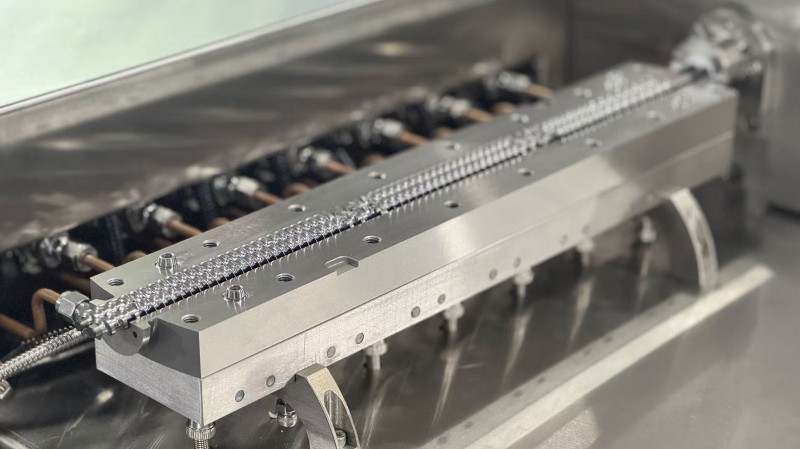
Vacuum degassing in twin screw extrusion removes moisture, trapped air, residual solvents, low-molecular volatiles, and odors by exposing a melted or softened material stream to vacuum through vented barrel sections. It improves pellet density, strand stability, product appearance, and downstream processing reliability.
Vacuum degassing is the process of removing gas, moisture, air, solvent, odor, and volatile substances from material during extrusion.
In a Twin Screw Extruder, material is first fed, conveyed, melted or softened, and mixed. After the material reaches a suitable melt state, it passes through a vacuum venting section. At this section, vacuum pressure pulls volatile substances out of the material before it reaches the die, pelletizer, or downstream forming system.
The process is also called vacuum venting, vacuum exhaust, or vacuum devolatilization. In many production lines, these terms are used together. The main purpose is the same: remove unwanted gas-phase substances before they create defects.
Vacuum degassing is important because hidden moisture or volatiles can create visible and functional defects later. These defects may not always appear immediately at the vent port. They may appear as bubbles, voids, rough pellets, strand breakage, poor surface quality, odor, unstable pressure, or downstream processing problems.
Vacuum degassing helps reduce:
Bubbles
Internal voids
Foaming
Strand breakage
Odor
Residual solvent
Moisture-related degradation
Unstable pellet density
Poor cable compound quality
Poor pharmaceutical extrudate uniformity
Poor mechanical performance in high-performance plastics
A useful process view is this: vacuum degassing is not only an exhaust function. It is a quality control point between mixing and final discharge.
Vacuum degassing works by preparing the material before the vacuum zone, exposing it to vacuum, removing volatiles, then rebuilding pressure before discharge.
A typical process sequence is:
| Step | What Happens | Why It Matters |
|---|---|---|
| Feeding | Resin, powder, additives, fillers, APIs, or premix enter the extruder | Stable feed prevents vent fluctuation |
| Melting or softening | Material becomes flowable under heat and shear | Volatiles can escape more easily from softened material |
| Mixing | Additives, fillers, polymers, or APIs are distributed | Uniform material improves degassing consistency |
| Vacuum venting | Moisture, air, solvent, and volatiles are pulled out | Prevents bubbles, voids, odor, and residual solvent issues |
| Pressure rebuilding | Screw elements rebuild melt pressure after the vent zone | Stabilizes discharge and pelletizing |
| Cooling or pelletizing | Material is cooled, cut, or shaped | Final quality depends on stable melt flow |
The vacuum section should not be placed too early. If material is still dry powder or unmelted particles, degassing will be weak. It should also not be placed too late if volatiles need time to escape before discharge.
Vacuum degassing is useful in many extrusion applications, but it is especially important for moisture-sensitive, volatile-containing, high-temperature, or high-value materials.
Common materials include:
| Material or Application | Why Vacuum Degassing Is Needed |
|---|---|
| Pharmaceutical HME | Removes moisture, residual solvents, and low-molecular impurities |
| PEEK and engineering plastics | Removes residual moisture and volatiles during high-temperature mixing |
| Bio-plastics | Reduces hydrolysis risk from trace moisture |
| TPE and TPU | Helps remove moisture and volatiles that cause bubbles |
| PVC cable compounds | Removes moisture and volatiles that affect cable surface quality |
| XLPE cable compounds | Supports moisture control and stable compound quality |
| Recycled plastics | Removes trapped air, odor, moisture, and volatile contaminants |
| WPC compounds | Removes residual moisture and gases from wood or plant fibers |
| Battery compounds | Helps remove small-molecule volatiles before final forming |
| Color and filler masterbatch | Reduces trapped air and improves pellet density |
The need for vacuum degassing should be judged by material behavior, not only material name. A dry pellet with low volatile content may need less vacuum capacity than a powder blend, recycled material, wet filler, solvent-containing formulation, or moisture-sensitive polymer.
A vacuum venting section creates a low-pressure environment above the material inside the barrel. This pressure difference helps pull moisture, air, and volatiles out of the melt.
In a well-designed twin screw extruder, the vacuum section usually has three requirements:
The material must be melted or softened before reaching the vent.
The screw channel near the vent should not be overfilled.
The screw must rebuild pressure after degassing.
If the screw is too full near the vent, material can rise into the vent port. This is called vent flooding. If the material is not properly melted before the vent, trapped gas may remain inside the material. If pressure is not rebuilt after the vent, discharge and pelletizing may become unstable.
Internal link: Twin Screw Extruder
Twin screw extrusion supports vacuum degassing well because the screw and barrel system can be configured with specific process sections. A twin screw extruder can melt, mix, open the material surface, reduce filling near the vent, remove volatiles, and rebuild pressure in one continuous line.
Compared with a simple melting process, a twin screw system offers:
Modular screw configuration
Modular barrel openings
Better material surface renewal
More controllable residence time
Better devolatilization after melting
More stable mixing before venting
Better pressure rebuilding after the vacuum section
Better integration with downstream pelletizing or forming
LEMIX modular barrel systems can be customized with openings or inserts for feeding, degassing, and venting. This allows the screw and barrel layout to match the material and process purpose.
Vacuum degassing and devolatilization are closely related, but the emphasis can be different.
Vacuum degassing often refers to removing gas-phase defects such as air, bubbles, moisture vapor, or trapped gas from the material.
Devolatilization usually refers to removing volatile substances such as residual solvents, monomers, low-molecular compounds, odor components, moisture, or reaction by-products.
In many extrusion plants, both terms are used together because the same vacuum section may remove several types of unwanted substances.
| Term | Main Focus | Typical Removed Substances |
|---|---|---|
| Vacuum degassing | Gas removal | Air, bubbles, moisture vapor, trapped gas |
| Vacuum venting | Process method | Air, water vapor, volatiles through a vent port |
| Vacuum devolatilization | Volatile removal | Solvent, monomer, low-molecular impurities, odor |
| Vacuum exhaust | General production term | Moisture, volatiles, gases |
For SEO and technical clarity, “vacuum degassing” and “vacuum devolatilization” can both be used naturally in the article.
Screw configuration strongly affects vacuum degassing because it controls melt formation, fill level, surface renewal, residence time, and pressure rebuilding.
A good screw design should create the right condition before, during, and after the vacuum section.
| Screw Section | Role in Vacuum Degassing |
|---|---|
| Upstream conveying | Moves material steadily toward melting zone |
| Melting section | Creates a soft or molten phase before venting |
| Mixing section | Opens material structure and distributes additives |
| Large-pitch vent section | Reduces filling and increases surface exposure |
| Vacuum zone | Allows gases and volatiles to escape |
| Downstream conveying | Moves degassed material forward |
| Pressure-building section | Stabilizes melt flow before the die |
If the screw design is wrong, vacuum performance may be weak even when the vacuum pump is strong. This is why vacuum problems should not be diagnosed by pump pressure alone.
Internal link: Screw Elements for TSE
Fill level is critical because the vacuum zone must create open space above the material. If the screw channel is too full, material can reach the vent opening and block or flood it.
Overfilled vacuum zones may cause:
Melt rising into the vent port
Material leakage from the vent
Unstable vacuum level
Poor gas removal
Pressure fluctuation
Product defects
Frequent cleaning around the vent
Vacuum pump contamination risk
Underfilled vacuum zones can also create problems. If the material is too underfilled or not properly melted, gases may not be released effectively from the melt.
The best condition is controlled partial filling with good melt surface exposure. The material should pass under the vent as an opened, renewed melt surface, not as a fully packed plug.
Vent flooding happens when material enters the vacuum vent opening instead of only gas and vapor being removed.
Common causes include:
Feed rate too high
Screw speed too low for the feed rate
Vacuum section overfilled
Poor screw configuration near the vent
Material not melted before venting
Excessive foaming
High moisture content
High filler loading
Die or screen restriction downstream
Vacuum applied too aggressively at the wrong stage
Melt viscosity too low
Wrong vent port position
A practical troubleshooting habit is to compare vacuum fluctuation with feed rate, torque, pressure, and pellet defects. If pressure rises before vent flooding, downstream restriction may be the trigger. If torque and feed rate fluctuate before flooding, feeding or screw filling may be the cause.
Vacuum degassing improves pellet quality by reducing gas and volatile content before the material is cut, cooled, and packaged.
Better degassing can help reduce:
Bubbles
Internal voids
Foaming
Low pellet density
Rough pellet surface
Strand breakage
Odor
Yellowing from volatile degradation
Poor downstream melting
Processing instability in the next extrusion or molding step
However, degassing alone cannot fix every pellet defect. If gels, black specks, color deviation, or size defects appear, the cause may also involve melting, screw cleaning, screw wear, barrel wear, temperature drift, cutter condition, or downstream cooling.
Internal link: in-Line Plastic Pellet Inspection
In pharmaceutical hot melt extrusion, vacuum degassing helps remove moisture, residual solvents, and low-molecular impurities from the API-polymer melt. This supports dense, uniform extrudates and helps reduce bubbles, voids, and residual solvent concerns.
Pharmaceutical HME has stricter process needs than normal plastic compounding. The process must support thermal stability, uniform mixing, amorphous stability, impurity control, PAT monitoring, and GMP reproducibility.
A pharmaceutical vacuum section should be designed to:
Increase contact area between material and vacuum
Remove residual moisture
Remove residual solvents
Reduce low-molecular impurities
Prevent bubbles and voids
Avoid vent flooding
Keep residence time stable
Protect heat-sensitive APIs
Support traceable process records
LEMIX pharmaceutical extrusion solutions use a dedicated large-pitch vacuum section with a multistage high-vacuum system for consistent product quality.
Internal links:
PEEK and other engineering plastics may require high processing temperature, strong shear-mixing capability, high torque, and effective devolatilization. During high-temperature processing, residual moisture or low-molecular volatiles can affect pellet quality and mechanical performance.
Vacuum degassing helps remove these substances before pelletizing. This is important because high-performance plastics are often used in demanding applications where voids, contamination, or weak dispersion can reduce final part reliability.
For PEEK compounding, the process should coordinate:
High-temperature control
Strong but controlled shear
Side feeding for fibers
Vacuum devolatilization
High-torque drive capacity
Wear-resistant screw and barrel materials
Stable pellet inspection
Internal link: Special Engineering Plastics - PEEK
Bio-plastics often contain moisture-sensitive polymers or plant-based fillers. Trace moisture can cause hydrolysis at high temperature, reducing melt strength and final material performance.
Vacuum degassing helps remove residual moisture, reaction by-products, small-molecule monomers, and volatiles during processing. This is especially useful for PLA, PBAT blends, starch-based compounds, bamboo powder compounds, straw-filled materials, and other bio-based formulations.
In bio-plastic compounding, vacuum degassing should be coordinated with:
Raw material drying
Multi-stage temperature control
Controlled residence time
Compatibilizer or chain extender reaction
Filler dispersion
Downstream granulation method
Moisture-protected packaging
Internal link: Bio-plastics
Cable compounds and TPE/TPU materials often require stable venting because moisture, trapped air, plasticizer volatiles, oil-related volatiles, or additive gases can create downstream defects.
For PVC cable compounds, weak venting may create bubbles, rough cable surface, pinholes, or unstable sheathing quality. For XLPE cable compounds, moisture control is especially important because moisture can affect storage stability and later crosslinking behavior. For TPE/TPU, moisture and volatiles may lead to bubbles, surface defects, poor pellet appearance, or unstable extrusion.
Vacuum degassing helps these materials by:
Reducing bubble formation
Improving pellet density
Reducing odor
Stabilizing strand quality
Supporting smoother downstream extrusion
Reducing moisture-related defects
Improving long-run process stability
Internal links:
Vacuum degassing performance depends on the full extrusion process, not only the vacuum pump.
Important process factors include:
| Process Factor | Effect on Degassing |
|---|---|
| Material drying | Reduces moisture load before extrusion |
| Feed rate | Controls screw filling and vent stability |
| Screw speed | Affects residence time, shear, and surface renewal |
| Screw configuration | Controls melting, vent fill level, and pressure rebuilding |
| Barrel temperature | Affects viscosity and volatile release |
| Melt viscosity | Controls gas escape and vent flooding risk |
| Vacuum level | Drives removal of gases and volatiles |
| Vent port design | Controls gas escape path and cleaning access |
| Downstream pressure | Can cause overfilling before the vent |
| Cooling and pelletizing | Affects final pellet density and appearance |
When degassing is weak, changing only the vacuum level may not solve the problem. The process should check material moisture, melt formation, fill level, screw design, pressure, and vent cleanliness together.
Vacuum level should be controlled according to material behavior and process stability. Stronger vacuum is not always better.
If vacuum is too weak, moisture and volatiles may remain in the material. If vacuum is too aggressive while the vent section is unstable, the material may foam, surge, or flood the vent.
A stable vacuum system should have:
Stable vacuum pressure
Clean vent port
Suitable trap or condenser if needed
Protected vacuum pump
No material carryover
Stable screw filling near the vent
Good sealing around the vent system
Process records linked with product quality
Vacuum should be adjusted with screw speed, feed rate, temperature, and screw configuration. A vacuum setting that works for one material may not work for another.
Weak vacuum degassing can appear in pellets, strands, extrudates, or downstream products.
Common signs include:
| Defect | Possible Vacuum-Related Cause |
|---|---|
| Bubbles | Moisture, trapped air, weak vacuum |
| Internal voids | Poor devolatilization or residual gas |
| Foaming | Excess moisture or volatile release |
| Strand breakage | Gas expansion or unstable melt density |
| Rough surface | Volatile escape after die exit |
| Odor | Residual volatile substances |
| Low pellet density | Trapped air or moisture |
| Popping at die | Vapor expansion near discharge |
| Residual solvent issue | Insufficient devolatilization |
| Unstable pressure | Gas pockets or vent instability |
These signs should be checked against drying records, vacuum trend, feed stability, melt pressure, temperature, and vent cleanliness.
Vacuum problems can also come from excessive vacuum, wrong vent design, or poor screw filling.
Warning signs include:
Vent flooding
Material pulled into the vent
Unstable vacuum level
Foaming under the vent port
Product output fluctuation
Material buildup around vent opening
Frequent vent cleaning
Vacuum pump contamination
Sudden torque or pressure movement
Poor pellet appearance after vent instability
If these signs appear, reducing feed rate may help temporarily, but the real cause may be screw configuration, vent section fill level, melt viscosity, or downstream pressure.
Vacuum degassing problems should be troubleshot by comparing material, machine, and defect timing. The fastest method is to find the first unstable signal.
A practical troubleshooting sequence:
Check raw material moisture and drying records.
Check whether the formula contains solvent, plasticizer, oil, or volatile additives.
Review feed rate and feeder stability.
Check screw speed and feed rate per screw revolution.
Check whether the material is fully melted before the vacuum zone.
Check vacuum level and vacuum fluctuation.
Inspect the vent port for blockage or material carryover.
Compare torque and melt pressure trends.
Check whether downstream pressure rose before vent flooding.
Inspect screw configuration near the vent section.
Check pellet defects with in-line or offline inspection.
Record the corrected setting after the line stabilizes.
This sequence helps avoid random adjustments. It separates drying problems, vacuum system problems, screw design problems, overfilling problems, and downstream restriction problems.
In-line pellet inspection helps connect degassing performance with visible pellet quality. It can show when bubbles, gels, burnt material, size issues, yellowing, contamination, or color deviation appear during production.
This matters because vacuum problems may happen for short periods. Manual sampling can miss these events. In-line inspection helps reveal whether defects appear after a vacuum fluctuation, feed change, torque movement, temperature drift, or vent flooding event.
LEMIX in-Line Plastic Pellet Inspection supports real-time continuous pellet inspection and sorting. It is suitable for compounding lines, cable extruder lines, and high-throughput resin lines.
Internal link: in-Line Plastic Pellet Inspection
Vacuum degassing performance depends on maintenance of the vent area, barrel, screw, vacuum pump, seals, cooling channels, and downstream pressure path.
Maintenance should include:
Cleaning vent ports
Checking vacuum seals
Inspecting traps or condensers
Protecting the vacuum pump from material carryover
Cleaning screw elements and vent-zone residue
Checking barrel wear near vent areas
Maintaining cooling channel flow
Checking die, screen, and discharge restriction
Recording vacuum trend changes
Residue near the vent section can disturb gas removal and create black specks or gels. Worn screw or barrel sections can change fill level and residence time, making vacuum performance less repeatable.
Relevant maintenance links:
A useful vacuum degassing record should connect process settings with product defects.
Recommended data includes:
Material name and batch
Drying temperature and drying time
Moisture measurement if available
Feed rate
Screw speed
Torque trend
Melt pressure trend
Barrel temperature trend
Vacuum level
Vacuum fluctuation
Vent port condition
Vent flooding events
Die or screen pressure
Pellet defect type
Bubble or void occurrence
Odor observation
Cleaning history
Screw configuration
Barrel wear condition
Downstream cooling and pelletizing condition
The most useful record is time-based. It should show what changed first, what changed next, and what defect appeared last.
LEMIX supports vacuum degassing through modular twin screw extruders, customizable barrel openings, screw configuration design, high-vacuum pharmaceutical extrusion systems, lab and pilot testing equipment, pellet inspection, maintenance devices, and Spare Parts.
| Vacuum Degassing Need | LEMIX Support |
|---|---|
| Industrial compounding with venting | Twin Screw Extruder |
| Pharmaceutical HME vacuum devolatilization | GMP Twin Screw Extruder |
| Lab and pilot degassing trials | Lab Type Twin Screw Extruder |
| Barrel openings for venting | Modular barrel system |
| Screw layout around vacuum section | Screw Elements for TSE |
| Pellet quality feedback | in-Line Plastic Pellet Inspection |
| Vent-zone cleaning and residue control | PRO-COOL Screw Cleaning Machine |
| Barrel condition checking | PROMAC-S / PROMAC-X Barrel Wear Measurement Device |
| Cooling stability | PRO-CLEAN Water Cooling Channel Cleaning Machine |
Relevant pages:
Vacuum degassing in twin screw extrusion works by exposing melted or softened material to a controlled vacuum section, so moisture, air, residual solvents, low-molecular volatiles, odor, and trapped gases can escape before final discharge.
A good vacuum degassing process depends on more than vacuum pump strength. It requires proper material drying, stable feeding, suitable screw configuration, correct fill level, enough melt surface exposure, clean vent ports, stable vacuum level, pressure rebuilding after venting, and downstream quality control.
LEMIX supports vacuum degassing through modular twin screw extruders, barrel openings for degassing and venting, screw configuration support, pharmaceutical vacuum devolatilization systems, pellet inspection, screw cleaning, barrel wear measurement, cooling channel maintenance, and full extrusion process support.